20VC: Klarna Founder Sebastian Siemiatkowski on Scaling Europe's Most Valuable Private Tech Company, How To Motivate and Challenge Your Team Most Effectively & The Biggest Lessons From Working with Mike Moritz

20VC: Klarna Founder Sebastian Siemiatkowski on Scaling Europe's Most Valuable Private Tech Company, How To Motivate and Challenge Your Team Most Effectively & The Biggest Lessons From Working with Mike Moritz

Sebastian Siemiatkowski is the Founder and CEO @ Klarna, the company that makes online shopping simple, allowing you to buy what you need today and pay later. To date, Sebastian has raised over $2.1Bn for the company from the likes of Sequoia, Silver Lake, Blackrock, DST, Northzone, Creandum and even Snoop Dog to name a few. Klarna has been an incredible 16-year journey for Sebastian with it now being the most valuable private technology company in Europe with over 3,500 employees.

In Today's Episode You Will Learn:

I. The Importance Of Learning To Learn Fast

What is the best way to learn fast?

"People talk about it like there's this learning curve, and the best spot is at the place where you're challenged to the precise point where you're almost giving up, but not entirely. That's exactly it.

"And I have this amazing swim teacher for my children, her name is Petra, and she's just fantastic. I just love watching her because she has this ability of taking my children in the pool and pushing them to that exact point where they are almost, almost giving up, and they're learning at such a pace. And if I can recreate such an environment in Klarna, if I can create an environment, if I can be part of creating an environment where we put people in that position where they just are exactly at that curve where they are challenged, supported, and kind of at the edge and being given the ability to learn really fast and really discover what it means to have an impact."

Does Sebastian compare his work to other companies'?

"I don't think that much about what other people or other companies or other things out there could have done different. And there's pros and cons to that. But the benefits of that is that it speeds up my learning. Because a lot of people – and I've realized that as I manage other people – is that because they're so obsessed with trying to think about what other people could have done differently, and why situations arose, and why it wasn't their responsibility and so forth, they spend a lot of time on that, because we've unfortunately been brought up in some kind of guilt that it's bad to do wrong, and it's bad if it's our fault, and you want to avoid that.

"And these psychological constraints, unfortunately, hinder people from developing much faster, because if you go into every situation and say, the only thing that's relevant here is what I could have done differently, what I could have learned from this – if that's the only thing, it's just like, whatever, I accept my responsibilities. What could I have done differently? If you only focus on that, you just learn much faster."

How does Sebastian transform his self-doubt into a positive?

"I think self-doubt is not nothing. It's not a bad thing, right? It's a very healthy thing, if it represents you continuously trying to understand, am I doing the right thing? Is this something that I want to do? Am I making the right decisions? So I think it's extremely healthy to do that. I'm not saying it's not painful or tough when you have it. But I think it's a very positive thing.

"I'm much more worried when people tell me they have no self-doubt. And then I'm like, uh-oh, because that means that you're not really reflecting on your actions, and you're not learning from them. So I wish I could give you something more comforting than that, but I would actually say enjoy it. Be happy that you have it, and it's gonna make you a better person."

II. Sebastian's Management Philosophy

What does Sebastian believe companies can learn from soccer?

"I love the fact that Michael Moritz wrote this book that I still haven't read, so it's kind of funny that I'm referring to it, but he wrote this book about Ferguson, that manager of Manchester United. And I think it's very relevant, because today, the saying is that for people to be motivated at work, they need to have a higher purpose, the company needs to do something good, and so forth. And I am not disputing that, that is very true that it contributes to people's sense of purpose, and so forth.

But before you even get to that level, we have to ask ourselves, what is it really that makes people motivated and enjoy themselves? And I think when I think about that, I often look at sports, because why do people love soccer? What's the higher purpose of winning Champions League? People say, oh, there's a massive higher purpose, but not entirely, you're not really making the planet better by winning. Still, people are massively engaged in these things. Why?

"Because it's a team effort, there are clear roles, you know exactly what you're supposed to do – I'm supposed to put the ball in that score. And then it's very clear how you win, there is a referee that stops people from cheating. And so there's a lot of things in that environment that makes it motivating, that makes people engaged, and those things are usually lacking in companies."

How do you know when someone is at that crucial point of the learning curve?

"The problem with a company is that it's a much more complex environment with a lot of other things going on in parallel in people's lives. And so I have definitely occasionally missed to see that people are beyond that point."

"In Sweden, there's this course called Situation Adopted Management, which basically means that there is no single management technique. You look into the situation, you try to understand it from multiple angles. And then depending on where that individual is, and how you perceive the mental status, and the mood of that individual, and so forth, you try to adapt. Either you coach or you challenge or you instruct or you do different things. There's not a single methodology that will allow you to deal with those situations. But a lot of it is empathy. It's the ability to look at people and read them, and try to understand, and ask them questions, and understand where they are."

III. How Sebastian Manages Complexity At Scale

What are Sebastian's biggest lessons learned from Klarna growing to 3000+ people spread across multiple offices across the world?

  1. It's the manager's job to deal with the complexity in a company
  2. It's not for everyone

What role does Sebastian believe a manager should play in a company as it scales?

"I think a lot of times as a company grows, what ends up happening is the thing just becomes so complex. So management tries to organize the company in a way that makes sense to them and that is easy to understand for them. But the consequence of that often, unfortunately, is it makes no sense for the person who's actually doing the job. So they lose the purpose. Why am I coming to work? What are we trying to achieve? All of these things get lost.

"So what we said is, we have to do the exact opposite. The critical element is that the people who are actually supposed to do something – not the manager – the people actually supposed to do something, if they program or to do a marketing campaign, or whatever they're doing, they need to come to work every day and feel I know exactly why I'm coming, I know how I'm contributing, I know who I'm contributing for, I know what value I'm creating.

"And if that thing creates tons of complexity for us, as managers, because the whole system becomes much more complex, then that's what we're getting paid for. That's the one. That's why we're getting a good salary. Because we need to manage that complexity."

What does Sebastian look for in talent?

"Keep very close on the recruitment … Especially in a country like Sweden, a country where a typical saying is, alla ska komma med, which means, everyone should come, everyone should join. And it's very nice. And I appreciate that with Swedish culture, I'm not trying to really call it. I think it's fantastic and it's a fantastic society. But as a consequence, it took us some time to conclude something which maybe in the US or maybe even in the UK as it would have been much more obvious, which is that it's not a company for everyone. It is a company for the people that want to have that challenge, that want to be in that environment, that think that's interesting, that want to learn a lot fast, and want to get a lot of things done. And that's not everyone, and that's okay.

"Like when you play soccer – some people play soccer for fun, other people play to win the Champions League. People do it for different reasons. And they have different ambitions with it and different objectives with it. And the same applies to us.

"So it took us some time to realize that we need to tell people, look, just so you know, this is not going to be your standard company, you're going to be expected to do a hell of a lot of things, you're going to be expected to be challenged, you're going to expect it to do your utmost. And we're going to try to support you and help you and grow. So just know what you're getting into, before you get into it."

IV. Retail Banking 10 Years From Now

What does Sebastian see as the future of everyday banking services?

"One thing I would say, it's going to be a much smaller industry. And that's because it is ridiculous that moving money back and forth is a trillion-dollar industry. That is ridiculous. There is no good reason for that whatsoever. This is going to be a much more cost-efficient, much smaller revenue business than it is today. But even though it would be much smaller than it is today, it's still massive, and Klarna has the opportunity to be one big player in that industry, similar to what Tesla is doing in cars or whatever, that's what I want to do. And I feel we have all the prerequisites to accomplish that."

"There's going to be this push that's going to transform this industry and the people are going to lose on it are the suits in the marble offices in the city centers. That's where the pain is going to be felt, but the winner is going to be the consumer."

What do the next five years look like for Klarna?

"It's a little bit like self-driving cars – we all know it's going to happen, the question is when. And based on what I've seen in the last 15 years, and I've seen how retail has gone from retail to ecommerce and all these trends, this decade is going to be the disruption of retail banking.

"At the end of this decade, there will be a couple of new total players that will be very dominating in this space, and the rest will either cease to exist, will merge and try to acquire some of the new ones, or maybe a few of them will manage to reinvent themselves. But this is going to be an extremely interesting time."

Sebastian's Favourite Book: The Neverending Story

As always you can follow Harry and The Twenty Minute VC on Twitter here!

Likewise, you can follow Harry on Instagram here for mojito madness and all things 20VC.

Jaksot(1391)

20VC: Why Google Will Win the AI Arms Race & OpenAI Will Not | NVIDIA vs AMD: Who Wins and Why | The Future of Inference vs Training | The Economics of Compute & Why To Win You Must Have Product, Data & Compute with Steeve Morin @ ZML

20VC: Why Google Will Win the AI Arms Race & OpenAI Will Not | NVIDIA vs AMD: Who Wins and Why | The Future of Inference vs Training | The Economics of Compute & Why To Win You Must Have Product, Data & Compute with Steeve Morin @ ZML

Steeve Morin is the Founder & CEO @ ZML, a next-generation inference engine enabling peak performance on a wide range of chips. Prior to founding ZML, Steeve was the VP Engineering at Zenly for 7 years leading eng to millions of users and an acquisition by Snap. In Today's Episode We Discuss: 04:17 How Will Inference Change and Evolve Over the Next 5 Years 09:17 Challenges and Innovations in AI Hardware 15:38 The Economics of AI Compute 18:01 Training vs. Inference: Infrastructure Needs 25:08 The Future of AI Chips and Market Dynamics 34:43 Nvidia's Market Position and Competitors 38:18 Challenges of Incremental Gains in the Market 39:12 The Zero Buy-In Strategy 39:34 Switching Between Compute Providers 40:40 The Importance of a Top-Down Strategy for Microsoft and Google 41:42 Microsoft's Strategy with AMD 45:50 Data Center Investments and Training 46:40 How to Succeed in AI: The Triangle of Products, Data, and Compute 48:25 Scaling Laws and Model Efficiency 49:52 Future of AI Models and Architectures 57:08 Retrieval Augmented Generation (RAG) 01:00:52 Why OpenAI's Position is Not as Strong as People Think 01:06:47 Challenges in AI Hardware Supply

24 Helmi 1h 12min

20VC Exclusive: Mercor Raises $100M at a $2BN Valuation: Scaling to $70M in ARR in 24 Months | 9-9-6: 9AM-9PM - 6 Days Per Week: The Most Intense Culture in Silicon Valley | The Future of Programming, Models and Data with Adarsh Hiremath

20VC Exclusive: Mercor Raises $100M at a $2BN Valuation: Scaling to $70M in ARR in 24 Months | 9-9-6: 9AM-9PM - 6 Days Per Week: The Most Intense Culture in Silicon Valley | The Future of Programming, Models and Data with Adarsh Hiremath

Adarsh Hiremath is the Co-Founder and CTO @ Mercor, an AI recruitment platform and one of the fastest-growing companies in technology. They have scaled to $70M in ARR in just 24 months. They are famed for working 6 days per week, 9AM to 9PM. All of their founders are Thiel fellows, they are also the youngest unicorn founders ever with the fundraise announced today raising $100M led by Felicis at a $2BN valuation. In Today's Episode We Discuss: 04:36 How Debating Makes The Best Founders 06:05 Do People Treat You Differently When a Unicorn Founder 10:58 Scaling to $70M ARR in 24 Months 13:42 How Culture Breaks When Scaling So Fast 23:49 The Future of Foundation Models 24:05 OpenAI vs Anthropic 24:32 Data: Synthetic vs Human 27:10 The Future of Programming and AI 28:15 The Impact of AI Tools on Software Development 28:51 Why Software Will Become Commoditised 29:55 Network Effects and Marketplaces 33:13 Raising From Benchmark After a Helicopter Ride 37:30 Quickfire Round: Insights and Reflections

20 Helmi 45min

20VC: NVIDIA vs Groq: The Future of Training vs Inference | Meta, Google, and Microsoft's Data Center Investments: Who Wins | Data, Compute, Models: The Core Bottlenecks in AI & Where Value Will Distribute with Jonathan Ross, Founder @ Groq

20VC: NVIDIA vs Groq: The Future of Training vs Inference | Meta, Google, and Microsoft's Data Center Investments: Who Wins | Data, Compute, Models: The Core Bottlenecks in AI & Where Value Will Distribute with Jonathan Ross, Founder @ Groq

Jonathan Ross is the Founder & CEO of Groq, the creator of the world's first Language Processing Unit (LPUTM). Prior to Groq, Jonathan began what became Google's Tensor Processing Unit (TPU) as a 20% project where he designed and implemented the core elements of the first-generation TPU chip. Jonathan next joined Google X's Rapid Eval Team, the initial stage of the famed "Moonshots Factory", where he devised and incubated new Bets (Units) for Google's parent company, Alphabet. In Today's Episode We Discuss: 04:20 Interview with Jonathan Ross Begins 04:59 Scaling Laws and AI Model Training 06:22 Synthetic Data and Model Efficiency 12:01 Inference vs. Training Costs: Why NVIDIA Loses Inference 17:06 The Future of AI Inference: Efficiency and Cost 18:15 Chip Supply and Scaling Concerns 20:57 Energy Efficiency in AI Computation 25:40 Why Most Dollars Into Datacenters Will Be Lost 31:05 Meta, Google, and Microsoft's Data Center Investments 41:11 Distribution of Value in the AI Economy 42:10 Stages of Startup Success 43:17 The AI Investment Bubble 45:00 The Keynesian Beauty Contest in VC 48:40 NVIDIA's Role in the AI Ecosystem 53:39 China's AI Strategy and Global Implications 57:51 Europe's Potential in the AI Revolution 01:10:14 Future Predictions and AI's Impact on Society

17 Helmi 1h 20min

20VC: From Penniless Printing Shop Offices to Public Company and One of the Largest Entertainment Companies: The Story of LADbible | The Future of Content & Social Media | US vs Europe: Is Europe F****** with Solly Solomou

20VC: From Penniless Printing Shop Offices to Public Company and One of the Largest Entertainment Companies: The Story of LADbible | The Future of Content & Social Media | US vs Europe: Is Europe F****** with Solly Solomou

Founder and CEO of LADbible Group, Solly Solomou has built one of the largest and most engaged digital media entertainment companies in the world. Under his leadership, LADbible has grown to reach two-thirds of 18-34-year-olds in the UK, with a global audience of over 494 million followers, including 141 million in the US. The company's content now has a total reach of over 1 billion people worldwide. In Today's Episode We Discuss: From Printer Shop Office to Ringing the IPO Bell: How did Solly start LADbible with no money and no experience? How did a moment with Kevin Hart and Ice Cube show Solly that he had something special with LADbible? In the expansion of the business, what new products did not work? What did Solly learn from the failures of products? Why did Solly always want to build the business without an external funding? What are the top 3 pieces of advice Solly gives to young entrepreneurs starting a business today? The Future of Content and Social Media: How does Solly see wearables changing the future of media and social? Does Solly agree that the friendship graph has been eradicated by interest graphs? Does Solly think TikTok should be banned? Why does Solly think TikTok Shop is the most interesting product in social today? Europe vs US: Is Europe F******: What are the single biggest differences between doing business in the US vs Europe? Why did Solly decide to go public in London on The London Stock Exchange? How tough is it being a public company in London? How important are local liquidity markets if Europe is to regain competitiveness? If Solly were advising Keir Starmer on how to stimulate growth in the UK, what would he say and advise?

14 Helmi 59min
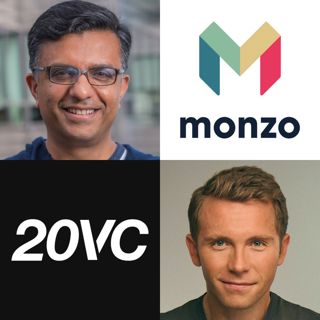
20VC: Monzo: The Greatest Turnaround in Tech: From £40M Revenues, Layoffs, Downrounds and Low Employee NPS to $1BN in Revenue, Profitable and 10M Customers with TS Anil, CEO @ Monzo

20VC: Monzo: The Greatest Turnaround in Tech: From £40M Revenues, Layoffs, Downrounds and Low Employee NPS to $1BN in Revenue, Profitable and 10M Customers with TS Anil, CEO @ Monzo

TS Anil is the CEO @ Monzo, where he has been the mastermind behind the greatest turnaround in tech in the last 10 years. When TS took over at Monzo they had £40M in revenue, very little runway, had a 40% down round and had large layoffs and low employee NPS. Today they are at £1BN in revenue, profitable and the UK's largest digital bank with more than 10m customers. From $40M Revenues to $1BN Revenues and Profitable: 1. What are the most profitable elements of Monzo's business today? How will that change in time? 2. What did TS do with Monzo that he wishes he had not done? What did he not do that he wishes he had done? 3. How does TS approach expansion? How will he win Europe against the competition of Revolut? 4. Why have no European fintechs won when expanding into the US? What do they do wrong? 5. How does TS think about the decision to go public? Will he go public in London? 6. How does TS respond to the notion that Monzo has a "work life balance" culture in the face of the fierce culture of Revolut? 7. What have been TS' biggest lessons from raising $1BN for Monzo from the largest institutions in the world? What was the easiest round? What was the hardest? 8. What three core traits does TS believe all great leaders need to have? If you do not have them, how can you develop them most efficiently?

13 Helmi 56min

20VC: The $5BN Company Built from the Belgian Countryside | The Story of Odoo: The Company with No Plans to Sell, IPO & Their Billionaire Founder Who Does Not Care About Money with Fabien Pinckaers, Founder & CEO @ Odoo

20VC: The $5BN Company Built from the Belgian Countryside | The Story of Odoo: The Company with No Plans to Sell, IPO & Their Billionaire Founder Who Does Not Care About Money with Fabien Pinckaers, Founder & CEO @ Odoo

Fabien Pinckaers is the Founder & CEO of Odoo, one of the most incredible businesses that you might not have heard of. Built from the countryside of Belgium, they do an astonishing $650M in ARR, they have over 5,000 employees and have over 50,000 companies as customers. Even better, Fabian openly does not ever want to sell the company, IPO, believes that titles in companies are total BS and most management is done completely wrong. In Today's Episode with Fabien We Discuss: 1. Everything You Know About Management is Wrong: Why is it BS to give people titles in a company? How does Odoo hire people after only one interview? Why does Odoo prefer to hire really young people under 30? Why does Fabien think it is the worst to build a team in Silicon Valley? 2. The Billionaire Who Does Not Care About Money: Why does Fabien literally not care about money and does not even own a house? Why does Fabien refuse to ever sell or IPO Odoo? How does Fabien plan to offer liquidity to investors if he never wants to sell or IPO? 3. Why Did Every VC Turn Down the $5BN Odoo: What are Fabien's biggest lessons from being rejected by every VC for Odoo? What did they not see that they should have seen? Why did Fabien always want the price of the company on every funding round to be as low as possible? How does Fabien advise founders on pitching VCs today, knowing all he knows? 4. Scaling to $650M in ARR: The Biggest Lessons: Why does Fabien believe the biggest mistake companies make is they lose focus? What did Fabien not do with Odoo that they should have done? What did Fabien do and invest in, that with the benefit of hindsight they should not have done? When did the business start to break with scale? What would Fabien have done differently knowing all he does know?

12 Helmi 1h 15min

20VC: Why Model Providers Will Kill Many Startups Moving into the Application Layer | Why Deepseek is not a Threat to OpenAI & Why OpenAI Beats Anthropic | Apps vs Models vs Infrastructure: Where is Value in AI with Sridhar Ramaswamy, Snowflake CEO

20VC: Why Model Providers Will Kill Many Startups Moving into the Application Layer | Why Deepseek is not a Threat to OpenAI & Why OpenAI Beats Anthropic | Apps vs Models vs Infrastructure: Where is Value in AI with Sridhar Ramaswamy, Snowflake CEO

Sridhar Ramaswamy is the CEO @ Snowflake, the $60BN public company with $3.5BN in revenue growing 30% per year. Sridhar joined Snowflake following his company, Neeva, being acquired by them for $150M. Prior to founding Neeva, Ramaswamy spent 15 years at Google where he had an integral part in the growth of AdWords and Google's advertising business from $1.5 billion to over $100 billion. In Today's Episode We Discuss: 1. OpenAI vs Deepseek vs Anthropic: Why will OpenAI beat Deepseek? What does no one see with Deepseek that they should see? Why has OpenAI beaten Anthropic? What elements turn a model from a commodity into a sustaining product suite? Will model providers become application providers? Will OpenAI be the biggest killer of startups in the next 10 years? 2. Snowflake vs Nvidia & Databricks: To what extent is Sridhar concerned NVIDIA will move into the data layer and compete with Snowflake? How does Sridhar view the competition from Databricks? What have they done better than them? What have they done worse than them and lost on? Does being private hurt or help Databricks in their fight against Snowflake? If Sridhar could, would he take Snowflake private today? 3. Leadership, Parenting, Money: Do richer leaders make better leaders? How does being rich change the mindset of a leader? What are Sridhar's biggest lessons when it comes to parenting? What about the way that Sridhar was brought up, did he do deliberately differently with his kids?

10 Helmi 55min

20Product: Product Secrets Behind Uber and Opendoor | How AI Changes the Role of the PM & The Product Development Process | How to Hire the Best Product Teams & What No One Does That Everyone Should Do with Brian Tolkin

20Product: Product Secrets Behind Uber and Opendoor | How AI Changes the Role of the PM & The Product Development Process | How to Hire the Best Product Teams & What No One Does That Everyone Should Do with Brian Tolkin

Brian Tolkin is the Head of Product @ Opendoor where he has spent the last 6 years and is responsible for product strategy and product and design teams. Before Opendoor, Brian spent an incredible 5 years at Uber through their wildest growth periods. In Today's Episode with Brian Tolkin: 03:53 Brian's Journey at Uber: Launching China Pool 05:07 Product Lessons from Uber's China Launch 08:22 The Role of a PM in a Pre vs. Post AI World 10:16 Product Development Process in an AI World 17:43 The Importance of Simplification in Product Management 19:21 OKRs and Prioritization in Product Management 23:12 The Importance of Feedback Loops in Product Development 23:38 Evaluating Product Changes: User Adaptation vs. Bad Decisions 25:00 Balancing Gut Instinct and Data in Product Leadership 25:38 The Role of Simplicity in Product Design 27:02 Consensus vs. Dictatorial Product Leadership 27:54 Hiring for the Best Product Teams 31:33 How to do Effective Sprint Management 38:39 Quickfire Round: Insights and Advice

7 Helmi 44min

Suosittua kategoriassa Liike-elämä ja talous

sijotuskasti
psykopodiaa-podcast
mimmit-sijoittaa
rss-rahapodi
rss-rahamania
ostan-asuntoja-podcast
herrasmieshakkerit
rss-lahtijat
pari-sanaa-lastensuojelusta
yrittaja
lakicast
rss-myynti-ei-ole-kirosana
taloudellinen-mielenrauha
rss-neuvottelija-sami-miettinen
rahapuhetta
oppimisen-psykologia
rss-startup-ministerio
rss-karon-grilli
rss-puhutaan-rahasta
rss-hyvin-johdettu