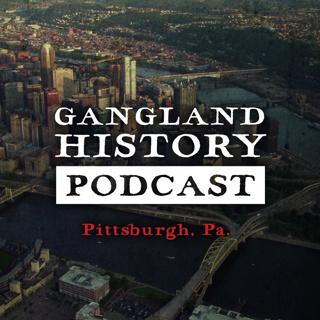
#48: History of the Pittsburgh Mob (Part Three): Prohibition, Bootlegging, Bullets, and the “Bootleg Kings”

#48: History of the Pittsburgh Mob (Part Three): Prohibition, Bootlegging, Bullets, and the “Bootleg Kings”

This video is Part Three of my History of the Pittsburgh Mob series, focusing on Prohibition and the rise of Pittsburgh’s early bootleg kings—men like Martin M. Burke who transformed decades of political influence, saloon ownership, and neighborhood control into large-scale criminal enterprises. Picking up in the aftermath of Gregorio Conti’s 1919 assassination, this episode explores how the vacuum he left behind becomes the foundation for a far more violent and organized underworld.

The episode opens with a chaotic, real-life gun battle on Pittsburgh’s streets. Rogue bootleggers, posing as Prohibition agents, attempt to move liquor under the cover of authority—until they are confronted by federal agent Andrew Carciere. What follows is a high-speed chase, gunfire, and arrests, capturing the instability of the early Prohibition years. The rules are unclear, enforcement is inconsistent, and in that confusion, opportunity thrives.

From there, the episode examines both sides of the equation—the criminals building a new underground economy and the men attempting to stop them. Enforcement efforts are shaped by figures like Prohibition Director John D. Pennington and Treasury Secretary Andrew W. Mellon, but even with federal attention, authorities struggle to keep pace with rapidly evolving bootlegging networks.

At the same time, the episode revisits the leadership vacuum created by Conti’s death. With no clear successor, attention turns to figures like Giuseppe “Peppino” Cusumano, Nicola “Nick” Gentile, and Salvatore Calderone. None immediately consolidate control, contributing to a fragmented and competitive early Prohibition landscape.

As alcohol is driven underground, Pittsburgh’s existing infrastructure adapts quickly. Saloons become speakeasies, political relationships remain intact, and distribution networks evolve rather than disappear. Demand never fades—it simply becomes illicit.

In this environment, bootlegging is scattered and competitive. Crews clash over territory and supply, while schemes involving forged federal permits reveal how operators exploit the system itself. Even when exposed, these operations prove difficult to dismantle, underscoring the limits of enforcement.

Within this shifting landscape, Martin M. Burke rises to prominence. Born in 1871 and shaped by decades in the saloon trade, Burke enters Prohibition prepared. Alongside his brothers, he builds a network of saloons, properties, and entertainment venues in the Hill District, centered around Wylie Avenue and Fullerton Street.

When alcohol goes underground, Burke converts what already exists. His saloons become speakeasies, his properties serve as distribution hubs, and his political connections provide insulation. In a city filled with small operators, he stands out for his ability to organize and scale, emerging as one of Pittsburgh’s first true bootleg kings.

But as profits grow, so does competition. Shipments are hijacked, armed guards protect deliveries, and disputes escalate into violence that spreads beyond the city into surrounding towns. Bootlegging becomes a capital-intensive, interconnected underground industry.

And within that system, the men who survive begin to evolve. They learn that structure is more profitable than chaos, refining their operations and building networks that move toward greater organization. Prohibition becomes a proving ground for the next phase of organized crime.

Martin Burke represents a critical step in that evolution—a bridge between the old world of saloons and ward politics and the emerging world of large-scale bootlegging. But his removal creates yet another vacuum, and like the one before it, it will not remain empty.

Because by the late 1920s, chaos begins to give way to consolidation. And among the figures positioned to take advantage of that shift is a man whose rise has been building in the background.

Stefano Monastero.

His story—and the next phase of Pittsburgh’s underworld—is just beginning.

Jaksot(49)

#47: History of the Pittsburgh Mob (Part Two): The Rise & Fall of Gregorio Conti

#47: History of the Pittsburgh Mob (Part Two): The Rise & Fall of Gregorio Conti

This episode is Part Two of The Gangland History Podcast’s History of the Pittsburgh Mob, focusing on Gregorio Conti, widely regarded as Pittsburgh’s second Mafia boss. Conti matters because he emerge...

28 Tammi 1h 42min

#46: History of the Pittsburgh Mob (Part One): Immigration, the Black Hand, and the Era of Salvatore Catanzaro

#46: History of the Pittsburgh Mob (Part One): Immigration, the Black Hand, and the Era of Salvatore Catanzaro

Long before Prohibition, long before speakeasies and Tommy guns, Pittsburgh’s underworld was already taking shape—quietly, violently, and largely unseen.This episode traces the true origins of organiz...

24 Joulu 20251h 4min
#45: History of the Tampa Mob: A Discussion with Author, Scott Deitche

#45: History of the Tampa Mob: A Discussion with Author, Scott Deitche

In this episode of The Gangland History Podcast, host Jacob Stoops interviews acclaimed author and Mafia historian Scott Deitche, one of the nation’s foremost experts on organized crime in Florida and...

8 Loka 20251h 14min

#44: Frank Costello to Alto Knights | Historical Fiction and the Mob with Author Ron K. Fried

#44: Frank Costello to Alto Knights | Historical Fiction and the Mob with Author Ron K. Fried

In this episode of the podcast, I’m joined by author Ron K. Fried for a deep dive into one of the most compelling figures in organized crime history: Frank Costello, the mob boss who rose to power dur...

27 Elo 20251h 33min

#43: The Gurney's Inn Operation: Roundtable Discussion with Daniel Edward Rosen & Frank DiMatteo

#43: The Gurney's Inn Operation: Roundtable Discussion with Daniel Edward Rosen & Frank DiMatteo

In late August 1979, the FBI's Brooklyn-Queens Metropolitan Resident Agency (the BQ) received a significant tip from a top-echelon informant within the Genovese crime family. This informant, known as ...

25 Kesä 202551min

#42: The State of the Mafia (1967): Part Three

#42: The State of the Mafia (1967): Part Three

In today's episode, we wrap up one of the most detailed and historically rich series we’ve ever done. In Part Three of our special deep dive into the FBI’s 1967 report on La Cosa Nostra, we close the ...

24 Huhti 20252h 31min

#41: Paul "The Waiter" Ricca (Part Two)

#41: Paul "The Waiter" Ricca (Part Two)

In Part Two of our deep-dive biography on Paul "The Waiter" Ricca, we chronicle his ascent to the top of the Chicago Outfit from the late 1940s through the early 1970s — a reign that cemented his lega...

6 Maalis 20252h 25min

Suosittua kategoriassa True crime

jaljilla
maanantaimysteeri
i-dont-like-mondays
palmujen-varjoissa
murhan-anatomia
backmanholmavuo
kurja-juttu
piinan-kirous-2
viimeinen-havainto
rss-jaljilla
joku-tietaa-jotain-2
motiivina-mustasukkaisuus
sattuman-vaara
rss-murhan-anatomia
rss-paha-syntyi-pohjolassa
hiljaisia-huutoja
rss-maanantaimysteeri-2
kulttien-johdossa
paha-syntyi-pohjolassa-bonuskausi
motiivina-raha