

Credit-Based Pricing Explained: How AI Companies Balance Cost, Value, and Scale with Steven Forth

Credit-Based Pricing Explained: How AI Companies Balance Cost, Value, and Scale with Steven Forth

AI pricing is changing fast—and suddenly, everyone is selling credits. But here's the uncomfortable question: Are credits actually helping you scale… or quietly pulling you back into cost-plus pricing?

Steven Forth, co-founder of ValueIQ, joins Mark Stiving to unpack what's really going on behind the rise of credit-based pricing—and why so many companies are adopting it despite its obvious flaws.

This isn't a polite discussion. Mark challenges the very foundation of credits, arguing they break the connection between price and value. Steven pushes back, revealing why credits may be the only viable system in a world where AI usage is unpredictable, costs are real, and value is still being discovered in real time.

What emerges is a deeper truth most companies are missing about credit-based pricing. If you're navigating AI pricing—or even just rethinking your current model—this episode will force you to rethink not just how you price… but what you're really charging for.

Why You Have to Check Out Today's Podcast:

  • Discover when credit-based pricing actually works—and when it quietly pulls you back into cost-plus thinking, weakening your ability to communicate real value.
  • Learn how AI companies balance cost, value, and scale using the "two dials" of pricing—credit price vs. credit consumption—and why this changes how you design pricing systems.
  • Avoid the hidden design traps that break credit models—including overages, rollovers, and pooling decisions that frustrate buyers and limit growth.

"AI is still early. Value is not preordained. Credits give you flexibility while you figure it out."

– Steven Forth

Topics Covered:

01:43 – Why Credits Break Value-Based Pricing (And Create Buyer Confusion). Mark explains why credits add a layer of abstraction between price and value—making it harder for buyers to connect what they pay to the outcomes they get.

05:47 – The Hidden Shift to Cost-Plus Pricing in AI. Why tokens = cost-plus pricing, and how rising compute costs are quietly pushing SaaS companies away from value-based pricing without realizing it.

10:11 – The "Two Dials" Strategy: How Credits Unlock Pricing Flexibility. Discover how adjusting price per credit vs. credits per action creates a more adaptable system—without constantly changing your pricing model.

12:05 – The Hardest Problem Nobody Solves: Mapping Credits to Value. Why most companies fail at credit pricing—not because of the model itself, but because they skip the deep work of aligning credits with real customer value.

15:22 – The 3 Critical Design Decisions That Make or Break Credits. A breakdown of pooling, rollovers, and overages—and how each one impacts buyer trust, revenue predictability, and product usage.

21:57 – Overage Mistakes That Kill Adoption (And What to Do Instead). Why hard stops frustrate users and reduce usage, plus smarter alternatives like soft limits, borrowing, and on-demand credit purchases.

25:34 – The Emerging Best Practice: Hybrid Credit + Subscription Models. How leading companies combine base subscriptions with flexible credit top-ups to balance predictability with scalability.

27:00 – The Only Rule That Matters: Understand How You Create Value. Steven's closing insight: pricing models don't matter if you don't deeply understand how your value is created—and how it's changing over time.

Key Takeaways:

"Credits add a layer of abstraction between price and value—and that's what makes them dangerous." – Mark Stiving

"Tokens are cost-plus pricing. Credits give you a way to reconnect pricing back to value." – Steven Forth

"Buyers are much more flexible with credits than with price increases." – Steven Forth

"Credits feel easier to allocate internally—because they've already been 'spent." – Mark Stiving

"Hard stops on usage are bad design—they hurt both the buyer and the seller." – Steven Forth

"Well-designed credit systems are actually buyer-centric—they give flexibility across different use cases." – Steven Forth

Resources and People Mentioned:

  • Lovable (AI platform) – Referenced for its approach to on-demand credit purchasing and overage design, including A/B testing credit top-ups to improve revenue and user experience
  • Box (company) – Example of a company implementing restricted credit pooling rules (e.g., limited sharing of AI credits), highlighting tension between buyer flexibility and revenue protection
  • AI Token Pricing Models – Discussed as a contrast to credits; tokens represent cost-plus pricing tied to compute usage, while credits can be designed to reflect value instead of just cost
  • Cell Phone Industry (Rollover & Subscription Models) – Referenced as the origin of many modern SaaS pricing mechanics like rollovers, ARR, and customer lifetime value thinking, influencing today's credit-based systems

Connect with Steven Forth:

Connect with Mark Stiving:

Jaksot(500)

Buyer Insight: "We Lost on Price" – Truthful and Useless

Buyer Insight: "We Lost on Price" – Truthful and Useless

This is an Impact Pricing Blog published on January 19, 2026, turned into an audio podcast so you can listen on the go. Read Full Article Here: https://impactpricing.com/blog/we-lost-on-price-truthfu...

3 Huhti 4min
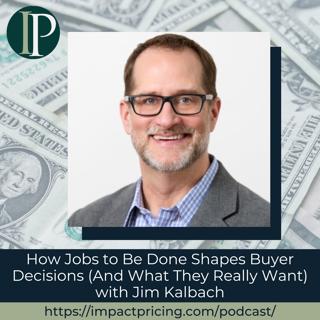
How Jobs to Be Done Shapes Buyer Decisions (And What They Really Want) with Jim Kalbach

How Jobs to Be Done Shapes Buyer Decisions (And What They Really Want) with Jim Kalbach

Jim Kalbach is the Chief Evangelist at Mural, where he helps teams uncover what customers actually need—not just what they say they want. Known for his work in Jobs to Be Done, experience mapping, and...

30 Maalis 28min

How to Quantify Value So Buyers Actually Believe It with Mark Stiving and Rebecca Kalogeris

How to Quantify Value So Buyers Actually Believe It with Mark Stiving and Rebecca Kalogeris

If buyers need to believe the value before they buy…why don't they trust ROI when we show it to them? In Episode 5 of the Buyer Decision Series, Mark Stiving and Rebecca Kalogeris explore how to actua...

23 Maalis 12min

Blogcast: AI Didn't Kill Per-User Pricing. It Exposed It.

Blogcast: AI Didn't Kill Per-User Pricing. It Exposed It.

This is an Impact Pricing Blog published on January 12, 2026, turned into an audio podcast so you can listen on the go. Read Full Article Here: https://impactpricing.com/blog/ai-didnt-kill-per-user-p...

20 Maalis 3min

Why Buyers Can't Articulate Their Real Problems (And Why That Matters for Pricing) with Mark Stiving and Rebecca Kalogeris

Why Buyers Can't Articulate Their Real Problems (And Why That Matters for Pricing) with Mark Stiving and Rebecca Kalogeris

If value comes from solving problems… why do buyers struggle to explain the problems they actually have? In Episode 4 of the Buyer Decision Series, Mark Stiving and Rebecca Kalogeris explore why buyer...

16 Maalis 14min

Blogcast: Price Is the Tradeoff

Blogcast: Price Is the Tradeoff

This is an Impact Pricing Blog published on January 5, 2026, turned into an audio podcast so you can listen on the go. Read Full Article Here: https://impactpricing.com/blog/price-is-the-tradeoff/ If ...

13 Maalis 3min

What Buyers Actually Pay For (Hint: It's Not Your Product) with Mark Stiving and Rebecca Kalogeris

What Buyers Actually Pay For (Hint: It's Not Your Product) with Mark Stiving and Rebecca Kalogeris

If buyers are predicting the future… and confidence determines when they act… what are they actually paying for? In Episode 3 of the Buyer Decision Series, Mark Stiving and Rebecca Kalogeris explore t...

10 Maalis 13min

Suosittua kategoriassa Liike-elämä ja talous

sijotuskasti
mimmit-sijoittaa
psykopodiaa-podcast
rss-rahapodi
ostan-asuntoja-podcast
rss-rahamania
rahapuhetta
rss-laakispodi
rss-sisalto-kuntoon
herrasmieshakkerit
sijoituspodi
rss-seuraava-potilas
rss-draivi
rss-sami-miettinen-neuvottelija
sivutuloja-ja-sijoituksia
rss-lahtijat
rss-bisnesta-bebeja
rss-karon-grilli
rss-paasipodi
rss-porssipodi