188: The Osireion

188: The Osireion

Sety at Abydos (Part 3). The Osireion is an intriguing monument, one that attracts a huge amount of debate, discussion, and speculation. Its discovery was unexpected, its excavation was an enormous undertaking, and there are many uncertainties about its purpose, history, and overall significance. Still, with an extensive photographic record, some meticulous archaeological work, and a great deal of discussion, we can attempt to understand the Osireion. Who built the Osireion (and how old is it)? Why is it here, behind Sety’s great temple? What purpose does it serve? In this episode, we explore these questions, and try to understand the monument overall. NOTE: Due to the complex nature of the Osireion’s history (ancient and modern), archaeology, and the difficulty of describing it, I will do a video lecture on YouTube in future. Check this post, or the website, for links when published. Further Information: The Osireion is surprisingly well documented, both in archival photography and modern analysis and discussion. Modern photos exploring the Osireion: Flickr: Soloegipto. Flickr: Archaeology Archive Project. Archaeology / Excavation Reports for The Osireion (free open access): Caulfeild, Temple of the Kings at Abydos, 1902: Internet Archive and Heidelberg University. Primarily focusses on main temple but brief discussion of work in western precinct that led to Murray’s excavations. Murray, The Osireion, 1904: Internet Archive, ETANA.org, and Academia.edu. Edouard Naville’s excavation reports (various journals) describing work at Abydos including the Osireion: JSTOR.org (requires free account). Frankfort, The Cenotaph of Sety I at Abydos, volume 1 and volume 2, 1933: Internet Archive. Includes complete summary of earlier excavations and fuller description of the monument (compared to Naville). James Westerman website (with database of articles and photos): JamesWesterman.org. Keith Hamilton, “Osiris: A Layman’s Guide,” on Academia.edu. Charles Herzer, “Study of the Osireion at Abydos,” at Isida Project. Photo Collections of early excavations at Abydos/Osireion: Dumbarton Oaks: Photo Exhibition Abydos 1910s—1920s. Egypt Exploration Society Photo Archives (Flickr): Excavations 1911. Entrance passages and central hall. Excavations 1913. Central hall. Excavations 1925 (Part 1). Central hall and side chambers. Excavations 1925 (Part 2). Central hall clearance and work. In this episode, I don’t discuss the mechanics of ancient stone working. That will come in future. But for now, you may be interested in archaeologists’ experiments to test ancient tools and the feasibility of carving hard stones (e.g., granite). Some good starter information can be found here: Denys Stocks, Experiments in Egyptian Archaeology: Stoneworking Technology in Ancient Egypt (2022 updated edition). Taylor and Francis Publications. YouTube: Ancient Egyptian Stoneworking with Denys Stocks (Sacred Geometry Decoded) https://www.youtube.com/watch?v=zoOCcrgWkIA. YouTube: Reconstruction of Ancient Technologies (Scientists Against Myths) https://www.youtube.com/playlist?list=PLJXCRTftQoU_AXz0_uxwMQZCt2O9ULxLE. Additional details and sources: Date: c.1300 BCE—1292 BCE. Website: www.egyptianhistorypodcast.com. Support the show via Patreon www.patreon.com/egyptpodcast. Make a one-time donation via PayPal payments. Music intro: Ihab Mahna. Music interludes and outro: Luke Chaos. Sistrum interludes: Tahya / Hathor Systrum. Peter Brand, Ramesses II: Egypt's Ultimate Pharaoh, out now from Lockwood Press. Select Bibliography: A. M. Abudeif et al., ‘Geoarchaeological Investigation of Abydos Area Using Land Magnetic and GPR Techniques, El-Balyana, Sohag, Egypt’, Applied Sciences 12 (2022), 9640. P. Brand, ‘Secondary Restorations in the Post-Amarna Period’, Journal of the American Research Center in Egypt 36 (1999), 113–34. Learn more about your ad choices. Visit megaphone.fm/adchoices

Jaksot(408)

230: Khaemwaset & the Book of Thoth

230: Khaemwaset & the Book of Thoth

The prince Kha-em-Waset (lived c.1260 BCE) was a learned man, and an accomplished priest. Centuries after his death, storytellers remembered the prince as a sage and magician. They told tales of his a...

16 Maalis 35min
229: The First Egyptologist? Khaemwaset & the Apis Bulls

229: The First Egyptologist? Khaemwaset & the Apis Bulls

In 1263 BCE, priests announced the death of the APIS BULL. Sacred to Ptah, the bull dwelled in the temple at Men-nefer (Memphis). Now, in year 30 of Ramesses II, the King's son KHA-EM-WASET would lead...

9 Maalis 24min
228: Three Funerals & a Sed Festival

228: Three Funerals & a Sed Festival

Loss and rejuvenation. Ramesses third decade in power was a time of death. The King's Great Wife Nefertari passed around year 25. Almost simultaneously, his mother Tuya, his second wife Iset-Nofret, a...

2 Maalis 31min
227: The One Where Iset Poisons Ra

227: The One Where Iset Poisons Ra

What is the true name of god? Once upon a time, Ra ruled the earth directly. But the great goddess Iset/Isis desired to know his private name, the one hidden from all outsiders. A name that, if known,...

16 Helmi 34min
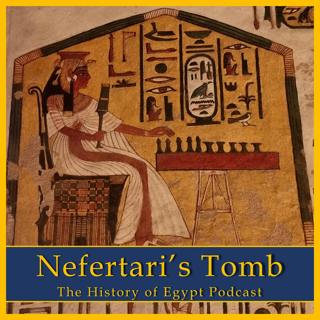
226: Nefertari's Tomb and Book of the Dead

226: Nefertari's Tomb and Book of the Dead

The tomb of Queen Nefertari is one of the masterpieces of New Kingdom funerary monuments. The tomb is stunningly preserved, with an array of exquisite images, evocative texts (from the Book of the Dea...

9 Helmi 28min
225: Nefertari Beloved of Mut

225: Nefertari Beloved of Mut

Around 1300 BCE, King Sety I selected a group of "beauties" for his son, to marry and produce children. One of these was Nefertari (Nefret-Iry, "She Has Become Beautiful"). A girl of unknown origins (...

2 Helmi 49min
Abu Simbel: Nefertari's Temple & Ramesses' Nubian Empire

Abu Simbel: Nefertari's Temple & Ramesses' Nubian Empire

Livestream recording about the Abu Simbel Temples, with a particular focus on Nefertari's monument (Part 1) and the political-religious context of Ramesses' Nubian monuments (Part 2). We also have a f...

26 Tammi 32min
Dinosaurs of Egypt (2026 Revised Edition)

Dinosaurs of Egypt (2026 Revised Edition)

In the Cretaceous Period (c.100 million years ago) Egypt and North Africa were radically different environments. With vast tidal flats and mangroves, and a shallow sea, the continent fostered numerous...

12 Tammi 30min

Suosittua kategoriassa Yhteiskunta

olipa-kerran-otsikko
siita-on-vaikea-puhua
gogin-ja-janin-maailmanhistoria
i-dont-like-mondays
kaksi-aitia
uutiscast
poks
antin-palautepalvelu
joku-tietaa-jotain-2
kolme-kaannekohtaa
sita
mamma-mia
aikalisa
yopuolen-tarinoita-2
rss-murhan-anatomia
rss-palmujen-varjoissa
lahko
rss-nikotellen
meidan-pitais-puhua
loukussa