191: Libya Minus One

191: Libya Minus One

How the west was won. Around 1298 BCE, King Sety I (Men-ma’at-Ra) attacked the peoples of modern-day Libya and, in a supposedly swift victory, took many captives back to Egypt. The relationship between Libyans and ancient Egyptians is complicated, but we go in search of some answers… Date: c.1298 BCE (Sety I, year 6). Website: www.egyptianhistorypodcast.com. Support the show via Patreon www.patreon.com/egyptpodcast. Make a one-time donation via PayPal payments. Music intro/outro: “Godzilla theme” by Akira Ifukube, cover version by Luke Chaos. Music interludes by: Keith Zizza, Luke Chaos. Sety’s War Reliefs at Karnak: Available in Open Access at The University of Chicago. Select Bibliography: P. J. Brand, The Monuments of Seti I: Epigraphic, Historical and Art Historical Analysis (2000). P. J. Brand, Ramesses II: Egypt’s Ultimate Pharaoh (2023). W. A. Cooney, ‘Egypt’s Encounter with the West: Race, Culture and Identity’, Unpublished PhD. Thesis, University of Durham (2011). A. Dodson, Sethy I King of Egypt: His Life and Afterlife (2019). A. A. el Magd, ‘Dehumanization of the “Other:” Animal Metaphors of Defeated Enemies in the New Kingdom Military Texts’, Journal of the American Research Center in Egypt 52 (2016), 329–341. H. El Saady, ‘The Wars of Sety I at Karnak: A New Chronological Structure’, Studien zur Altägyptischen Kultur 19 (1992), 285–94. R. O. Faulkner, ‘The Wars of Sethos I’, The Journal of Egyptian Archaeology 33 (1947), 34–9. J. C. M. García, ‘Ḥwt jḥ(w)t, The Administration of the Western Delta and the “Libyan Question” in the Third Millennium BC’, Journal of Egyptian Archaeology 101 (2015), 69–105. K. A. Kitchen, Ramesside Inscriptions Historical and Biographical, I (Oxford, 1975). K. A. Kitchen, ‘The Arrival of the Libyans in Late New Kingdom Egypt’, in A. Leahy (ed.), Libya and Egypt c.1300–750 BC (1990), 15–27. K. A. Kitchen, Ramesside Inscriptions Translated and Annotated: Translations Volume I: Ramesses I, Sethos I and Contemporaries (Second Publication edn, 2017). E. F. Morris, The Architecture of Imperialism: Military Bases and the Evolution of Foreign Policy in Egypt’s New Kingdom (2005). W. J. Murnane, The Road to Kadesh: A Historical Interpretation of the Battle Reliefs of King Sety I at Karnak (1985). D. O’Connor, ‘The Nature of Tjemhu (Libyan) Society in the Later New Kingdom’, in A. Leahy (ed.), Libya and Egypt c.1300–750 BC (1990), 29–113. A. J. Spalinger, ‘The Northern Wars of Seti I: An Integrative Study’, Journal of the American Research Center in Egypt 16 (1979), 29–47. A. J. Spalinger, War in Ancient Egypt: The New Kingdom (2005). The Epigraphic Survey, Medinet Habu, Volume I. Earlier Historical Records of Ramses III (1930). The Epigraphic Survey, Medinet Habu, Volume II. The Later Historical Records of Ramses III (1932). The Epigraphic Survey, Reliefs and Inscriptions at Karnak Volume 4: The Battle Reliefs of King Sety I (1986). Learn more about your ad choices. Visit megaphone.fm/adchoices

Jaksot(410)

Khaemwaset Forever with Dr. Campbell Price

Khaemwaset Forever with Dr. Campbell Price

Campbell Price is Curator of Egypt & Sudan at Manchester Museum. Enthusiasts will know him from the books Ancient Egypt in 50 Discoveries and Golden Mummies of Egypt. Interpreting Identities from the ...

23 Maalis 57min
Introducing Lost Roman Heroes (Feed Swap)

Introducing Lost Roman Heroes (Feed Swap)

This week we’re sharing a special episode from Lost Roman Heroes, recently named a “must-listen history podcast” by Amazon Music and named one of the "Best Ancient History Podcasts" in Find that Pod! ...

20 Maalis 1h 7min
230: Khaemwaset & the Book of Thoth

230: Khaemwaset & the Book of Thoth

The prince Kha-em-Waset (lived c.1260 BCE) was a learned man, and an accomplished priest. Centuries after his death, storytellers remembered the prince as a sage and magician. They told tales of his a...

16 Maalis 35min
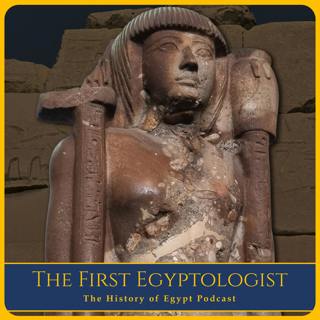
229: The First Egyptologist? Khaemwaset & the Apis Bulls

229: The First Egyptologist? Khaemwaset & the Apis Bulls

In 1263 BCE, priests announced the death of the APIS BULL. Sacred to Ptah, the bull dwelled in the temple at Men-nefer (Memphis). Now, in year 30 of Ramesses II, the King's son KHA-EM-WASET would lead...

9 Maalis 24min
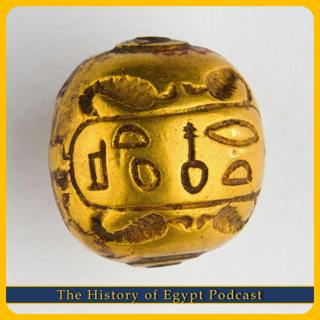
228: Three Funerals & a Sed Festival

228: Three Funerals & a Sed Festival

Loss and rejuvenation. Ramesses third decade in power was a time of death. The King's Great Wife Nefertari passed around year 25. Almost simultaneously, his mother Tuya, his second wife Iset-Nofret, a...

2 Maalis 31min
227: The One Where Iset Poisons Ra

227: The One Where Iset Poisons Ra

What is the true name of god? Once upon a time, Ra ruled the earth directly. But the great goddess Iset/Isis desired to know his private name, the one hidden from all outsiders. A name that, if known,...

16 Helmi 34min
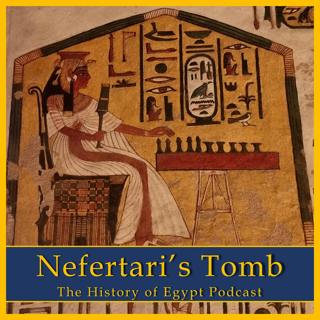
226: Nefertari's Tomb and Book of the Dead

226: Nefertari's Tomb and Book of the Dead

The tomb of Queen Nefertari is one of the masterpieces of New Kingdom funerary monuments. The tomb is stunningly preserved, with an array of exquisite images, evocative texts (from the Book of the Dea...

9 Helmi 28min
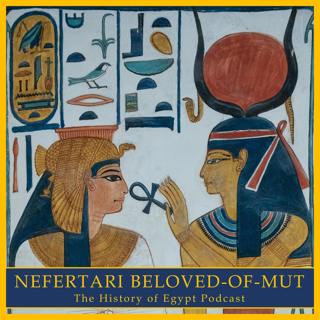
225: Nefertari Beloved of Mut

225: Nefertari Beloved of Mut

Around 1300 BCE, King Sety I selected a group of "beauties" for his son, to marry and produce children. One of these was Nefertari (Nefret-Iry, "She Has Become Beautiful"). A girl of unknown origins (...

2 Helmi 49min

Suosittua kategoriassa Yhteiskunta

olipa-kerran-otsikko
siita-on-vaikea-puhua
kaksi-aitia
gogin-ja-janin-maailmanhistoria
i-dont-like-mondays
uutiscast
poks
antin-palautepalvelu
kolme-kaannekohtaa
joku-tietaa-jotain-2
sita
mamma-mia
aikalisa
yopuolen-tarinoita-2
rss-murhan-anatomia
meidan-pitais-puhua
rss-nikotellen
rss-palmujen-varjoissa
lahko
rss-haudattu