
#25 - Robin Hanson on why we have to lie to ourselves about why we do what we do
80,000 Hours Podcast28 Maalis 2018

#25 - Robin Hanson on why we have to lie to ourselves about why we do what we do

On February 2, 1685, England’s King Charles II was struck by a sudden illness. Fortunately his physicians were the best of the best. To reassure the public they kept them abreast of the King’s treatment regimen. King Charles was made to swallow a toxic metal; had blistering agents applied to his scalp; had pigeon droppings attached to his feet; was prodded with a red-hot poker; given forty drops of ooze from “the skull of a man that was never buried”; and, finally, had crushed stones from the intestines of an East Indian goat forced down his throat. Sadly, despite these heroic efforts, he passed away the following week.

Why did the doctors go this far?

Prof, Robin Hanson, Associate Professor of Economics at George Mason University suspects that on top of any medical beliefs they also had a hidden motive: it needed to be clear, to the king and the public, that the physicians cared enormously about saving His Royal Majesty. Only by going ‘all out’ would they be protected against accusations of negligence should the King die.

Full transcript, summary, and links to articles discussed in the show.

If you believe Hanson, the same desire to be seen to care about our family and friends explains much of what’s perverse about our medical system today.

And not just medicine - Robin thinks we’re mostly kidding ourselves when we say our charities exist to help others, our schools exist to educate students and our politics are about choosing wise policies.

So important are hidden motives for navigating our social world that we have to deny them to ourselves, lest we accidentally reveal them to others.

Robin is a polymath economist, who has come up with surprising and novel insight in a range of fields including psychology, politics and futurology. In this extensive episode we discuss his latest book with Kevin Simler, *The Elephant in the Brain: Hidden Motives in Everyday Life*, but also:

* What was it like being part of a competitor group to the ‘World Wide Web’, and being beaten to the post?
* If people aren’t going to school to learn, what’s education all about?
* What split brain patients tell us about our ability to justify anything
* The hidden motivations that shape religions
* Why we choose the friends we do
* Why is our attitude to medicine mysterious?
* What would it look like if people were focused on doing as much good as possible?
* Are we better off donating now, when we’re older, or even wait until well after our deaths?
* How much of the behavior of ‘effective altruists’ can we assume is genuinely motivated by wanting to do as much good as possible?
* What does Robin mean when he refers to effective altruism as a youth movement? Is that a good or bad thing?
* And much more...

Jaksot(333)

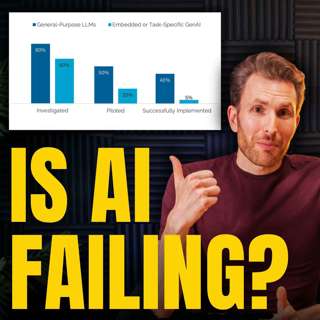
'95% of AI Pilots Fail': The hidden agenda behind the viral stat that misled millions

'95% of AI Pilots Fail': The hidden agenda behind the viral stat that misled millions

You might have heard that '95% of corporate AI pilots' are failing. It was one of the most widely cited AI statistics of 2025, parroted by media outlets everywhere. It helped trigger a Nasdaq selloff ...

28 Huhti 10min

#242 – Will MacAskill on how we survive the 'intelligence explosion,' AI character, and the case for 'viatopia'

#242 – Will MacAskill on how we survive the 'intelligence explosion,' AI character, and the case for 'viatopia'

Hundreds of millions already turn to AI on the most personal of topics — therapy, political opinions, and how to treat others. And as AI takes over more of the economy, the character of these systems ...

22 Huhti 3h 9min
Risks from power-seeking AI systems (article narration by Zershaaneh Qureshi)

Risks from power-seeking AI systems (article narration by Zershaaneh Qureshi)

Hundreds of prominent AI scientists and other notable figures signed a statement in 2023 saying that mitigating the risk of extinction from AI should be a global priority. At 80,000 Hours, we’ve consi...

16 Huhti 1h 29min

How scary is Claude Mythos? 303 pages in 21 minutes

How scary is Claude Mythos? 303 pages in 21 minutes

With Claude Mythos we have an AI that knows when it's being tested, can obscure its reasoning when it wants, and is better at breaking into (and out of) computers than any human alive. Rob Wiblin work...

10 Huhti 21min

Village gossip, pesticide bans, and gene drives: 17 experts on the future of global health

Village gossip, pesticide bans, and gene drives: 17 experts on the future of global health

What does it really take to lift millions out of poverty and prevent needless deaths?In this special compilation episode, 17 past guests — including economists, nonprofit founders, and policy advisors...

7 Huhti 4h 6min

What everyone is missing about Anthropic vs the Pentagon. And: The Meta leaks are worse than you think.

What everyone is missing about Anthropic vs the Pentagon. And: The Meta leaks are worse than you think.

When the Pentagon tried to strong-arm Anthropic into dropping its ban on AI-only kill decisions and mass domestic surveillance, the company refused. Its critics went on the attack: Anthropic and its s...

3 Huhti 20min

#241 – Richard Moulange on how now AI codes viable genomes from scratch and outperforms virologists at lab work — what could go wrong?

#241 – Richard Moulange on how now AI codes viable genomes from scratch and outperforms virologists at lab work — what could go wrong?

Last September, scientists used an AI model to design genomes for entirely new bacteriophages (viruses that infect bacteria). They then built them in a lab. Many were viable. And despite being entirel...

31 Maalis 3h 7min

#240 – Samuel Charap on how a Ukraine ceasefire could accidentally set Europe up for a bigger war

#240 – Samuel Charap on how a Ukraine ceasefire could accidentally set Europe up for a bigger war

Many people believe a ceasefire in Ukraine will leave Europe safer. But today's guest lays out how a deal could potentially generate insidious new risks — leaving us in a situation that's equally dang...

24 Maalis 1h 12min

Suosittua kategoriassa Koulutus

rss-murhan-anatomia
psykopodiaa-podcast
voi-hyvin-meditaatiot-2
adhd-podi
rss-liian-kuuma-peruna
rss-niinku-asia-on
rss-rahamania
jari-sarasvuo-podcast
rss-tietoinen-yhteys-podcast-2
rss-valo-minussa-2
rss-vapaudu-voimaasi
kesken
psykologia
ihminen-tavattavissa-tommy-hellsten-instituutti
rss-narsisti
rss-arkea-ja-aurinkoa-podcast-espanjasta
rahapuhetta
filocast-filosofian-perusteet
rss-uskonto-on-tylsaa
rss-duodecim-lehti