

What AI Changed—and What It Didn’t—for Founders (feat. Jermaine Ee)
When I sat down to speak with Jermaine Ee from HeirLight, I expected a conversation about software, startups, and maybe a bit about AI. What I didn’t expect was how much it would challenge the way I think about why we build things in the first place. Jermaine is a non-technical founder by background, but that label almost feels misleading. He understands systems, architecture, and product trade-offs deeply—just without writing code himself. What stood out to me immediately was that he didn’t arrive at software because he wanted to build software. He arrived there because he wanted to solve a human problem. That distinction matters more now than it ever has.
22 Tammi 1h 17min

The Future of Code Security: Insights on AI Transformation (feat. Nir Valtman)
In this conversation, Nir Valtman, co-founder and CEO of Arnica, discusses the transformative impact of AI on code security and the software development lifecycle. He emphasizes the importance of understanding vulnerabilities, managing dependencies, and integrating security into developer workflows. In a rapidly evolving digital landscape, ensuring code security has never been more critical. Krish & Nir dive deep into the transformative role of artificial intelligence in software development life cycles. Nir shares his unique insights on how AI is reshaping code security and the essential steps developers must take to mitigate risks. The discussion also touches on the balance between feature development and security, the role of AI in generating code, and the evolving landscape of development teams.
21 Tammi 49min

From MVP to Market: Building Smarter with AI (feat. Victor Varnado)
Victor Varnado is not easily defined by a single title. A comedian, filmmaker, writer, game designer, cartoonist, actor, and software developer, he operates at the intersection of creativity and technology. As the CEO of SupremeRobot, a tech-and-media incubator, Victor develops intellectual property that can evolve into standalone companies. In this conversation, he shares how AI is reshaping writing, software development, outsourcing, and creative work at large .
20 Tammi 55min

From Scripture to Software: How AI Is Shaping Faith Tech (feat. Preston Zeller)
The rapid rise of artificial intelligence is reshaping nearly every industry, from finance to healthcare to creative work. One emerging and less-discussed frontier is Faith Tech—the application of modern technology, including AI, to support spiritual practice and religious life. In this conversation, entrepreneur and founder of venture studio Zellerhaus, Preston Zeller explores how AI can be used thoughtfully to build purpose-driven technology that supports faith, reflection, and personal growth.
20 Tammi 1h 5min
Datadog vs. CoreWeave: Two Software Companies, Two Very Different Market Stories
In a market dominated by AI narratives and software-driven growth, it’s easy to lump technology companies into a single bucket. But a closer look often reveals very different stories beneath the surface. Two companies that highlight this contrast particularly well are Datadog (DDOG) and CoreWeave (CRWV)—both high-quality software businesses, yet operating in entirely different domains and exhibiting sharply different market behavior.
16 Tammi 21min
Apple and Google’s Gemini Deal: What It Means for Siri, Smartphones, and the Future of AI
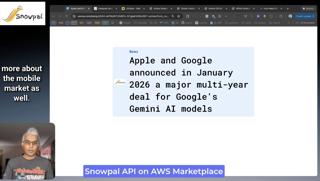
Earlier this month, Apple and Google announced a major multi-year partnership that will bring Google’s Gemini AI models into Apple’s ecosystem, most notably to power Siri. The deal signals a profound shift in how the world’s most influential consumer technology company approaches artificial intelligence and raises important questions about competition, platform control, and the future of mobile computing.
16 Tammi 57min
The Social Contract of Immigration: Why Assimilation Still Matters (feat. Nikki Barua)
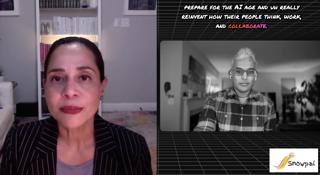
Welcome to the Snowpal Podcast, where we explore technology, leadership, and the ideas shaping the future. I’m your host, Krish Palaniappan, founder of Snowpal and a long-time software builder and entrepreneur, and on this show we go beyond surface-level trends to unpack real experiences and hard-earned insights. Today’s conversation is both timely and deeply personal. Our guest is Nikki Barua (LinkedIn), a serial entrepreneur, keynote speaker, bestselling author, and the CEO of FlipWork, where she helps people and organizations prepare for the AI age. Nikki’s work sits at the intersection of technology, culture, and human potential, but her story goes far beyond the boardroom. As an immigrant who has navigated visas, uncertainty, and reinvention over decades, she brings a deeply lived perspective to today’s discussion. In this episode, we explore what immigration really means beyond headlines and politics, diving into themes of belonging, assimilation, and cultural responsibility. We examine the difference between entitlement and privilege, why immigrants often become entrepreneurs and leaders, and how identity, contribution, and shared values shape acceptance. This is a conversation about people, not policies—about responsibility, opportunity, and the social contracts that bind us together in a rapidly changing world.
15 Tammi 36min
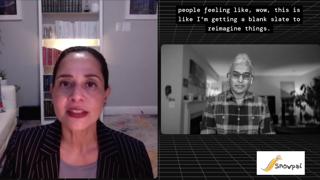
AI Demands Reinvention, Not Optimization: The Operating System of Future-Ready Companies (feat. Nikki Barua)
In this conversation, Nikki Barua (LinkedIn), CEO of FlipWork, discusses the critical need for companies to fundamentally reinvent themselves rather than merely transform. She emphasizes the difference between evolutionary and revolutionary change, highlighting the importance of leadership, cultural shifts, and the iterative process of change. Nikki shares insights on how organizations can identify focus areas for change, engage teams in the process, and navigate the complexities of implementing new strategies in a rapidly evolving business landscape. In this conversation, Nikki Barua and Krish Palaniappan explore the complexities of high-stakes decision-making, the future of software development, and the impact of AI on careers. They discuss personal reflections on identity and belonging, particularly in the context of immigration and cultural assimilation. The dialogue emphasizes the importance of adapting to new environments while maintaining one’s cultural roots, and the role of language in fostering connections. Ultimately, they highlight the shared human experience of seeking belonging and the potential for innovation in a rapidly changing world.
15 Tammi 1h 17min

