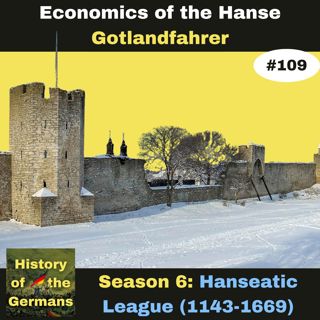
Ep. 109: The Hanseatic League (12th century) - The Economics - Gotlandfahrer

Ep. 109: The Hanseatic League (12th century) - The Economics - Gotlandfahrer

If I put the word Hanseatic into Google Search I get as result number 4 “Hanseatic King’s Lynn -Visit West Norfolk”. I can say with absolute confidence that there is not a single German individual, place or organisation that a small town in England would choose to not just associate with but incorporate itself into its history, safe for the Hanseatic League. They may play Zedoch the Priest at the coronation but that is because both Handel and Price Charles are considered English with German roots. Kings Lynn calling itself a Hanseatic city is a different thing. And it happens in many other places, Bergen is proud of its Hanseatic past as is Visby in Gotland or the Dutch former members of the League.

The love of all things Hanseatic goes so far that it even overrides the German fascination with all things car related. As you may know, the German system of numberplates is strictly hierarchical. The first 1, 2 or 3 letters indicate the place where the vehicle is registered at the time. The more letters, the smaller the town or county of registration. For instance, WES stands for Wesel and STD for Stade, two of the smaller members of the Hanseatic League. The two-letter cities are plentiful and some, like LG stands for Lüneburg and BS for Brunswick. Only the largest cities get to proudly display just one single letter – for instance K for Cologne, B for Berlin and F for Frankfurt.

But what about Germany’s second largest city, the Free and Hanseatic City of Hamburg? Does your honourable Hamburg merchant drive round in a car ostentatiously displaying a proud single H? No, of course he doesn’t. His numberplate is HH, standing for Hansestadt Hamburg, leaving the single H to the inland Hanoverians. Other Hanseatic cities like Bremen, Lübeck, Wismar, Rostock, Greifswald and Stralsund also proudly carry an additional H on their numberplate, a subtle reminder to everyone that their hometowns are different and dare one say, superior to other cities.

How can an organisation that had hardly any permanent institutions traded rather pedestrian commodities like grain, Hering, furs and beeswax and ceased to exist in 1669 still stir so many peoples’ hearts with pride, that is what we will try to figure out in this podcast series.

The music for the show is Flute Sonata in E-flat major, H.545 by Carl Phillip Emmanuel Bach (or some claim it as BWV 1031 Johann Sebastian Bach) performed and arranged by Michel Rondeau under Common Creative Licence 3.0.

As always:

Homepage with maps, photos, transcripts and blog: www.historyofthegermans.com

If you wish to support the show go to: Support • History of the Germans Podcast

For do it yourself merchandise go to: Merchandise • History of the Germans Podcast

Facebook: @HOTGPod

Threads: @history_of_the_germans_podcast

Bluesky: @hotgpod.bsky.social

Instagram: history_of_the_germans

Twitter: @germanshistory

To make it easier for you to share the podcast, I have created separate playlists for some of the seasons that are set up as individual podcasts. they have the exact same episodes as in the History of the Germans, but they may be a helpful device for those who want to concentrate on only one season.

So far I have:

The Ottonians

Salian Emperors and Investiture Controversy

Fredrick Barbarossa and Early Hohenstaufen

Frederick II Stupor Mundi

Saxony and Eastward Expansion

The Hanseatic League

The Teutonic Knights

The Holy Roman Empire 1250-1356

The Reformation before the Reformation

The Empire in the 15th century

The Fall and Rise of the Habsburgs

Bibliography:

Philippe Dillinger: Die Hanse

Die Hanse, Lebenswirklichkeit und Mythos, curated by Jürgen Bracker, Volker Henn and Rainer Postel

Rolf Hammel-Kieslow: Die Hanse

And special thanks for the translation of the Artlenburg Privileg to Dr. Jenny Benham.

And special thanks to Dr. justyna Wubs-Montzewicz whose research I found eye-opening

Jaksot(244)

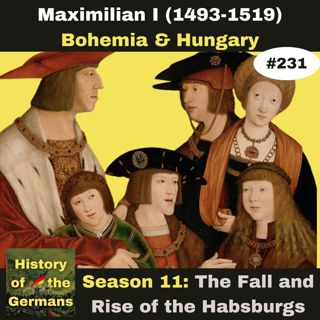
Ep.: 231 – Maximilian I (1493-1519) - Marrying Bohemia and Hungary

Ep.: 231 – Maximilian I (1493-1519) - Marrying Bohemia and Hungary

You have almost certainly seen the image in today’s episode artwork before. It is a family portrait showing Maximilian, his first wife Marie of Burgundy, his son, Philip the Handsome and three childre...

2 Huhti 41min
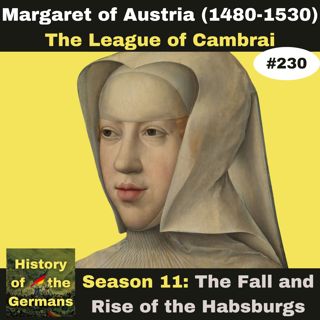
Ep.230: Margaret of Austria (1480-1530) - The League of Cambrai

Ep.230: Margaret of Austria (1480-1530) - The League of Cambrai

Another Thursday and another episode dealing with another epic fail of our hero, Maximilian I. But despite a military campaign that once again failed for all the usual reasons, no money, no strategy, ...

26 Maalis 43min
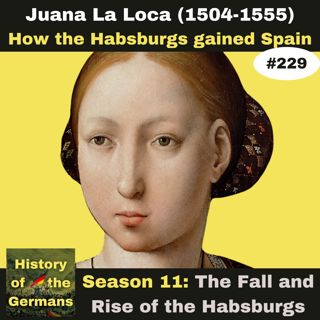
Ep. 229: Joanna the (not?) Mad (1504-1555) - How the Habsburgs gained Spain

Ep. 229: Joanna the (not?) Mad (1504-1555) - How the Habsburgs gained Spain

“Bella gerant alii, tu felix Austria nube" – ‘Let others wage war; thou, happy Austria, marry’ is one of the few terms that almost anyone with a cursory interest in European history knows, only rivall...

19 Maalis 48min
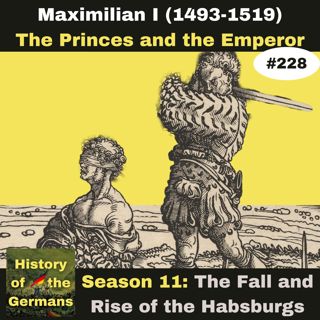
Ep. 228 – Maximilian I (1493-1519) - The Princes and the Emperor.

Ep. 228 – Maximilian I (1493-1519) - The Princes and the Emperor.

If there was one group that consistently thwarted Maximilian’s grand plans for world domination, it was the princes of the Holy Roman Empire. He had given in to their demands for Imperial Reform, had ...

12 Maalis 26min
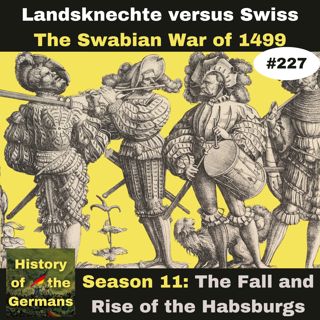
Ep. 227: Landsknechte vs. Swiss Mercenaries – The Swabian (Swiss) War of 1499

Ep. 227: Landsknechte vs. Swiss Mercenaries – The Swabian (Swiss) War of 1499

Why are the Swiss called the Swiss? After all, Schwyz in only of 26 cantons, and not one of the largest ones. How did the proud and prosperous citizens of Zurich or Berne, mighty city states in their ...

5 Maalis 38min
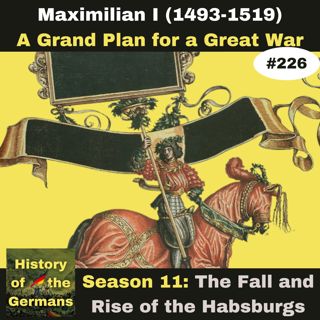
Ep. 226: Maximilian I (1493-1519) - A Grand Plan for a Great War

Ep. 226: Maximilian I (1493-1519) - A Grand Plan for a Great War

Europe's political landscape is shifting fundamentally. No longer are wars fought between kings and their vassals, and emperors against popes - it is all about the balance of power. and this balaance ...

26 Helmi 36min
The Imperial Reform of 1495 with Prof. Duncan Hardy

The Imperial Reform of 1495 with Prof. Duncan Hardy

Prof Duncan Hardy is one of the leading experts in the history of the Holy Roman Empire and one of his main topics is the Imperial reform of 1495, making him the ideal guest for our show.In his first ...

19 Helmi 1h 3min
Ep. 225: Imperial Reform 1495 - The Ewige Landfrieden (Public Peace) of 1495

Ep. 225: Imperial Reform 1495 - The Ewige Landfrieden (Public Peace) of 1495

Let me start today’s episode with some outrageous national stereotypes. If an Englishman is disappointed with the way the affairs of state are conducted, he writes a letter to his member of Parliament...

12 Helmi 36min

Suosittua kategoriassa Koulutus

rss-murhan-anatomia
psykopodiaa-podcast
voi-hyvin-meditaatiot-2
adhd-podi
rss-rahamania
rss-narsisti
aamukahvilla
rss-vapaudu-voimaasi
psykologia
rss-liian-kuuma-peruna
rahapuhetta
kesken
rss-duodecim-lehti
rss-eron-alkemiaa
rss-valo-minussa-2
uskonnon-pitka-oppimaara
jari-sarasvuo-podcast
mielipaivakirja
rss-tietoinen-yhteys-podcast-2
rss-koira-haudattuna