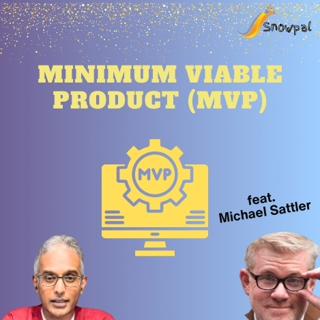

Minimum Viable Product (feat. Michael Sattler)

Minimum Viable Product (feat. Michael Sattler)

In this episode, ⁠Krish Palaniappan⁠ and ⁠Michael Sattler⁠ delve into the concept of Minimum Viable Product (MVP). Michael shares his extensive experience as a serial entrepreneur and fractional technical product executive, discussing the evolution of his understanding of MVP over the years. The conversation covers the definition of MVP, common misconceptions, the importance of recognizing team capabilities, and the necessity of proving value through MVPs. They also explore the concept of MVP in non-engineering contexts, such as opening a restaurant, and the relationship between MVP and product-market fit. The episode emphasizes the iterative nature of MVP development and the importance of user feedback in refining the product.

Takeaways

• MVP is the smallest feature set to prove value.

• Aesthetics matter only if they communicate value.

• Founders often confuse their vision with user needs.

• Recognizing team capabilities is crucial for MVP success.

• MVP should be a test of hypotheses about user needs.

• Iterate based on user feedback to improve MVP.

• MVP can be applied in various contexts, not just software.

• Product-market fit is different from MVP.

• Cutting unnecessary features simplifies MVP development.

• Learning from MVP failures is essential for growth.

• MVP should be designed to teach rather than be perfect.

• Finding product-market fit is crucial for startup success.

• Startups often fail due to lack of market validation.

• Testing ideas before building can save resources.

• It’s essential to identify the most critical features first.

• Big companies also struggle to identify valuable features.

• Startups can learn from the testing methods of larger companies.

• Understanding customer needs is vital before building an MVP.

• The process of building an MVP should be iterative and flexible.

• Feature selection is both an art and a science.

• Building something beautiful for personal satisfaction is valid.

• Skepticism is crucial in evaluating your own ideas.

• Validation from friends is often just sympathy, not real feedback.

• Understanding consumer willingness to pay is essential for success.

• Simulating the buying experience yields more valid data.

• Execution is as much a science as it is an art.

Chapters

00:00 Introduction to MVP and Michael Sattler's Background 02:16 Defining Minimum Viable Product (MVP) 06:42 Common Misinterpretations of MVP 09:33 Recognizing Team Capabilities in MVP Development 12:55 The Importance of Proving Value in MVPs 15:47 Exploring MVP in Non-Engineering Contexts 20:46 Understanding Product-Market Fit vs. MVP 24:35 Iterating on MVP Based on User Feedback 29:45 Defining the Minimum Viable Product (MVP) 32:43 The Importance of Product-Market Fit 35:19 Alternative Approaches to Feature Development 39:41 Testing Before Building: The Agile Approach 43:36 Learning from Big Companies: What Startups Can Do 48:34 Understanding Product-Market Fit vs. Problem-Solution Fit 51:55 Translating Restaurant Validation to SaaS 56:39 The Art vs. Science of Feature Selection 01:04:53 The Joy of Building for Personal Satisfaction 01:05:47 The Importance of Skepticism in Entrepreneurship 01:08:04 The Reality of Validation and Market Testing 01:11:41 Understanding Consumer Willingness to Pay 01:18:45 Execution: The Science Behind Successful Startups 01:19:45 Looking Ahead: Future Conversations on Execution Challenges

Jaksot(408)

From Product Design to Healthcare Lending: The Entrepreneurial Journey (feat. Sharmeen Aqeel)

From Product Design to Healthcare Lending: The Entrepreneurial Journey (feat. Sharmeen Aqeel)

In the fast-evolving world of medical spas and aesthetic clinics, securing funding is a critical step for growth and sustainability. In this episode of the Snowpal podcast, host Krish Palaniappan speaks with Sharmeen Aqeel, founder of Lyyvora, a lending platform tailored for healthcare businesses. Sharmeen shares her journey, the challenges faced by clinic owners, and how her platform is revolutionizing the lending process for medical spas across North America.

13 Tammi 1h

Oracle, Snowflake, and Datadog: Three Cloud Giants, Three Very Different Stories

Oracle, Snowflake, and Datadog: Three Cloud Giants, Three Very Different Stories

In this finance-focused discussion, we examine three companies that often appear together in conversations about cloud computing and data—but operate in meaningfully different segments of the market: Oracle, Snowflake, and Datadog.

9 Tammi 17min

When User Experience Goes Wrong: A Cautionary Tale for Product Builders

When User Experience Goes Wrong: A Cautionary Tale for Product Builders

In today’s conversations about software, AI, and innovation, it’s easy to forget one critical truth: humans still use the products we build. No matter how powerful the backend or how advanced the algorithms, a poor user experience can render a product nearly unusable.

9 Tammi 23min

Early 2026 Stock Market: Momentum, Volatility, and What Traders Are Watching

Early 2026 Stock Market: Momentum, Volatility, and What Traders Are Watching

The first four trading days of 2026 have delivered exactly what active market participants look for: movement, volume, and clear intraday patterns. While the year is still young, early signals across indices, semiconductors, hyperscalers, and financials are already shaping trader sentiment and short-term strategies .

8 Tammi 18min

What AI Is Forcing Every Founder to Rethink (feat. Suri Nagarajan)

What AI Is Forcing Every Founder to Rethink (feat. Suri Nagarajan)

In this engaging conversation, Krish Palaniappan and Suri Nagarajan delve into the intricacies of investing, particularly in the tech sector versus non-tech industries. They discuss the importance of financial literacy, the risks associated with high-risk investments, and the significance of diversification for new investors. Suri shares insights on industry allocation for a hypothetical $100 investment, emphasizing stable sectors like healthcare and energy. The discussion also touches on the cyclical nature of markets, the risks of entrepreneurship versus employment, and personal reflections on career choices and cultural opportunities in the US. Ultimately, the conversation highlights the importance of pursuing one’s passions and the unique educational experiences available in America.

4 Tammi 1h 57min

Happy New Year 2026: The Boring Path to an Interesting Life

Happy New Year 2026: The Boring Path to an Interesting Life

Only take vacations you can afford—debt and relaxation should never meet. If it needs installments and isn’t food or medicine, you don’t need it. Credit card debt is just regret charging interest—kill it first. Don’t enroll in college by muscle memory; 2026 doesn’t care about tradition. If you switch careers, pick a role that actually matters—vibes don’t pay rent. Skipping AI in 2026 is like skipping email in 1999—bold, but stupid. Invest real money if you can, fake money if you can’t, ignorance is not an option. Park far away—walking is free cardio and cheaper than therapy. Eat because you’re hungry, not because the fridge made eye contact. There is no perfect time—there’s only now and a lot of excuses. Build a side hustle so layoffs don’t decide your personality. If every year feels the same, congratulations—you’re on career autopilot. Social media isn’t real life—it’s a heavily filtered lie with Wi-Fi. Comparison kills joy, and titles won’t fix insecurity. Everything important takes longer than promised—welcome to reality. Ignore naysayers—they’re deeply committed to being comfortable. One focused person with AI can now replace a small team—choose wisely. If your car works, keep it—nobody’s impressed by your loan balance. Be selfish enough to protect your time, energy, and sanity. Nothing is saturated—most people just quit early.

2 Tammi 31min

What Paper Trading Teaches You About Risk and Discipline: Practice First, Profit Later

What Paper Trading Teaches You About Risk and Discipline: Practice First, Profit Later

As 2025 comes to a close, it’s a good time to reflect, experiment, and learn—especially if you’re interested in investing, trading, or building fintech products. On the final trading day of the year, I spent some time walking through live paper trades using a desktop trading platform, sharing practical insights along the way. This article distills those lessons into a beginner-friendly guide for anyone curious about trading, risk, and tools.

31 Joulu 202534min

Why We’re Building Our Next API in FinTech — And Why Timing Matters More Than Ever

Why We’re Building Our Next API in FinTech — And Why Timing Matters More Than Ever

At Snowpal, we’ve spent years building and running production-grade software products across multiple domains. Most recently, our focus has been on B2B APIs — tools designed to help teams move faster, build reliably, and scale without reinventing the wheel. As we head into 2026, we’re starting work on our next API product. It will begin life as an API, but over time, it will grow into something broader — firmly rooted in the fintech space.

30 Joulu 202514min