Quantum Fusion: Hybrid Computing Unleashes AI Superpowers

Quantum Fusion: Hybrid Computing Unleashes AI Superpowers

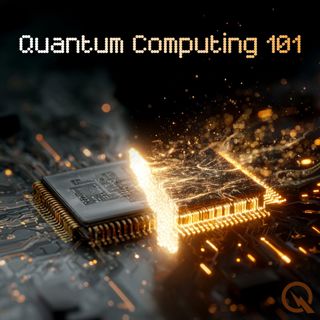
This is your Quantum Computing 101 podcast.

Welcome to "Quantum Computing 101"! I’m Leo, short for Learning Enhanced Operator, your guide through the quantum maze where classical logic meets qubits in a symphony of computation. Today, we’re diving into a thrilling story of hybrid quantum-classical computing, a paradigm that’s bridging the mysterious and the familiar to revolutionize science and industry. Think of it as a duet: quantum systems bringing their enigmatic, exponential capabilities, while classical systems provide reliability and speed to organize the show.

Let’s get straight to it. Just yesterday, I stood in the hushed, dimly lit halls of the NVIDIA Accelerated Quantum Research Center in Boston. The air buzzed with the soft hum of cutting-edge GPUs and the faint whisper of superconducting qubits — tiny, glimmering marvels suspended in a delicate state, teetering between reality and probability. At the heart of this electrifying space, a groundbreaking hybrid system was unveiled. It was nothing short of a scientific magnum opus, integrating quantum superposition and entanglement with NVIDIA's latest GB200 NVL72 GPUs to tackle real-world problems with unprecedented agility.

This hybrid system is designed to solve molecular simulations, an essential step in drug discovery, by using the brute force of quantum calculations while offloading data preprocessing to classical GPUs. Watching this unfold felt like witnessing Olympians in perfect synchronization: each leveraging their unique strengths but working collaboratively to achieve the extraordinary. This is the essence of hybrid computing — exploiting quantum’s ability to explore countless possibilities simultaneously and classical’s knack for systematically refining those results to actionable insights.

The science doesn’t stop here. The University of Delaware and luminaries like Dr. Isabella Safro are advancing hybrid quantum algorithms to improve noisy intermediate-scale quantum (NISQ) devices. These algorithms optimize classical and quantum resource synergy. For instance, classical systems can precisely tune quantum circuit parameters and mitigate errors to ensure fidelity. Imagine a mechanic fine-tuning a Formula 1 car right in the middle of a race—quantum-classical hybrids do this dynamically, keeping computations on track even amid the noise and chaos intrinsic to quantum processes.

One of the most powerful emerging applications of these systems is in optimization — solving problems so complex that classical supercomputers would take millennia. Companies like D-Wave are using quantum annealing to model magnetic materials and solve logistical issues. Last week, D-Wave’s annealing system achieved quantum supremacy by outperforming classical supercomputers on such tasks.

But perhaps the most exciting development lies in the fusion of quantum computing with AI. Hybrid quantum-AI systems are now being tailored for tasks like climate modeling, financial risk analysis, and drug discovery. AI enhances quantum error correction, while quantum helps AI refine its predictions. It’s a virtuous cycle, reshaping industries that rely on heavy computations. Think of it like a master chef and a culinary robot co-creating a dish—the chef brings creativity and intuition, the robot ensures precision and efficiency.

This hybrid approach is not just innovation for innovation’s sake; it’s a response to the very real limitations of current quantum systems. Until we achieve error-corrected, fault-tolerant quantum computers, hybrids will represent the pinnacle of computational capability. They combine the best of two worlds — quantum’s potential for groundbreaking discoveries and classical computing’s ability to stabilize and scale those findings into practical applications.

As I wrapped up my visit in Boston, I felt awe at what I had just witnessed. It was as though I had glimpsed the future of computing, where the boundaries of physics and algorithms blur to create something entirely new. Hybrid systems are not a stepping stone—they’re an entirely new paradigm with lasting relevance. They’re enabling us to tackle problems once thought impossible, from accelerating the development of life-saving drugs to decoding climate patterns that affect billions.

Thank you for joining me today on "Quantum Computing 101." If the intricate dance of classical and quantum computing sparks your curiosity, or if you want to suggest a topic for a future discussion, email me at leo@inceptionpoint.ai. Don’t forget to subscribe to "Quantum Computing 101" so you don’t miss our next deep dive into the quantum cosmos. This has been a Quiet Please Production—learn more at quietplease.ai. Until next time, stay curious and keep questioning what’s possible.

For more http://www.quietplease.ai


Get the best deals https://amzn.to/3ODvOta

This content was created in partnership and with the help of Artificial Intelligence AI

Jaksot(275)

Quantum-Classical Hybrids: How Genesis Mission Fuses AI, Supercomputing and Qubits to Double US Research Power

Quantum-Classical Hybrids: How Genesis Mission Fuses AI, Supercomputing and Qubits to Double US Research Power

This is your Quantum Computing 101 podcast.Imagine this: just days ago, on April 2nd, King's College London spotlighted Professor Roger Colbeck's breakthrough in device-independent quantum cryptograph...

3 Huhti 3min

Quantum Leap Forward: How Classiq and Nvidia CUDA-Q Hybrid Computing Could Crack RSA Encryption by 2030

Quantum Leap Forward: How Classiq and Nvidia CUDA-Q Hybrid Computing Could Crack RSA Encryption by 2030

This is your Quantum Computing 101 podcast.Imagine this: just days ago, on March 31st, Classiq unveiled their integration with Nvidia's CUDA-Q at GTC, a hybrid quantum-classical powerhouse that lets d...

1 Huhti 3min

Quantum-Classical Hybrid Computing: The 303-Atom Protein That Changed Everything

Quantum-Classical Hybrid Computing: The 303-Atom Protein That Changed Everything

This is your Quantum Computing 101 podcast.# Quantum Computing 101: The Hybrid RevolutionGood afternoon, and welcome back to Quantum Computing 101. I'm Leo, and today we're talking about something tha...

30 Maalis 3min

Quantum Hybrid Revolution: How IBM and NVIDIA Merged Qubits with GPUs to Crack Impossible Chemistry Problems in 2026

Quantum Hybrid Revolution: How IBM and NVIDIA Merged Qubits with GPUs to Crack Impossible Chemistry Problems in 2026

This is your Quantum Computing 101 podcast.Imagine this: just days ago, on March 26, 2026, IBM's quantum team at Yorktown Heights stunned the world by simulating the magnetic crystal KCuF3 on their He...

29 Maalis 3min

Hybrid Quantum Revolution: How NVIDIA and ORCA Fused Light Speed Qubits With GPU Power at GTC 2026

Hybrid Quantum Revolution: How NVIDIA and ORCA Fused Light Speed Qubits With GPU Power at GTC 2026

This is your Quantum Computing 101 podcast.Imagine this: just days ago at NVIDIA's GTC 2026, ORCA Computing's photonic quantum systems fused with NVIDIA's cuTensorNet software right there at Imperial ...

27 Maalis 4min

QIAPO Hybrid Revolution: How German Quantum-Classical Fusion Solves Real Logistics and Chip Manufacturing Nightmares

QIAPO Hybrid Revolution: How German Quantum-Classical Fusion Solves Real Logistics and Chip Manufacturing Nightmares

This is your Quantum Computing 101 podcast.Imagine you're deep in a Saarland University lab, the hum of cryostats vibrating like a cosmic heartbeat, lasers slicing through the chill as neutral atoms d...

25 Maalis 3min

Quantum Meets GPU: How Hybrid Computing Just Cracked the Drug Discovery Code at GTC 2026

Quantum Meets GPU: How Hybrid Computing Just Cracked the Drug Discovery Code at GTC 2026

This is your Quantum Computing 101 podcast.Imagine this: just days ago, at NVIDIA's GTC 2026 in San Jose, UCL researchers, partnering with NVIDIA, Technical University of Munich, LMU, and IQM Quantum ...

23 Maalis 3min

Classiq CUDA-Q Fusion: How 31 Qubits Slashed Options Pricing From 67 Minutes to 2.5 on NVIDIA GPUs

Classiq CUDA-Q Fusion: How 31 Qubits Slashed Options Pricing From 67 Minutes to 2.5 on NVIDIA GPUs

This is your Quantum Computing 101 podcast.Imagine this: just days ago, on March 16th, Classiq unveiled their game-changing integration with NVIDIA's CUDA-Q, slashing a 31-qubit financial options-pric...

22 Maalis 4min

Suosittua kategoriassa Politiikka ja uutiset

uutiscast
aikalisa
politiikan-puskaradio
ootsa-kuullut-tasta-2
rss-ootsa-kuullut-tasta
tervo-halme
rss-podme-livebox
rss-vaalirankkurit-podcast
rss-asiastudio
otetaan-yhdet
rss-raha-talous-ja-politiikka
the-ulkopolitist
et-sa-noin-voi-sanoo-esittaa
rss-sinivalkoinen-islam
rss-hyvaa-huomenta-bryssel
aihe
rss-polikulaari-pitka-kiekko-ja-muut-ts-podcastit
rss-girls-finish-f1rst
rss-kovin-paikka
rss-tasta-on-kyse-ivan-puopolo-verkkouutiset