
Rebuilding after apocalypse: What 13 experts say about bouncing back
80,000 Hours Podcast15 Heinä 2025

Rebuilding after apocalypse: What 13 experts say about bouncing back

What happens when civilisation faces its greatest tests?

This compilation brings together insights from researchers, defence experts, philosophers, and policymakers on humanity’s ability to survive and recover from catastrophic events. From nuclear winter and electromagnetic pulses to pandemics and climate disasters, we explore both the threats that could bring down modern civilisation and the practical solutions that could help us bounce back.

Learn more and see the full transcript: https://80k.info/cr25

Chapters:

  • Cold open (00:00:00)
  • Luisa’s intro (00:01:16)
  • Zach Weinersmith on how settling space won’t help with threats to civilisation anytime soon (unless AI gets crazy good) (00:03:12)
  • Luisa Rodriguez on what the world might look like after a global catastrophe (00:11:42)
  • Dave Denkenberger on the catastrophes that could cause global starvation (00:22:29)
  • Lewis Dartnell on how we could rediscover essential information if the worst happened (00:34:36)
  • Andy Weber on how people in US defence circles think about nuclear winter (00:39:24)
  • Toby Ord on risks to our atmosphere and whether climate change could really threaten civilisation (00:42:34)
  • Mark Lynas on how likely it is that climate change leads to civilisational collapse (00:54:27)
  • Lewis Dartnell on how we could recover without much coal or oil (01:02:17)
  • Kevin Esvelt on people who want to bring down civilisation — and how AI could help them succeed (01:08:41)
  • Toby Ord on whether rogue AI really could wipe us all out (01:19:50)
  • Joan Rohlfing on why we need to worry about more than just nuclear winter (01:25:06)
  • Annie Jacobsen on the effects of firestorms, rings of annihilation, and electromagnetic pulses from nuclear blasts (01:31:25)
  • Dave Denkenberger on disruptions to electricity and communications (01:44:43)
  • Luisa Rodriguez on how we might lose critical knowledge (01:53:01)
  • Kevin Esvelt on the pandemic scenarios that could bring down civilisation (01:57:32)
  • Andy Weber on tech to help with pandemics (02:15:45)
  • Christian Ruhl on why we need the equivalents of seatbelts and airbags to prevent nuclear war from threatening civilisation (02:24:54)
  • Mark Lynas on whether wide-scale famine would lead to civilisational collapse (02:37:58)
  • Dave Denkenberger on low-cost, low-tech solutions to make sure everyone is fed no matter what (02:49:02)
  • Athena Aktipis on whether society would go all Mad Max in the apocalypse (02:59:57)
  • Luisa Rodriguez on why she’s optimistic survivors wouldn’t turn on one another (03:08:02)
  • David Denkenberger on how resilient foods research overlaps with space technologies (03:16:08)
  • Zach Weinersmith on what we’d practically need to do to save a pocket of humanity in space (03:18:57)
  • Lewis Dartnell on changes we could make today to make us more resilient to potential catastrophes (03:40:45)
  • Christian Ruhl on thoughtful philanthropy to reduce the impact of catastrophes (03:46:40)
  • Toby Ord on whether civilisation could rebuild from a small surviving population (03:55:21)
  • Luisa Rodriguez on how fast populations might rebound (04:00:07)
  • David Denkenberger on the odds civilisation recovers even without much preparation (04:02:13)
  • Athena Aktipis on the best ways to prepare for a catastrophe, and keeping it fun (04:04:15)
  • Will MacAskill on the virtues of the potato (04:19:43)
  • Luisa’s outro (04:25:37)

Tell us what you thought! https://forms.gle/T2PHNQjwGj2dyCqV9

Content editing: Katy Moore and Milo McGuire
Audio engineering: Ben Cordell, Milo McGuire, Simon Monsour, and Dominic Armstrong
Music: Ben Cordell
Transcriptions and web: Katy Moore

Jaksot(318)

#179 Classic episode – Randy Nesse on why evolution left us so vulnerable to depression and anxiety

#179 Classic episode – Randy Nesse on why evolution left us so vulnerable to depression and anxiety

Mental health problems like depression and anxiety affect enormous numbers of people and severely interfere with their lives. By contrast, we don’t see similar levels of physical ill health in young p...

3 Helmi 2h 51min
Why 'Aligned AI' Would Still Kill Democracy | David Duvenaud, ex-Anthropic team lead

Why 'Aligned AI' Would Still Kill Democracy | David Duvenaud, ex-Anthropic team lead

Democracy might be a brief historical blip. That’s the unsettling thesis of a recent paper, which argues AI that can do all the work a human can do inevitably leads to the “gradual disempowerment” of ...

27 Tammi 2h 31min
#145 Classic episode – Christopher Brown on why slavery abolition wasn't inevitable

#145 Classic episode – Christopher Brown on why slavery abolition wasn't inevitable

In many ways, humanity seems to have become more humane and inclusive over time. While there’s still a lot of progress to be made, campaigns to give people of different genders, races, sexualities, et...

20 Tammi 2h 56min

#233 – James Smith on how to prevent a mirror life catastrophe

#233 – James Smith on how to prevent a mirror life catastrophe

When James Smith first heard about mirror bacteria, he was sceptical. But within two weeks, he’d dropped everything to work on it full time, considering it the worst biothreat that he’d seen described...

13 Tammi 2h 9min
#144 Classic episode – Athena Aktipis on why cancer is a fundamental universal phenomena

#144 Classic episode – Athena Aktipis on why cancer is a fundamental universal phenomena

What’s the opposite of cancer? If you answered “cure,” “antidote,” or “antivenom” — you’ve obviously been reading the antonym section at www.merriam-webster.com/thesaurus/cancer.But today’s guest Athe...

9 Tammi 3h 30min
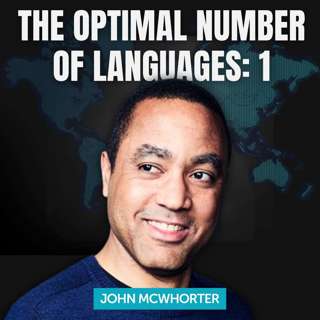
#142 Classic episode – John McWhorter on why the optimal number of languages might be one, and other provocative claims about language

#142 Classic episode – John McWhorter on why the optimal number of languages might be one, and other provocative claims about language

John McWhorter is a linguistics professor at Columbia University specialising in research on creole languages. He's also a content-producing machine, never afraid to give his frank opinion on anything...

6 Tammi 1h 35min

2025 Highlight-o-thon: Oops! All Bests

2025 Highlight-o-thon: Oops! All Bests

It’s that magical time of year once again — highlightapalooza! Stick around for one top bit from each episode we recorded this year, including:Kyle Fish explaining how Anthropic’s AI Claude descends i...

29 Joulu 20251h 40min

#232 – Andreas Mogensen on what we owe 'philosophical Vulcans' and unconscious beings

#232 – Andreas Mogensen on what we owe 'philosophical Vulcans' and unconscious beings

Most debates about the moral status of AI systems circle the same question: is there something that it feels like to be them? But what if that’s the wrong question to ask? Andreas Mogensen — a senior ...

19 Joulu 20252h 37min

Suosittua kategoriassa Koulutus

rss-murhan-anatomia
psykopodiaa-podcast
voi-hyvin-meditaatiot-2
rss-niinku-asia-on
kesken
rss-liian-kuuma-peruna
rss-narsisti
adhd-podi
psykologia
rss-duodecim-lehti
ihminen-tavattavissa-tommy-hellsten-instituutti
rss-psykalab
aamukahvilla
aloita-meditaatio
rss-honest-talk-with-laurrenna
rss-luonnollinen-synnytys-podcast
rss-tietoinen-yhteys-podcast-2
rahapuhetta
puhutaan-koiraa
rss-elamankoulu