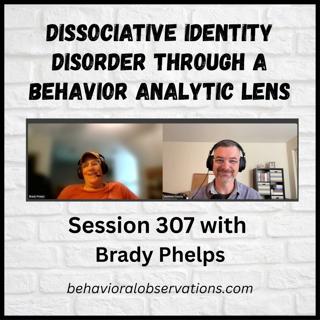
Dissociative Identity Disorder through a Behavior Analytic Lens: Session 307 with Brady Phelps

Dissociative Identity Disorder through a Behavior Analytic Lens: Session 307 with Brady Phelps

In this episode of the Behavioral Observations Podcast, I had the pleasure of speaking with Dr. Brady Phelps, about a topic that has perplexed, and perhaps captivated both mainstream Psychology as well as pop culture: Dissociative Identity Disorder (DID). Our wide-ranging conversation explored the intersection of behavior analysis, mental health, and trauma, with a special focus on how we can understand DID through a scientific, behavioral lens.

Brady's Career Journey

Brady shared how he discovered behavior analysis almost by accident as an undergrad at Utah State University, under the mentorship of Carl Cheney. After a long academic career, Brady retired in 2021 but remains actively involved in the field. He's currently developing an Experimental Analysis of Behavior (EAB) toolkit with Dr. Steve Eversole at Behavior Development Solutions, and he's also writing a textbook on learning and behavior designed to be accessible to 20-year-olds.

Understanding Dissociative Identity Disorder Behaviorally

We dove deep into Brady's research on DID, originally published in 2000. His goal was to approach DID from a behavior-analytic perspective, not through traditional psychoanalytic theory. As we discussed, DID has evolved from being characterized by dramatic behavioral shifts to more subtle, self-reported identity disruptions. Brady argued that the identities themselves are better understood as reified constructs—products of distorted tacting that contacts reinforcement—rather than discrete psychological entities.

Trauma, Dissociation, and Behavioral Function

Brady emphasized the importance of not dismissing trauma reports, while also cautioning against assuming trauma automatically leads to DID. We talked about avoidance behaviors, escape contingencies, and how dissociation might function as a response to overwhelming experiences. He brought up examples like Cotard's Syndrome to show how distorted tacting can manifest in extreme ways.

Rethinking Diagnostic Criteria for DID

We discussed research into amnesiac barriers, such as the Concealed Information Test, which shows people might learn something even if they claim not to remember it. These findings, Brady suggested, should prompt a re-evaluation of how DID is diagnosed, particularly the differences between the Post-Trauma Model and the Social-Cognitive Model—the latter of which emphasizes social reinforcement and therapist influence in shaping alternate identities.

Therapy Techniques and Reinforcement Contingencies

Brady detailed how some therapists use techniques like "roll calls" or even suggesting names to clients in session. While these methods may sound extreme, they reflect how therapist behavior can inadvertently reinforce identity fragmentation. We also discussed Robert Kohlenberg's 1973 study on behavioral repertoires, which demonstrated how social reinforcement shaped client behavior across different identity presentations.

The Sybil Case and Media Influence

We revisited the infamous Sybil case, which helped popularize DID in the 20th century. Despite being exposed as fraudulent, Sybil's story continues to shape public and clinical views of the disorder. We also talked about more recent media portrayals—from TikTok to a 2023 Scientific American article—and how social media can reinforce the performance of alternate identities, especially among vulnerable populations.

Behavior Analysis in Mental Health

Brady and I wrapped up with a discussion on how behavior analysts can contribute to mental health conversations. He encouraged new BCBAs to collaborate with non-behavioral colleagues while staying rooted in behavioral principles. Above all, he emphasized balancing empathy with scientific rigor—understanding people without falling into speculative mentalism.

Show Notes and Resources
  • Brady (2025). Dissociative Identity Disorder: An Analysis of the Behaviors and Contingencies
  • Brady (2000). Dissociative Identity Disorder: The Relevance of Behavior Analysis
  • Kohlenberg (1973). Behavioristic approach to multiple personality: A case study
  • Wakatama (2024). Court allows witness with dissociative identity disorder to give evidence in multiple personalities
  • Explore the EAB Toolkit at Behavior Development Solutions
  • Lester (2023). A New Therapy for Multiple Personality Disorder Helps a Woman with 12 Selves
  • Who was Sybil? The true story behind her multiple personalities
📢 Sponsor shoutouts:
  • Frontera. Consider taking a demo of Frontera's Assessment Builder and see how the ethical application of AI technologies can help you serve clients and save you time! Your first assessment report is free. And if you use code BOP25 you'll get an additional five assessments for just $100. So head to fronterahealth.com to check it out!
  • CEUs from Behavioral Observations. Learn from your favorite podcast guests while you're commuting, walking the dog, or whatever else you do while listening to podcasts. New events are being added all the time, so check them out here.
  • The Behavioral Toolbox. Check out our courses for school-based and other behavioral professionals, including our newest one, Motivational Interviewing: Getting Educator Buy-In.
  • The inaugural ABA CON CEU cruise, which launches on Royal Caribbean's Wonder of the Seas from February 16–20, 2026. Learn more about this cruise here

Jaksot(325)

Building Clinical Excellence in Autism Services: How Apollo Trains and Supports RBTs and BCBAs - Session 322

Building Clinical Excellence in Autism Services: How Apollo Trains and Supports RBTs and BCBAs - Session 322

In this episode of the Behavioral Observations Podcast, I'm joined by Kim Dean, founder of Apollo Behavior, and Kristen Vaughn, Vice President of Clinical Operations, to talk about what it really take...

30 Tammi 1h 1min

Entrenamiento de Habilidades Conductuales: BOP en Español 16 con Maria Sanchez

Entrenamiento de Habilidades Conductuales: BOP en Español 16 con Maria Sanchez

En este episodio, Miguel conversa con María Sánchez, una profesional con un impacto notable en la formación de analistas de conducta en España y Latinoamérica. La charla gira en torno al Behavioral Sk...

27 Tammi 43min

The Four Leadership Hats: Applying Behavioral Science to Leadership and Supervision — Session 321 with John Guercio

The Four Leadership Hats: Applying Behavioral Science to Leadership and Supervision — Session 321 with John Guercio

In this episode, I'm joined by John Guercio for a wide-ranging and practical conversation about leadership through a behavioral lens. John and I dig into what it actually means to lead in applied beha...

15 Tammi 1h 30min

The Importance of Hard and Soft Skills in ABA Practice: Session 320 with Tiffany Kodak and Landon Cowan

The Importance of Hard and Soft Skills in ABA Practice: Session 320 with Tiffany Kodak and Landon Cowan

In Session 320, I sit down with Landon Cowan and Tiffany Kodak to talk about an area of behavior analysis that doesn't get nearly enough attention: professional (or "soft") skills. We spend a lot of t...

7 Tammi 1h 14min

2025 Year in Review: Session 319 with ABA Inside Track

2025 Year in Review: Session 319 with ABA Inside Track

Don't adjust your podcast player folks, you have the right show. Welcome to Session 319 of the Behavioral Observations Podcast. If you've been listening for a bit, you know what's coming. If you're ne...

31 Joulu 20251h 14min

Smarter Study Strategies Using Cover, Copy, and Compare: Session 318 with Sarah Frampton

Smarter Study Strategies Using Cover, Copy, and Compare: Session 318 with Sarah Frampton

In this episode, I sit down with Dr. Sarah Frampton, who conducts research on, amongst other things, improving how we teach, learn, and organize information using behavior-analytic strategies. We expl...

10 Joulu 20251h 35min

Eye Contact and AI in ABA Treatment: Session 317 with Francesca degli Espinosa

Eye Contact and AI in ABA Treatment: Session 317 with Francesca degli Espinosa

In Session 317, I sit down with Dr. Francesca Delia Espinoza to revisit one of the most foundational—but often misunderstood—topics in behavior analysis: eye contact. We explore why eye contact should...

29 Marras 20251h 17min

Making ABA Research Matter: Practical Dissemination Strategies for Behavior Analytic Scholars, Inside JABA 25

Making ABA Research Matter: Practical Dissemination Strategies for Behavior Analytic Scholars, Inside JABA 25

Episode Overview In this special episode of the Behavioral Observations Podcast, I had the honor of celebrating the 25th installment of the Inside JABA Series. This one was particularly meaningful bec...

19 Marras 20251h 9min

Suosittua kategoriassa Tiede

rss-mita-tulisi-tietaa
tiedekulma-podcast
rss-poliisin-mieli
utelias-mieli
rss-lihavuudesta-podcast
rss-duodecim-lehti
rss-laakaripodi
rss-opeklubi
docemilia
sotataidon-ytimessa
hippokrateen-vastaanotolla
mielipaivakirja
rss-vaasan-yliopiston-podcastit
rss-mental-race
rss-ylistys-elaimille