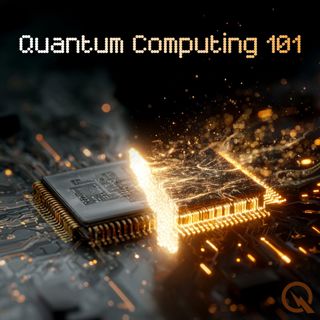
Quantum Leaps: IonQ, Oak Ridge Crack Power Grid Puzzle | Quantum Computing 101 with Leo

Quantum Leaps: IonQ, Oak Ridge Crack Power Grid Puzzle | Quantum Computing 101 with Leo

This is your Quantum Computing 101 podcast.

Picture this: It’s 2AM. The Mission Control screens at Oak Ridge National Lab spill a cold, electric glow across the faces of a joint team of quantum physicists and energy engineers. I’m Leo—the Learning Enhanced Operator—and as a quantum computing specialist, I’m not just watching history unfold. I’m helping architect it. This week, the quantum community was electrified by news from IonQ and Oak Ridge: our hybrid quantum-classical approach tackled one of the most stubborn puzzles in power grid optimization—the infamous Unit Commitment problem. And let me tell you, it’s a problem as tangled as a city’s rush-hour gridlock, but on the scale of an entire continent.

The challenge is simple to state and fiendishly hard to solve: Given dozens of generators, renewables, and fluctuating demand, when do you turn each plant on or off to minimize cost and waste? For decades, supercomputers have attacked this, but as we add more variables—think how solar and wind upend predictability—it swiftly outpaces classical brute force. Here’s where the recent hybrid solution makes its mark: Picture classical computers as project managers—relentless, logical, great with spreadsheets. But some pieces of the problem are like encrypted riddles that take forever to crack. That’s when the quantum computer, with its shimmering 36 trapped ions, steps in, exploring multiple possibilities simultaneously—a bit like letting light through a prism to reveal every possible color at once.

The IonQ system delegates routine computation to the classical side, which weeds through data, preps scenarios, and guides the search. Then, it hands the truly wicked subproblems—the combinatorial knots—to the quantum machine, where superposition and entanglement let us see viable solutions classical computers might never stumble upon. The process loops back: quantum inspiration, classical refinement, quantum acceleration, classical orchestration—until an optimal schedule snaps into place. Last night, we solved a 26-generator, 24-hour scheduling problem: something unmanageable for classical code alone. Suddenly, this isn’t theoretical promise anymore. It’s the pulse of real-world electrons, more efficiently routed, with less waste and lower bills as the tangible benefit.

This week hasn’t just been a win for IonQ either. D-Wave’s massive Advantage2 processor—4,400 qubits strong—debuted new quantum-AI toolkits that bring PyTorch deep learning together with quantum generative models. Europe’s JUPITER exascale supercomputer is already weaving these hybrid routines into its architecture. And Fujitsu announced development of a 10,000-qubit superconducting beast, foreshadowing the next leap in scale.

These quantum-classical hybrids are more than just collaborations; they mirror the world outside our labs. Think of the global power grid itself—a web of classical infrastructure now upgraded with quantum intelligence—just like today’s headlines, where human ingenuity and AI interlace to navigate uncertainty, crisis, and opportunity. To me, every live-wire problem is a chance for quantum insight.

Thanks for tuning in to Quantum Computing 101! If you have questions or burning topics for future episodes, just send an email to leo@inceptionpoint.ai. Don’t forget to subscribe, and visit quietplease.ai for more info. This has been a Quiet Please Production. Until next time, this is Leo, signing off at the intersection of superposition and reality.

For more http://www.quietplease.ai


Get the best deals https://amzn.to/3ODvOta

This content was created in partnership and with the help of Artificial Intelligence AI

Jaksot(276)

Quantum Meets AI: How PhysVEC Hybrid Systems Are Cracking Crypto and Fixing the Qubit Noise Problem

Quantum Meets AI: How PhysVEC Hybrid Systems Are Cracking Crypto and Fixing the Qubit Noise Problem

This is your Quantum Computing 101 podcast.Imagine this: just days ago, Google Quantum AI unleashed a bombshell whitepaper, revealing they can shatter 256-bit elliptic curve cryptography—the backbone ...

5 Huhti 3min

Quantum-Classical Hybrids: How Genesis Mission Fuses AI, Supercomputing and Qubits to Double US Research Power

Quantum-Classical Hybrids: How Genesis Mission Fuses AI, Supercomputing and Qubits to Double US Research Power

This is your Quantum Computing 101 podcast.Imagine this: just days ago, on April 2nd, King's College London spotlighted Professor Roger Colbeck's breakthrough in device-independent quantum cryptograph...

3 Huhti 3min

Quantum Leap Forward: How Classiq and Nvidia CUDA-Q Hybrid Computing Could Crack RSA Encryption by 2030

Quantum Leap Forward: How Classiq and Nvidia CUDA-Q Hybrid Computing Could Crack RSA Encryption by 2030

This is your Quantum Computing 101 podcast.Imagine this: just days ago, on March 31st, Classiq unveiled their integration with Nvidia's CUDA-Q at GTC, a hybrid quantum-classical powerhouse that lets d...

1 Huhti 3min

Quantum-Classical Hybrid Computing: The 303-Atom Protein That Changed Everything

Quantum-Classical Hybrid Computing: The 303-Atom Protein That Changed Everything

This is your Quantum Computing 101 podcast.# Quantum Computing 101: The Hybrid RevolutionGood afternoon, and welcome back to Quantum Computing 101. I'm Leo, and today we're talking about something tha...

30 Maalis 3min

Quantum Hybrid Revolution: How IBM and NVIDIA Merged Qubits with GPUs to Crack Impossible Chemistry Problems in 2026

Quantum Hybrid Revolution: How IBM and NVIDIA Merged Qubits with GPUs to Crack Impossible Chemistry Problems in 2026

This is your Quantum Computing 101 podcast.Imagine this: just days ago, on March 26, 2026, IBM's quantum team at Yorktown Heights stunned the world by simulating the magnetic crystal KCuF3 on their He...

29 Maalis 3min

Hybrid Quantum Revolution: How NVIDIA and ORCA Fused Light Speed Qubits With GPU Power at GTC 2026

Hybrid Quantum Revolution: How NVIDIA and ORCA Fused Light Speed Qubits With GPU Power at GTC 2026

This is your Quantum Computing 101 podcast.Imagine this: just days ago at NVIDIA's GTC 2026, ORCA Computing's photonic quantum systems fused with NVIDIA's cuTensorNet software right there at Imperial ...

27 Maalis 4min

QIAPO Hybrid Revolution: How German Quantum-Classical Fusion Solves Real Logistics and Chip Manufacturing Nightmares

QIAPO Hybrid Revolution: How German Quantum-Classical Fusion Solves Real Logistics and Chip Manufacturing Nightmares

This is your Quantum Computing 101 podcast.Imagine you're deep in a Saarland University lab, the hum of cryostats vibrating like a cosmic heartbeat, lasers slicing through the chill as neutral atoms d...

25 Maalis 3min

Quantum Meets GPU: How Hybrid Computing Just Cracked the Drug Discovery Code at GTC 2026

Quantum Meets GPU: How Hybrid Computing Just Cracked the Drug Discovery Code at GTC 2026

This is your Quantum Computing 101 podcast.Imagine this: just days ago, at NVIDIA's GTC 2026 in San Jose, UCL researchers, partnering with NVIDIA, Technical University of Munich, LMU, and IQM Quantum ...

23 Maalis 3min

Suosittua kategoriassa Politiikka ja uutiset

uutiscast
aikalisa
politiikan-puskaradio
ootsa-kuullut-tasta-2
rss-ootsa-kuullut-tasta
tervo-halme
rss-podme-livebox
rss-vaalirankkurit-podcast
rss-asiastudio
otetaan-yhdet
rss-raha-talous-ja-politiikka
the-ulkopolitist
et-sa-noin-voi-sanoo-esittaa
rss-sinivalkoinen-islam
rss-hyvaa-huomenta-bryssel
aihe
rss-polikulaari-pitka-kiekko-ja-muut-ts-podcastit
rss-girls-finish-f1rst
rss-kovin-paikka
rss-tasta-on-kyse-ivan-puopolo-verkkouutiset