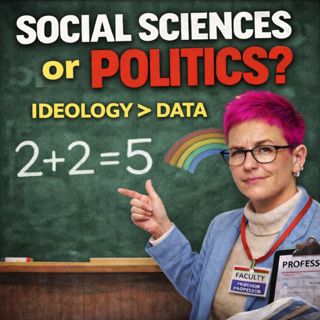

E181: Politics Is the Best Predictor of Academic Research — Prof Mark Horowitz
El Podcast27 Jan

E181: Politics Is the Best Predictor of Academic Research — Prof Mark Horowitz

Political beliefs often matter more than data or methods in shaping how social scientists think about controversial issues. In this episode, sociologist Dr. Mark Horowitz explains why many professors line up by politics on hot-button questions, drawing on moral psychology, groupthink inside universities, and the idea that some topics become treated as morally untouchable “sacred victims.”

Guest bio:

Dr. Mark Horowitz is a Professor of Sociology at Seton Hall University whose research uses large surveys of faculty to study political bias, motivated reasoning, and viewpoint diversity in the social sciences.

Topics discussed:
  • Why politics predicts social-science positions on controversial questions
  • Moral Foundations Theory (Jonathan Haidt): care/fairness vs. loyalty/authority/sanctity
  • “Bio-resistance” / discomfort with biological explanations in parts of the academy
  • Anthropology & sociology survey findings (e.g., plausibility of evolved sex differences; biology & STEM gaps)
  • “Sacred victims,” ingroup policing, and why some hypotheses become morally “off-limits”
  • Postmodernism vs. “postmodern vibes”: activist scholarship without explicit postmodern labels
  • Grievance studies hoax + “idea laundering” and how ideas move journal → curriculum → common sense
  • Tenure realities: how dissent can be managed without formal firing
  • Replication/reliability worries and what “fixes” might actually help: introspection + viewpoint diversity
Main points:
  • Humans reason with motivated cognition, and academics aren’t exempt—political identity often tracks judgments on contested claims.
  • Moral intuitions shape what feels plausible: some explanations trigger moral disgust (e.g., claims perceived as “naturalizing inequality”).
  • Fields with extreme ideological skew risk narrowing hypothesis space, intensifying policing, and losing public legitimacy.
  • The issue isn’t “one side evil”—it’s how moral communities become interpretive communities (and vice versa).
  • The best corrective mechanisms are viewpoint diversity, active engagement with opposing arguments, and self-awareness about bias.
Top 3 quotes:
  • Do you believe it because the evidence suggests it—or because it’s congenial to how you feel?
  • Interpretive communities become moral and emotional communities—and then disagreement feels morally wrong, not just empirically wrong.
  • The only way to minimize distortion is introspection plus viewpoint diversity—actively seeking ideas that unsettle us.

🎙 The Pod is hosted by Jesse Wright
💬 For guest suggestions, questions, or media inquiries, reach out at https://elpodcast.media/
📬 Never miss an episode – subscribe and follow wherever you get your podcasts.
⭐️ If you enjoyed this episode, please rate and review the show. It helps others find us.

Thanks for listening!

Episoder(186)

1 in 20 Deaths: Inside Canada’s Assisted Dying System - Dr. Ramona Coelho

1 in 20 Deaths: Inside Canada’s Assisted Dying System - Dr. Ramona Coelho

Canada’s MAiD program has expanded rapidly—Dr. Ramona Coelho argues the system increasingly serves vulnerable people, with uneven safeguards and serious ethical, legal, and social risks. Guest bio: Dr...

24 Feb 1h
The Eavesdropper Economy: How Surveillance Built AI (E186)

The Eavesdropper Economy: How Surveillance Built AI (E186)

A lively tour from Cold War “The Thing” to today’s surveillance capitalism—showing how audio capture, too much data, and automation pressures helped turn listening into AI.Guest bios:Dr. Toby Heys — P...

18 Feb 1h
Managerial Class Ruined Tech (E185) - Darryl Campbell

Managerial Class Ruined Tech (E185) - Darryl Campbell

A former Silicon Valley insider explains how MBA-style “spreadsheet management” is breaking software—and why it’s making tech, AI, and everyday products worse.Guest bio:Darryl Campbell is a former tec...

10 Feb 1h 13min
55% of MIT Faculty Self-Censor — Here’s Why (E184)

55% of MIT Faculty Self-Censor — Here’s Why (E184)

MIT Free Speech Alliance president Wayne Stargardt explains how a few high-profile cancellations can drive widespread faculty self-censorship—even at a STEM powerhouse like MIT.Guest bio:Wayne Stargar...

5 Feb 52min

E183: Why Corporate America Will Never De-Woke | Law Prof Explains

E183: Why Corporate America Will Never De-Woke | Law Prof Explains

In this episode, Jesse talks with Fordham University School of Law corporate-law professor Sean J. Griffith about why “go woke, go broke” hasn’t really played out—and why big, publicly traded firms ca...

3 Feb 59min
E180: Attraction & Disgust: Evolutionary Psychology Explained (Dr. Deb Lieberman)

E180: Attraction & Disgust: Evolutionary Psychology Explained (Dr. Deb Lieberman)

Evolutionary psychologist Debra Lieberman explains how “disgust” and other built-in mental programs shape attraction, kinship, morality, and even law—while modern technology and social media scramble ...

20 Jan 1h 3min

E179: Breaking the Gerontocracy: How Amanda Litman Is Getting Young People into Office

E179: Breaking the Gerontocracy: How Amanda Litman Is Getting Young People into Office

Amanda Litman argues U.S. leadership is too old, local races are dangerously uncontested, and the fastest fix is getting more young people to run—backed by better pay and campaign-finance reform.Guest...

16 Jan 50min

Populært innen Business og økonomi

stopp-verden
lydartikler-fra-aftenposten
dine-penger-pengeradet
e24-podden
rss-penger-polser-og-politikk
rss-borsmorgen-okonominyhetene
utbytte
pengepodden-2
pengesnakk
livet-pa-veien-med-jan-erik-larssen
rss-sunn-okonomi
morgenkaffen-med-finansavisen
tid-er-penger-en-podcast-med-peter-warren
okonomiamatorene
finansredaksjonen
lederpodden
liberal-halvtime
rss-markedspuls-2
rss-impressions-2
rss-andelige-tanker-med-camillo