#126 – Bryan Caplan on whether lazy parenting is OK, what really helps workers, and betting on beliefs

#126 – Bryan Caplan on whether lazy parenting is OK, what really helps workers, and betting on beliefs

Everybody knows that good parenting has a big impact on how kids turn out. Except that maybe they don't, because it doesn't.

Incredible though it might seem, according to today's guest — economist Bryan Caplan, the author of Selfish Reasons To Have More Kids, The Myth of the Rational Voter, and The Case Against Education — the best evidence we have on the question suggests that, within reason, what parents do has little impact on how their children's lives play out once they're adults.

Links to learn more, summary and full transcript.

Of course, kids do resemble their parents. But just as we probably can't say it was attentive parenting that gave me my mother's nose, perhaps we can't say it was attentive parenting that made me succeed at school. Both the social environment we grow up in and the genes we receive from our parents influence the person we become, and looking at a typical family we can't really distinguish the impact of one from the other.

But nature does offer us up a random experiment that can let us tell the difference: identical twins share all their genes, while fraternal twins only share half their genes. If you look at how much more similar outcomes are for identical twins than fraternal twins, you see the effect of sharing 100% of your genetic material, rather than the usual 50%. Double that amount, and you've got the full effect of genetic inheritance. Whatever unexplained variation remains is still up for grabs — and might be down to different experiences in the home, outside the home, or just random noise.

The crazy thing about this research is that it says for a range of adult outcomes (e.g. years of education, income, health, personality, and happiness), it's differences in the genes children inherit rather than differences in parental behaviour that are doing most of the work. Other research suggests that differences in “out-of-home environment” take second place. Parenting style does matter for something, but it comes in a clear third.

Bryan is quick to point out that there are several factors that help reconcile these findings with conventional wisdom about the importance of parenting.

First, for some adult outcomes, parenting was a big deal (i.e. the quality of the parent/child relationship) or at least a moderate deal (i.e. drug use, criminality, and religious/political identity).

Second, parents can and do influence you quite a lot — so long as you're young and still living with them. But as soon as you move out, the influence of their behaviour begins to wane and eventually becomes hard to spot.

Third, this research only studies variation in parenting behaviour that was common among the families studied.

And fourth, research on international adoptions shows they can cause massive improvements in health, income and other outcomes.

But the findings are still remarkable, and imply many hyper-diligent parents could live much less stressful lives without doing their kids any harm at all. In this extensive interview Rob interrogates whether Bryan can really be right, or whether the research he's drawing on has taken a wrong turn somewhere.

And that's just one topic we cover, some of the others being:

• People’s biggest misconceptions about the labour market
• Arguments against open borders
• Whether most people actually vote based on self-interest
• Whether philosophy should stick to common sense or depart from it radically
• Personal autonomy vs. the possible benefits of government regulation
• Bryan's perfect betting record
• And much more

Chapters:

  • Rob’s intro (00:00:00)
  • The interview begins (00:01:15)
  • Labor Econ Versus the World (00:04:55)
  • Open Borders (00:20:30)
  • How much parenting matters (00:35:49)
  • Self-Interested Voter Hypothesis (01:00:31)
  • Why Bryan and Rob disagree so much on philosophy (01:12:04)
  • Libertarian free will (01:25:10)
  • The effective altruism community (01:38:46)
  • Bryan’s betting record (01:48:19)
  • Individual autonomy vs. welfare (01:59:06)
  • Arrogant hedgehogs (02:10:43)

Producer: Keiran Harris
Audio mastering: Ben Cordell
Transcriptions: Katy Moore

Denne episoden er hentet fra en åpen RSS-feed og er ikke publisert av Podme. Den kan derfor inneholde annonser.

Episoder(364)

Luke Muehlhauser on the most important AI safety work nobody is doing

Luke Muehlhauser on the most important AI safety work nobody is doing

The US government spends 25 times more on military marching bands than on its AI safety institute. And that’s just one of the many institutions we’re missing as AI becomes more powerful and dangerous....

29 Okt 2h 36min
Why Silicon Valley can’t slow down AI on its own | Luisa Rodriguez

Why Silicon Valley can’t slow down AI on its own | Luisa Rodriguez

Two-thirds of Americans think AI is moving too fast. So do the people building it. So why the hell isn’t anyone slowing down?We can’t tell when models are too dangerous. We mostly don’t know how they ...

27 Okt 21min

Tom Milton on how we could verify a US–China deal on AI

Tom Milton on how we could verify a US–China deal on AI

If the US and China agreed to pause frontier AI training, how would either side confirm the other was complying? Today, Tom Milton argues, the most likely answer would be to shut down data centres ent...

23 Okt 1h 48min

AI lab staff: Has your project been overtaken by events? 8 strategic updates | Rob Wiblin

AI lab staff: Has your project been overtaken by events? 8 strategic updates | Rob Wiblin

I have a plea for all staff at AI companies: reassess if your current role is still your best opportunity for impact. And if it’s not — move.Frontier lab staff listening to this show will mostly alrea...

21 Okt 14min

Introducing our new YouTube channel: Zershaaneh Talks AI

Introducing our new YouTube channel: Zershaaneh Talks AI

Our host Zershaaneh Qureshi has just launched a new YouTube channel: Zershaaneh Talks AI — featuring conversations about who should control AI, how to control AI, and who gets the benefits.The first e...

20 Okt 1min

How to get into AI safety in 3 months (article reading by career advisor Matt Beard)

How to get into AI safety in 3 months (article reading by career advisor Matt Beard)

The AI safety field has grown by about 30x in the last eight years. Yet it is still in need of more people. Many want to help, but don’t know where to start. As an advisor at 80,000 Hours, Matt Beard ...

15 Okt 18min

OpenAI Security: Controlling Models is Now ‘Hell’ (AI Explained cross-post)

OpenAI Security: Controlling Models is Now ‘Hell’ (AI Explained cross-post)

This is an (unpaid) cross-post of a video from the podcast 'AI Explained', which Rob Wiblin thought you might be interested in.You can find the original on YouTube here. If you like it and want more s...

9 Okt 40min
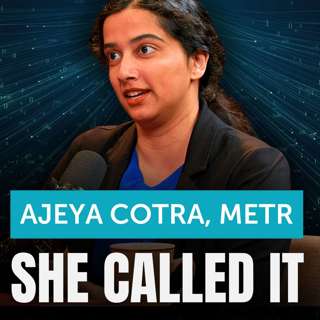
In 2023 Ajeya Cotra already knew what was coming (classic episode)

In 2023 Ajeya Cotra already knew what was coming (classic episode)

We're rereleasing some of older episodes that seem more relevant than ever with new rogue AI incidents now seemingly announced every day. Ajeya was one of three independent investigators into the Hugg...

8 Okt 2h 46min
Populært innen Fakta

fastlegen
dine-penger-pengeradet
fryktlos
relasjonspodden-med-dora-thorhallsdottir-kjersti-idem
foreldreradet
rss-strid
treningspodden
jakt-og-fiskepodden
rss-kunsten-a-leve
rss-bisarr-historie
sinnsyn
rss-ekteskapet
rss-orjasater
rss-kull
hverdagspsyken
mikkels-paskenotter
rss-kunstig-intelligens-med-elisabeth-maren-og-morten
gravid-uke-for-uke
rss-sarbar-med-lotte-erik
branncast