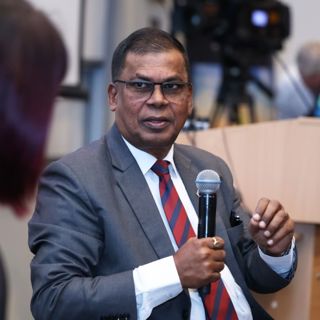

Fiji's economic future: a conversation with Deputy Prime Minister Biman Prasad
Devpolicy Talks13 Jun 2025

Fiji's economic future: a conversation with Deputy Prime Minister Biman Prasad

The episode opens with Deputy Prime Minister Biman Prasad reflecting on his transition from academia to politics. Born in Dreketi, Vanua Levu, in a rice farming area that benefited from Australian aid programs in the 1970s, Prasad rose through the academic ranks to become Professor of Economics and Dean of the Faculty of Business and Economics at the University of the South Pacific. He left academia in 2014 to lead the National Federation Party, entering politics during what he describes as a challenging period following the 2006 coup and years of military rule.

Prasad characterises the government that ruled from 2014 to 2022 as an "elective dictatorship," noting that despite elections being held, strict media censorship, restrictions on freedom of speech, and draconian laws carried over from the military regime created an undemocratic environment. His eight years in opposition taught him valuable lessons about the tension between good economics and good politics — a perspective he now applies as Finance Minister in Fiji's first coalition government in over 30 years.

The conversation explores Fiji's economic recovery from COVID-19, when the country experienced the fourth-largest economic contraction globally with GDP falling by almost 20%. While acknowledging IMF concerns about the pace of fiscal consolidation, Prasad defends the government's approach of balancing debt reduction with continued social spending. He highlights the decision to write off $650 million in student debt — replacing it with merit-based scholarships — as an example of necessary post-COVID support that the IMF might not fully appreciate.

Prasad outlines ambitious targets for Fiji's economic future, including becoming a high-income country by 2050, which would require sustained growth of 4-5% annually. The government has reduced the debt-to-GDP ratio from 90% to 78% since taking office and aims to bring it below 60% over the next 15 years. However, he emphasises that this must be achieved through economic growth rather than excessive spending cuts, which could be counterproductive.

A significant portion of the discussion focuses on regional integration, with Prasad articulating his vision for visa-free travel throughout the Pacific, including Australia and New Zealand. He argues this would represent Australia's "century in the Pacific," creating deeper unity and common purpose across the region. While acknowledging this cannot happen overnight, he points to recent improvements in visa processing times and growing support from Pacific leaders as evidence of progress.

The interview addresses current challenges including the 32% US tariff on Fijian exports — the highest in the Pacific — which particularly affects Fiji Water. Prasad expresses disappointment but remains optimistic about negotiations, while warning about the broader risks of global trade wars potentially affecting tourism and remittances if major economies slow down.

On climate finance, Prasad advocates for what he calls "decolonising climate finance", arguing that Pacific Island countries need urgent support for adaptation and loss and damage rather than just mitigation. He criticises the application of the same funding rules to small island states as to large countries like Indonesia or India, calling for recognition of the unique vulnerabilities and limited fiscal capacity of Pacific nations.

The episode also examines Fiji's complex relationship with development assistance. While the reduction in US aid presence is manageable given USAID had only recently re-established operations, Prasad sees the current global funding constraints as potentially beneficial, forcing African countries in particular to reduce aid dependence and take greater control of their health systems. He notes that Pacific countries, unlike many African nations, have largely avoided becoming overly dependent on external funding.

Throughout the conversation, Prasad emphasises the importance of technical education in addressing labour shortages, particularly in tourism. He acknowledges that many trained Fijians will migrate to Australia and New Zealand but sees this as part of a broader regional integration that benefits Fiji through remittances. The government is investing heavily in technical education infrastructure that was neglected by the previous administration.

The discussion concludes with Prasad's reflections on governance and democratic institutions. He notes with pride that the current coalition is the first in Fiji's 54-year history where a government has changed hands democratically and lasted more than a year. The immediate repeal of media restrictions, including the draconian Media Industry Development Act, and the restoration of academic freedom, represent fundamental changes. While acknowledging that "no government gets everything right", he believes they have established a solid foundation for democracy that augurs well for Fiji's future stability and prosperity.

Devpolicy Talks is the podcast of the Australian National University's Development Policy Centre.

Read and subscribe to our daily blogs at devpolicy.org.

Learn more about our research and join our public events at devpolicy.anu.edu.au.

Follow us on Twitter, Facebook, LinkedIn and Instagram for latest updates on our blogs, research and events.

You can send us feedback, and ideas for episodes too, to devpolicy@anu.edu.au.

Episoder(348)

Navigating China and the Global South: a conversation with Eric Olander

Navigating China and the Global South: a conversation with Eric Olander

Eric Olander, Editor-in-Chief of the China Global South Project, offers a nuanced perspective on China’s engagement with developing countries across Africa, Southeast Asia, Latin America and the Pacif...

15 Des 20251h 34min

Pacific democracy: global indices and lived realities

Pacific democracy: global indices and lived realities

This episode explores the state of democracy in the Pacific, focusing on a joint report by International IDEA and the Australia National University's Department of Pacific Affairs (DPA). The report, r...

6 Des 20251h 18min

Global public goods and the architecture of cooperation: a conversation with Inge Kaul

Global public goods and the architecture of cooperation: a conversation with Inge Kaul

Inge Kaul, pioneering development economist and architect of the global public goods framework, discusses her groundbreaking work on international cooperation and development financing in this 2015 in...

14 Nov 20252h 12min

Water, climate and adaptation: a conversation with Dr Aditi Mukherji

Water, climate and adaptation: a conversation with Dr Aditi Mukherji

Dr Aditi Mukherji, Principal Scientist at the International Livestock Research Institute and coordinating lead author of the Intergovernmental Panel on Climate Change's water chapter, discusses her ca...

1 Nov 202535min
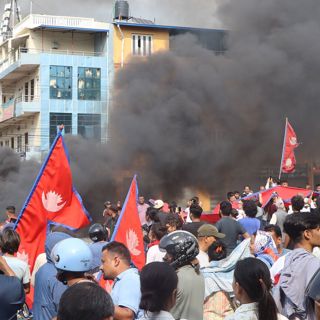
Youth uprisings: understanding the protests in Indonesia and Nepal

Youth uprisings: understanding the protests in Indonesia and Nepal

In August and September 2024, thousands of young people took to the streets across Southeast and South Asia in unprecedented displays of protest. This episode examines the youth-led demonstrations tha...

17 Okt 202546min
From Vanuatu's challenges to Melanesian cooperation: a conversation with Gregoire Nimbtik

From Vanuatu's challenges to Melanesian cooperation: a conversation with Gregoire Nimbtik

The conversation begins with Nimbtik's background as head of Vanuatu's Prime Minister's Department and Deputy Director General of the Melanesian Spearhead Group Secretariat. He provides context for un...

10 Okt 202535min

From serendipity to global impact: a conversation with Glenn Denning

From serendipity to global impact: a conversation with Glenn Denning

Glenn Denning, Professor of Practice at Columbia University's School of International and Public Affairs and founding Director of the Master of Public Administration in Development Practice program, r...

2 Sep 20251h 6min

The Pacific Engagement Visa: what you need to know about the 2025 ballot

The Pacific Engagement Visa: what you need to know about the 2025 ballot

The Pacific Engagement Visa offers a life-changing opportunity for up to 3,000 Pacific Islanders and Timorese citizens annually to gain permanent residency in Australia. In this episode, Development P...

13 Aug 202529min

Populært innen Politikk og nyheter

giver-og-gjengen-vg
aftenpodden
aftenpodden-usa
forklart
stopp-verden
i-retten
popradet
lydartikler-fra-aftenposten
rss-gukild-johaug
fotballpodden-2
det-store-bildet
dine-penger-pengeradet
nokon-ma-ga
rss-ness
hanna-de-heldige
aftenbla-bla
frokostshowet-pa-p5
rss-dannet-uten-piano
e24-podden
rss-penger-polser-og-politikk