World Benzodiazepine Awareness Day 2018 - Part 2 - Robert Whitaker

World Benzodiazepine Awareness Day 2018 - Part 2 - Robert Whitaker

This week on MIA Radio, we present a special episode of the podcast to join in the many events being held for World Benzodiazepine Awareness Day, July 11, 2018.

In part 2 of the podcast, we interview Mad in America founder, Robert Whitaker. For many of us, Robert needs no introduction as he is well known for his award-winning book, Anatomy of an Epidemic: Magic Bullets, Psychiatric Drugs, and the Astonishing Rise of Mental Illness in America, which was released in 2010.

Robert has been a medical writer at the Albany Times Union newspaper, A journalism fellow at the Massachusetts Institute of Technology and Director of publications at the Harvard Medical School. Besides many papers, journals and articles, Robert has written five books which include Mad In America: Bad Science, Bad Medicine, and The Enduring Mistreatment of the Mentally Ill in 2001, Anatomy of an Epidemic in 2010 and Psychiatry Under The Influence: Institutional Corruption, Social Injury, and Prescriptions for Reform published in 2015.

We discuss:
  • What took Bob from writing as an industry insider covering clinical trials to founding Mad in America.
  • How writing a story about the botched introduction of laparoscopic surgery led to an interest in how commerce was corrupting healthcare.
  • How Freedom of Information requests led to an understanding of the corruption in the clinical trials of antipsychotic drugs.
  • What led to writing the book Mad in America: Bad Science, Bad Medicine, and The Enduring Mistreatment of the Mentally Ill in 2001.
  • That, when you look at the science, you see an enduring theme in psychiatry of treatments that are full of promise, but ultimately can lead to harm.
  • That Bob came to these issues as a journalist who felt a sense of public duty to be an honest reporter of the facts and the science.
  • The extraordinary history behind the revival of the market for benzodiazepines.
  • How Valium became the western world's most prescribed psychiatric drug during the late 1960s.
  • How, in the 1970s, it became apparent that people were struggling to get off the drugs.
  • That women's magazines started to write about the experiences of women addicted to Valium, and it was recognised as a bigger issue than heroin addiction.
  • That the reaction by the pharmaceutical manufacturers was to reconceptualize anxiety-related distress as depressive distress and move patients on to SSRIs.
  • How in 1980, in the third version of the Diagnostic and Statistical Manual, a new disorder is named: Panic Disorder, leading the maker of Alprazolam, Upjohn, to get it approved specifically for the treatment of panic disorder.
  • How the study published showed that the reduction in panic attacks in the medicated group over four weeks was greater than the unmedicated group, but the study actually ran for eight weeks, by which time there was no difference between the medicated and unmedicated groups.
  • That in the six-week withdrawal phase of the study, 44% were not able to stop the drugs.
  • How newspapers reported that Xanax (Alprazolam) was an efficacious, safe and non-addictive treatment for panic disorder.
  • That what you see in the heart of the Xanax story is a betrayal of the public.
  • The reasons why doctors often don't review the papers that would lead them to conclude that benzodiazepines are highly problematic drugs.
  • A paper from a new International Task Force on Benzodiazepines which seems to be a statement of intent to increase benzodiazepine prescribing.
  • That people should keep on telling their stories of withdrawal and iatrogenic harm.
  • The attempt in Massachusetts to pass a bill requiring informed consent.
  • The problems inherent in using the language of withdrawal when the symptoms are protracted and that it would be more appropriate to describe this as a neurological injury.
  • That the benzodiazepine community is doing an incredible service by alerting the public to what should be seen as a public health crisis.
Relevant links:

Revival of the market for Benzodiazepines

Malcolm Lader: It is more difficult to withdraw people from benzodiazepines than it is from heroin

International Task Force on Benzodiazepines

Episoder(290)

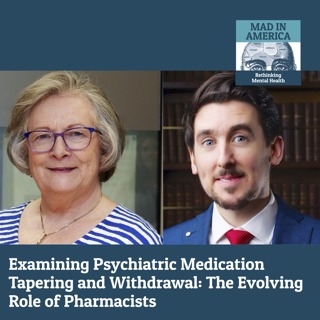
Examining Psychiatric Medication Tapering and Withdrawal: The Evolving Role of Pharmacists — A Conversation with Agnes Higgins and Cathal Cadogan

Examining Psychiatric Medication Tapering and Withdrawal: The Evolving Role of Pharmacists — A Conversation with Agnes Higgins and Cathal Cadogan

Welcome to the Mad in America podcast, my name is James. Today, we are discussing the experiences of people who have attempted to stop taking psychiatric drugs. These experiences are captured in a sur...

1 Apr 32min
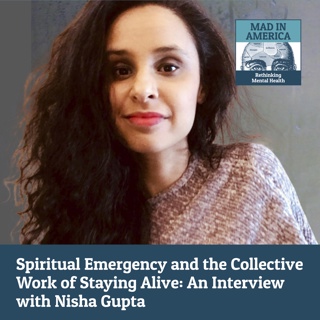
Spiritual Emergency and the Collective Work of Staying Alive: An Interview with Nisha Gupta

Spiritual Emergency and the Collective Work of Staying Alive: An Interview with Nisha Gupta

Nisha Gupta is an existential phenomenologist, a depth psychotherapist, a creativity scholar, and an artist. She's an Associate Professor of Psychology at the University of West Georgia and earned her...

25 Mar 48min

The Political Systems Driving Abuse in Psychiatry: An Interview with Human Rights Lawyer Alicia Ely Yamin

The Political Systems Driving Abuse in Psychiatry: An Interview with Human Rights Lawyer Alicia Ely Yamin

Alicia Ely Yamin is the Director of the Global Health and Rights Project and a lecturer at Harvard Law School. She's also an adjunct senior lecturer on health policy and management at the Harvard T.H....

18 Mar 45min
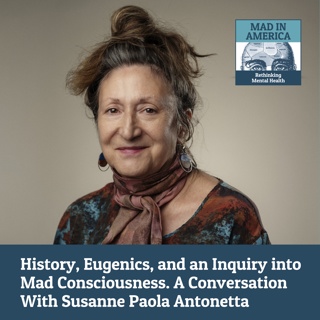
History, Eugenics, and an Inquiry into Mad Consciousness: A Conversation With Susanne Paola Antonetta

History, Eugenics, and an Inquiry into Mad Consciousness: A Conversation With Susanne Paola Antonetta

Susanne Paola Antonetta is an accomplished writer and poet, the author of numerous books, and in 2001 her book Body Toxic: An Environmental Memoir, won a prestigious American Book Award. Her latest bo...

11 Mar 49min
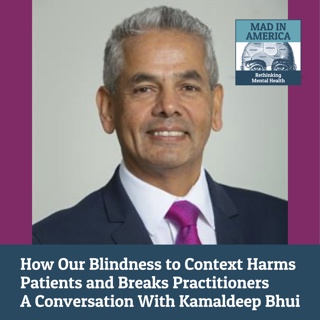
How Our Blindness to Context Harms Patients and Breaks Practitioners: A Conversation With Kamaldeep Bhui

How Our Blindness to Context Harms Patients and Breaks Practitioners: A Conversation With Kamaldeep Bhui

Kamaldeep Bhui is Professor of Psychiatry at the University of Oxford and Honorary Professor at Queen Mary University of London. He is internationally recognized for his groundbreaking work on cultura...

4 Mar 51min
UberTherapy and the Enshittification of our Relational Lives: Part 2 of our Interview with Elizabeth Cotton

UberTherapy and the Enshittification of our Relational Lives: Part 2 of our Interview with Elizabeth Cotton

Elizabeth Cotton is Associate Professor of Responsible Business at the University of Leicester and the founder of Surviving Work, which carries out socially engaged research on mental health and work....

18 Feb 39min
UberTherapy and the Enshittification of our Relational Lives: Part 1 of our Interview with Elizabeth Cotton

UberTherapy and the Enshittification of our Relational Lives: Part 1 of our Interview with Elizabeth Cotton

Elizabeth Cotton is Associate Professor of Responsible Business at the University of Leicester and the founder of Surviving Work, which carries out socially engaged research on mental health and work....

11 Feb 46min
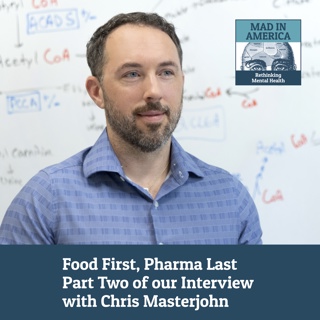
Food First, Pharma Last - Part Two of our Interview with Chris Masterjohn

Food First, Pharma Last - Part Two of our Interview with Chris Masterjohn

This week, we are joined by Chris Masterjohn, PhD. Chris is a nutritional scientist, a former professor, and the founder of Mitome. With a PhD in nutritional science and years of research in mitochond...

28 Jan 44min

Populært innen Helse

lydartikler-fra-aftenposten
fastlegen
hvordan-har-du-det-mann
rss-gukild-johaug
psykodrama
leger-om-livet
relasjonspodden-med-dora-thorhallsdottir-kjersti-idem
rss-garne-damer
foreldreradet
rss-lopedrommen
morten-ramm-lar-kakla-ga-til-du-sovner
hjernesterk
bak-fasaden-en-reise-i-livet-med-sykepleier-ine
klimaks
g-punktet
treningsprat
sinnsyn
helsetipspodden
rss-kull
rss-kunsten-a-leve