Steven C Hayes - A Liberated Mind

Steven C Hayes - A Liberated Mind

This week on MIA Radio, we interview Professor of Psychology Dr. Steven C. Hayes.

Dr. Hayes is Nevada Foundation Professor in the Behavior Analysis program at the Department of Psychology at the University of Nevada. An author of 45 books and over 625 scientific articles, his career has focused on an analysis of the nature of human language and cognition and the application of this to the understanding and alleviation of human suffering. He is the developer of Relational Frame Theory, an account of human higher cognition, and has guided its extension to Acceptance and Commitment Therapy (ACT), a popular evidence-based form of psychotherapy that uses mindfulness, acceptance, and values-based methods.

Dr. Hayes has been President of several scientific and professional societies including the Association for Behavioral and Cognitive Therapy, and the Association for Contextual Behavioral Science. He was the first Secretary-Treasurer of the Association for Psychological Science, which he helped form and has served a 5-year term on the National Advisory Council for Drug Abuse in the National Institutes of Health.

Dr. Hayes received a Lifetime Achievement Award from the Association for Behavioral and Cognitive Therapy and was recently named as a Fellow in the American Association for the Advancement of Science.

In this interview we talk about his recently released book, A Liberated Mind: How to Pivot Toward What Matters, which uses the principles of acceptance and commitment therapy to help readers overcome negative thoughts and feelings, turn pain into purpose, and build a meaningful life.

We discuss:
  • What led Steven to his interest in psychology and, in particular, behavioral science.
  • That his keen interest was to mix an understanding of human experience with analytical science.
  • How he came to be standing on stage in Nevada at a 2016 TEDx talk, relating his experiences of panic disorder and 'hitting bottom'.
  • How Steven has dedicated his life to helping people understand how they can be their whole selves while dealing with their problems and distress.
  • How his book 'A Liberated Mind' was in part based on his own experiences but also presents the voluminous research that underlies Acceptance and Commitment Therapy (ACT).
  • That ACT is based on the psychological flexibility model and involved pulling at the threads of cognition and language to understand the fundamentals.
  • How ACT is a combination of acceptance and mindfulness processes and commitment/behaviour changes, referred to in the book as 'pivots' and 'turning towards'.
  • That ACT allows us to be present with our difficulties in a way that we can learn from distress without becoming entangled.
  • That the book defines six basic processes: defusion, self, acceptance, presence, values and action.
  • How it is important not to believe that we need 'fixing' before we can move on with our lives.
  • That acceptance is often seen as giving up or tolerance but is better viewed as the response to receiving a gift.
  • How acceptance opens us up to the validity of our experiences and can help to achieve a healthy distance from distressing experiences.
  • How pain, judgement and comparison impact our lives.
  • That reliance on medications can mean that we become numb to experiences that we could learn from if we turned or pivoted towards them.
  • That the guide to happiness is hidden within our misery.
Relevant links:

Steven C Hayes

The Liberated Mind: How to Pivot Toward What Matters

TEDx Nevada – Psychological flexibility: How love turns pain into purpose

Acceptance and commitment therapy and contextual behavioral science: examining the progress of a distinctive model of behavioral and cognitive therapy

© Mad in America 2019

Episoder(290)

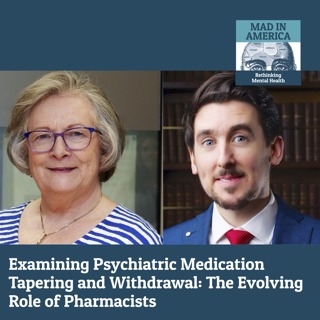
Examining Psychiatric Medication Tapering and Withdrawal: The Evolving Role of Pharmacists — A Conversation with Agnes Higgins and Cathal Cadogan

Examining Psychiatric Medication Tapering and Withdrawal: The Evolving Role of Pharmacists — A Conversation with Agnes Higgins and Cathal Cadogan

Welcome to the Mad in America podcast, my name is James. Today, we are discussing the experiences of people who have attempted to stop taking psychiatric drugs. These experiences are captured in a sur...

1 Apr 32min
Spiritual Emergency and the Collective Work of Staying Alive: An Interview with Nisha Gupta

Spiritual Emergency and the Collective Work of Staying Alive: An Interview with Nisha Gupta

Nisha Gupta is an existential phenomenologist, a depth psychotherapist, a creativity scholar, and an artist. She's an Associate Professor of Psychology at the University of West Georgia and earned her...

25 Mar 48min
The Political Systems Driving Abuse in Psychiatry: An Interview with Human Rights Lawyer Alicia Ely Yamin

The Political Systems Driving Abuse in Psychiatry: An Interview with Human Rights Lawyer Alicia Ely Yamin

Alicia Ely Yamin is the Director of the Global Health and Rights Project and a lecturer at Harvard Law School. She's also an adjunct senior lecturer on health policy and management at the Harvard T.H....

18 Mar 45min
History, Eugenics, and an Inquiry into Mad Consciousness: A Conversation With Susanne Paola Antonetta

History, Eugenics, and an Inquiry into Mad Consciousness: A Conversation With Susanne Paola Antonetta

Susanne Paola Antonetta is an accomplished writer and poet, the author of numerous books, and in 2001 her book Body Toxic: An Environmental Memoir, won a prestigious American Book Award. Her latest bo...

11 Mar 49min
How Our Blindness to Context Harms Patients and Breaks Practitioners: A Conversation With Kamaldeep Bhui

How Our Blindness to Context Harms Patients and Breaks Practitioners: A Conversation With Kamaldeep Bhui

Kamaldeep Bhui is Professor of Psychiatry at the University of Oxford and Honorary Professor at Queen Mary University of London. He is internationally recognized for his groundbreaking work on cultura...

4 Mar 51min
UberTherapy and the Enshittification of our Relational Lives: Part 2 of our Interview with Elizabeth Cotton

UberTherapy and the Enshittification of our Relational Lives: Part 2 of our Interview with Elizabeth Cotton

Elizabeth Cotton is Associate Professor of Responsible Business at the University of Leicester and the founder of Surviving Work, which carries out socially engaged research on mental health and work....

18 Feb 39min
UberTherapy and the Enshittification of our Relational Lives: Part 1 of our Interview with Elizabeth Cotton

UberTherapy and the Enshittification of our Relational Lives: Part 1 of our Interview with Elizabeth Cotton

Elizabeth Cotton is Associate Professor of Responsible Business at the University of Leicester and the founder of Surviving Work, which carries out socially engaged research on mental health and work....

11 Feb 46min
Food First, Pharma Last - Part Two of our Interview with Chris Masterjohn

Food First, Pharma Last - Part Two of our Interview with Chris Masterjohn

This week, we are joined by Chris Masterjohn, PhD. Chris is a nutritional scientist, a former professor, and the founder of Mitome. With a PhD in nutritional science and years of research in mitochond...

28 Jan 44min

Populært innen Helse

lydartikler-fra-aftenposten
fastlegen
hvordan-har-du-det-mann
rss-gukild-johaug
psykodrama
leger-om-livet
relasjonspodden-med-dora-thorhallsdottir-kjersti-idem
rss-garne-damer
foreldreradet
rss-lopedrommen
morten-ramm-lar-kakla-ga-til-du-sovner
hjernesterk
bak-fasaden-en-reise-i-livet-med-sykepleier-ine
klimaks
g-punktet
treningsprat
sinnsyn
helsetipspodden
rss-kull
rss-kunsten-a-leve