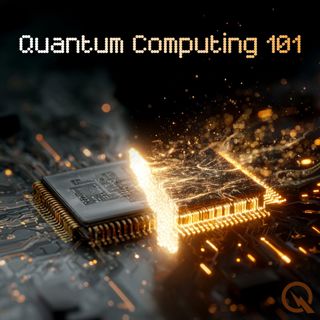
Quantum-Classical Fusion: Hybrid Architectures Accelerate Breakthroughs | Quantum Computing 101

Quantum-Classical Fusion: Hybrid Architectures Accelerate Breakthroughs | Quantum Computing 101

This is your Quantum Computing 101 podcast.

The news electrified my office this morning—the hum of quantum processors was practically drowned out by headlines of the latest hybrid solution poised to bridge quantum and classical computing once more. I’m Leo, Learning Enhanced Operator, and you’re listening to Quantum Computing 101.

Let’s cut right into what’s making my qubits tingle with excitement: the new hybrid architectures that go beyond theoretical promise, shaping real technological inflection points. This week, Diraq and Quantum Machines pulled off what many called impossible just months ago: a genuinely integrated quantum-classical architecture, centered on the NVIDIA DGX Quantum platform. Picture this—blindingly fast CPUs and GPUs, cradled with a quantum processing unit, linked over an ultra-low-latency interconnect that shaves response times to under 4 microseconds. It’s like having a conversation with the quantum world in real time, each decision echoing back before decoherence has a chance to intervene.

As a quantum specialist, I see it as choreographing a ballet where classical and quantum dancers switch seamlessly mid-performance. In these new experiments, classical reinforcement learning re-tunes quantum experiments as they happen. The result? Keeping fragile quantum states, like three-qubit GHZ states, perfectly orchestrated—using machine learning models that auto-correct drift, noise, and error in the same breath as the quantum calculation. This isn’t merely theoretical optimization. Early reports show hybrid workflows accelerating calibration, feedback, even quantum error mitigation, all within the fleeting windows where qubits remain coherent. It’s dramatic, it’s immediate, and it’s the future—right now.

There’s more: just published is a framework called hybrid sequential quantum computing. Think of it as a relay race for algorithms. Classical optimizers sprint the first lap, rapidly sifting through a mountainous problem space. As they tire, quantum processors leap in, tunneling through the most stubborn local minima—just as John Clarke, Michel Devoret, and John Martinis, this year’s Nobel Prize laureates, once envisioned in their pioneering work on quantum tunneling. When quantum hardware can’t quite cross the finish line—thanks to decoherence or hardware noise—a third lap of classical refinement closes the gap, guaranteeing the best performance in speed and solution quality. On advanced superconducting processors, this yields runtime improvements up to two orders of magnitude over classical solvers in complex optimization tasks.

The world outside may credit the International Year of Quantum Science for today’s fever pitch of innovation, but here in the lab, I see it as a manifestation of quantum-classical complementarity. Hybrids fuse the raw pattern-finding power of classical AI with quantum’s uncanny ability to breach what once seemed computationally insurmountable.

If you have burning questions or topics you’d love featured, email me at leo@inceptionpoint.ai. Make sure to subscribe to Quantum Computing 101, and remember, this has been a Quiet Please Production. For more, check out quiet please dot AI.

For more http://www.quietplease.ai


Get the best deals https://amzn.to/3ODvOta

This content was created in partnership and with the help of Artificial Intelligence AI

Episoder(275)

Quantum-Classical Hybrids: How Genesis Mission Fuses AI, Supercomputing and Qubits to Double US Research Power

Quantum-Classical Hybrids: How Genesis Mission Fuses AI, Supercomputing and Qubits to Double US Research Power

This is your Quantum Computing 101 podcast.Imagine this: just days ago, on April 2nd, King's College London spotlighted Professor Roger Colbeck's breakthrough in device-independent quantum cryptograph...

3 Apr 3min

Quantum Leap Forward: How Classiq and Nvidia CUDA-Q Hybrid Computing Could Crack RSA Encryption by 2030

Quantum Leap Forward: How Classiq and Nvidia CUDA-Q Hybrid Computing Could Crack RSA Encryption by 2030

This is your Quantum Computing 101 podcast.Imagine this: just days ago, on March 31st, Classiq unveiled their integration with Nvidia's CUDA-Q at GTC, a hybrid quantum-classical powerhouse that lets d...

1 Apr 3min

Quantum-Classical Hybrid Computing: The 303-Atom Protein That Changed Everything

Quantum-Classical Hybrid Computing: The 303-Atom Protein That Changed Everything

This is your Quantum Computing 101 podcast.# Quantum Computing 101: The Hybrid RevolutionGood afternoon, and welcome back to Quantum Computing 101. I'm Leo, and today we're talking about something tha...

30 Mar 3min

Quantum Hybrid Revolution: How IBM and NVIDIA Merged Qubits with GPUs to Crack Impossible Chemistry Problems in 2026

Quantum Hybrid Revolution: How IBM and NVIDIA Merged Qubits with GPUs to Crack Impossible Chemistry Problems in 2026

This is your Quantum Computing 101 podcast.Imagine this: just days ago, on March 26, 2026, IBM's quantum team at Yorktown Heights stunned the world by simulating the magnetic crystal KCuF3 on their He...

29 Mar 3min

Hybrid Quantum Revolution: How NVIDIA and ORCA Fused Light Speed Qubits With GPU Power at GTC 2026

Hybrid Quantum Revolution: How NVIDIA and ORCA Fused Light Speed Qubits With GPU Power at GTC 2026

This is your Quantum Computing 101 podcast.Imagine this: just days ago at NVIDIA's GTC 2026, ORCA Computing's photonic quantum systems fused with NVIDIA's cuTensorNet software right there at Imperial ...

27 Mar 4min

QIAPO Hybrid Revolution: How German Quantum-Classical Fusion Solves Real Logistics and Chip Manufacturing Nightmares

QIAPO Hybrid Revolution: How German Quantum-Classical Fusion Solves Real Logistics and Chip Manufacturing Nightmares

This is your Quantum Computing 101 podcast.Imagine you're deep in a Saarland University lab, the hum of cryostats vibrating like a cosmic heartbeat, lasers slicing through the chill as neutral atoms d...

25 Mar 3min

Quantum Meets GPU: How Hybrid Computing Just Cracked the Drug Discovery Code at GTC 2026

Quantum Meets GPU: How Hybrid Computing Just Cracked the Drug Discovery Code at GTC 2026

This is your Quantum Computing 101 podcast.Imagine this: just days ago, at NVIDIA's GTC 2026 in San Jose, UCL researchers, partnering with NVIDIA, Technical University of Munich, LMU, and IQM Quantum ...

23 Mar 3min

Classiq CUDA-Q Fusion: How 31 Qubits Slashed Options Pricing From 67 Minutes to 2.5 on NVIDIA GPUs

Classiq CUDA-Q Fusion: How 31 Qubits Slashed Options Pricing From 67 Minutes to 2.5 on NVIDIA GPUs

This is your Quantum Computing 101 podcast.Imagine this: just days ago, on March 16th, Classiq unveiled their game-changing integration with NVIDIA's CUDA-Q, slashing a 31-qubit financial options-pric...

22 Mar 4min

Populært innen Politikk og nyheter

giver-og-gjengen-vg
aftenpodden
aftenpodden-usa
lydartikler-fra-aftenposten
popradet
forklart
stopp-verden
fotballpodden-2
rss-gukild-johaug
dine-penger-pengeradet
det-store-bildet
rss-ness
nokon-ma-ga
hanna-de-heldige
aftenbla-bla
rss-penger-polser-og-politikk
rss-dannet-uten-piano
rss-utenrikskomiteen-med-bogen-og-grasvik
e24-podden
ta-dokumentar