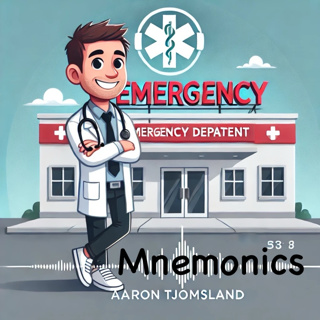
H’s and T’s mnemonic: OKTV, THROW TEN TOXIC TAMPONS

H’s and T’s mnemonic: OKTV, THROW TEN TOXIC TAMPONS

The “H’s and T’s” refer to a mnemonic used in medicine to help healthcare professionals quickly recall the most common causes of cardiac arrest during a code (a medical emergency requiring CPR). Memorizing these is crucial because identifying and addressing these causes rapidly can improve the chances of saving a patient’s life.

Here’s a breakdown:


The H’s: OK TV


Hypoxia - Lack of oxygen to tissues can lead to a heart stopping, so ensuring proper oxygenation is key.


Hypo-/Hyperkalemia - Abnormal potassium levels affect the heart’s electrical activity, potentially causing it to stop.


Hypothermia - Low body temperature can slow heart function and lead to cardiac arrest.


Hypovolemia - Loss of blood or fluids can lead to insufficient circulation and cardiac arrest.


Hydrogen ion (acidosis) - A build-up of acid in the blood (often due to respiratory failure or shock) can disrupt heart function.


The T’s: THROW TEN TOXIC TAMPONS


Thrombosis (pulmonary or coronary) - Blood clots in the lungs (pulmonary embolism) or heart (myocardial infarction) can obstruct blood flow, leading to cardiac arrest.


Tension Pneumothorax - Air trapped in the chest cavity compresses the heart and lungs, affecting circulation.


Toxins - Certain substances (medications, drugs, poisons) can disrupt heart rhythms.


Tamponade (cardiac) - Accumulation of fluid around the heart prevents it from pumping effectively.


Importance of Memorizing the H’s and T’s:


These causes cover many reversible conditions that may lead to cardiac arrest. During a code, time is critical, so having these potential causes at the top of your mind helps quickly assess and treat the patient. Remembering the “H’s and T’s” mnemonic ensures that a healthcare provider methodically works through possible causes and provides the best chance of resuscitation.

Episoder(63)

Sick-Tachy or Tachy-sick: S.T.O.P. Secondary Compensations (Must-consider Differentials)

Sick-Tachy or Tachy-sick: S.T.O.P. Secondary Compensations (Must-consider Differentials)

When the heart rate blasts past 150, our reflex is often to grab a syringe—diltiazem, metoprolol, something to slow things down. But here’s the hard truth: if the patient is in sick-tachy—tachycardia ...

11 Sep 202540min

6 S’s & 6 H’s Heart Score: Chest Pain & Diamond Classification Risk Stratification

6 S’s & 6 H’s Heart Score: Chest Pain & Diamond Classification Risk Stratification

Chest pain is one of the most common—and highest risk—complaints in the ED. Missing acute coronary syndrome can be catastrophic, but keeping every patient in the hospital isn’t realistic either. That’...

11 Sep 202539min

STEMI ischemic and reciprocal change patterns

STEMI ischemic and reciprocal change patterns

In a cardiac emergency, pattern recognition saves lives. The ability to rapidly identify ST-elevation myocardial infarctions (STEMIs) — and recognize their reciprocal changes — is one of the most high...

5 Sep 202554min

LBBB Sgarbossa Criteria: 1 Excessive Disc, 2 Concordance Contact Lenses

LBBB Sgarbossa Criteria: 1 Excessive Disc, 2 Concordance Contact Lenses

When a left bundle branch block (LBBB) throws a wrench into your ECG interpretation, how do you know if it’s a STEMI… or just baseline noise?In this unforgettable episode, we ride full throttle into t...

3 Sep 202541min

EKG Basic Basic Basic Framework for EM Docs: Ischemia, Arrhythmias, Intervals, Anomalies

EKG Basic Basic Basic Framework for EM Docs: Ischemia, Arrhythmias, Intervals, Anomalies

This is the most basic, essential framework for EKG interpretation — built for emergency medicine clinicians who need clarity, speed, and confidence in the heat of the moment.Our brains are wired for ...

26 Aug 20251h 5min

Macrocytic Anemia in the ED: My Liver Bleeds a Lot (part 3)

Macrocytic Anemia in the ED: My Liver Bleeds a Lot (part 3)

Step into the macrocytic anemia caboose and remember the non-megaloblastic causes with the mnemonic My Liver Bleeds a Lot: • My → Multiple Myeloma (CRAB: Hypercalcemia, Renal failure, Anemia, Bone les...

11 Aug 202551min

Sickle Cell Crisis: 4 R’s Mnemonic — Recognize, Reverse, Radiology, Refer

Sickle Cell Crisis: 4 R’s Mnemonic — Recognize, Reverse, Radiology, Refer

In the fast-paced, high-stakes world of emergency medicine, every second matters—especially when it comes to sickle cell crisis. This podcast takes you straight to the heart of what matters most for E...

8 Aug 202522min

Hemolytic Anemias: TAG My Suitcase mnemonic

Hemolytic Anemias: TAG My Suitcase mnemonic

Hemolytic Anemias Mnemonic for the ED: TAG MY SUITCASEIn this high‑impact episode of Emergency Medicine Mind Palace, we break down hemolytic anemias into a memorable 5‑suitcase system that will stick ...

2 Aug 202519min

Populært innen Helse

lydartikler-fra-aftenposten
fastlegen
hvordan-har-du-det-mann
rss-gukild-johaug
psykodrama
leger-om-livet
rss-garne-damer
relasjonspodden-med-dora-thorhallsdottir-kjersti-idem
foreldreradet
bak-fasaden-en-reise-i-livet-med-sykepleier-ine
morten-ramm-lar-kakla-ga-til-du-sovner
rss-lopedrommen
klimaks
hjernesterk
hormonelle-frida
rss-sunn-okonomi
sinnsyn
g-punktet
helsetipspodden
hverdagspsyken