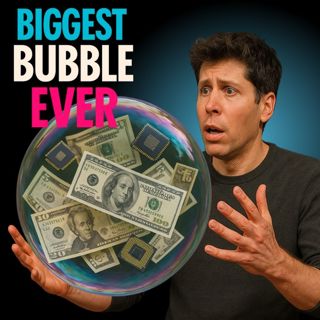

E168: AI - Biggest Bubble in Human History? Tech Economist Says YES
El Podcast20 Nov 2025

E168: AI - Biggest Bubble in Human History? Tech Economist Says YES

Tech economist Dr. Jeffrey Funk argues that today’s AI boom is the biggest bubble in history—far larger than dot-com or housing—because colossal infrastructure spending is chasing tiny, unprofitable revenues.

Guest bio:

Jeffrey Funk is a technology economist and author of Unicorns, Hype and Bubbles: A Guide to Spotting, Avoiding and Exploiting Investment Bubbles in Tech. A longtime researcher and professor of innovation and high-tech industries, he now writes widely on startup hype, AI economics, and investment manias, including a popular newsletter and presence on LinkedIn.

Topics discussed:
  • Why Funk thinks the AI boom is the “biggest bubble ever”
  • OpenAI’s revenues, mounting losses, and opaque accounting vs. Microsoft’s audited numbers
  • Nvidia, cloud providers, and “circular finance” in AI infrastructure
  • Sora, video generation, and the economics of ultra-expensive AI features
  • Comparisons with the 1929 crash, the dot-com bubble, and the 2008 housing crisis
  • How much of AI is real utility vs. hype, scams, and accounting tricks
  • Hallucinations as an inherent limitation of large language models
  • World-model approaches, quantum computing, and why breakthroughs are harder than advertised
  • Energy use, exploding electricity demand, and Bill Gates’ shifting climate rhetoric
  • Possible winners after the bubble: why it’s still “wide open”
  • Labor markets, layoffs, and why “AI took their jobs” is mostly a PR story
  • College and career advice for young people in an AI-saturated economy
  • China, regulation, and small language models
  • What the pop might look like: shuttered data centers, broken pensions, and a long VC winter
  • Final advice: how to think more clearly about tech futures and bubbles
Main points:
  • Investment vs. returns: A bubble is simply when more money goes into companies than comes out; by that standard, AI is extreme—OpenAI’s losses and projected $115B cash burn dwarf its revenues.
  • Subsidized demand: OpenAI’s ultra-low prices and free tiers artificially inflate usage and pump up Nvidia and cloud revenues; if prices reflected true cost, demand (and infra spending) would fall sharply.
  • Accounting red flags: Discrepancies between OpenAI’s figures and Microsoft’s audited statements, plus aggressive depreciation assumptions for AI chips, echo Enron-style financial engineering.
  • Bigger than past bubbles: Unlike dot-com, where consumers paid for internet access, PCs, and e-commerce (≈$1.5T in 2024 dollars), AI currently generates tiny, niche revenues relative to the trillions being poured into infrastructure.
  • Tech limits: LLM hallucinations are a built-in feature of statistical generative models, not a temporary bug; GPT-5 and similar systems haven’t solved this, and world-model or quantum fixes would be extremely costly and distant.
  • Real but narrow use-cases: AI can help with things like drafting emails, simple ads, and some coding assistance, but broad productivity gains across manufacturing, construction, healthcare, etc., remain largely unrealized.
  • Jobs & layoffs: Headlines about AI-driven mass unemployment are mostly hype; unemployment overall is low, many “AI layoffs” are reversals of pandemic over-hiring, and outsourcing plus H-1B dynamics matter more than LLMs.
  • Crash mechanics: When the narrative finally flips and big investors (like Michael Burry) exit or short AI, overbuilt data centers, utility expansions, and VC portfolios will be left stranded, hurting pensions and index investors.
  • Careers & education: Young people should be skeptical of hype, but still learn math, coding, and predictive AI; trades and biotech remain attractive, and the key skill is learning to reason about trends instead of chasing bandwagons.
Top 3 quotes:

On what a bubble really is:

“When people are putting more money into companies than they’re getting out, it becomes a bubble. It’s just exaggeration.”

On Nvidia, cloud, and OpenAI’s losses:

“Who cares if Nvidia and the cloud providers are making so much money if OpenAI is losing billions to subsidize them? The car might be selling, but if you’re selling it for half price, it’s not a good business.”

On how young people should respond:

“If you’re young, don’t worry too much about the bubble. Be open-minded, be curious, learn to think for yourself instead of believing what the tech bros say, and things will work out.”

🎙 The Pod is hosted by Jesse Wright
💬 For guest suggestions, questions, or media inquiries, reach out at https://elpodcast.media/
📬 Never miss an episode – subscribe and follow wherever you get your podcasts.
⭐️ If you enjoyed this episode, please rate and review the show. It helps others find us.

Thanks for listening!

Episoder(186)

1 in 20 Deaths: Inside Canada’s Assisted Dying System - Dr. Ramona Coelho

1 in 20 Deaths: Inside Canada’s Assisted Dying System - Dr. Ramona Coelho

Canada’s MAiD program has expanded rapidly—Dr. Ramona Coelho argues the system increasingly serves vulnerable people, with uneven safeguards and serious ethical, legal, and social risks. Guest bio: Dr...

24 Feb 1h
The Eavesdropper Economy: How Surveillance Built AI (E186)

The Eavesdropper Economy: How Surveillance Built AI (E186)

A lively tour from Cold War “The Thing” to today’s surveillance capitalism—showing how audio capture, too much data, and automation pressures helped turn listening into AI.Guest bios:Dr. Toby Heys — P...

18 Feb 1h
Managerial Class Ruined Tech (E185) - Darryl Campbell

Managerial Class Ruined Tech (E185) - Darryl Campbell

A former Silicon Valley insider explains how MBA-style “spreadsheet management” is breaking software—and why it’s making tech, AI, and everyday products worse.Guest bio:Darryl Campbell is a former tec...

10 Feb 1h 13min

55% of MIT Faculty Self-Censor — Here’s Why (E184)

55% of MIT Faculty Self-Censor — Here’s Why (E184)

MIT Free Speech Alliance president Wayne Stargardt explains how a few high-profile cancellations can drive widespread faculty self-censorship—even at a STEM powerhouse like MIT.Guest bio:Wayne Stargar...

5 Feb 52min

E183: Why Corporate America Will Never De-Woke | Law Prof Explains

E183: Why Corporate America Will Never De-Woke | Law Prof Explains

In this episode, Jesse talks with Fordham University School of Law corporate-law professor Sean J. Griffith about why “go woke, go broke” hasn’t really played out—and why big, publicly traded firms ca...

3 Feb 59min
E181: Politics Is the Best Predictor of Academic Research — Prof Mark Horowitz

E181: Politics Is the Best Predictor of Academic Research — Prof Mark Horowitz

Political beliefs often matter more than data or methods in shaping how social scientists think about controversial issues. In this episode, sociologist Dr. Mark Horowitz explains why many professors ...

27 Jan 1h 8min

E180: Attraction & Disgust: Evolutionary Psychology Explained (Dr. Deb Lieberman)

E180: Attraction & Disgust: Evolutionary Psychology Explained (Dr. Deb Lieberman)

Evolutionary psychologist Debra Lieberman explains how “disgust” and other built-in mental programs shape attraction, kinship, morality, and even law—while modern technology and social media scramble ...

20 Jan 1h 3min

E179: Breaking the Gerontocracy: How Amanda Litman Is Getting Young People into Office

E179: Breaking the Gerontocracy: How Amanda Litman Is Getting Young People into Office

Amanda Litman argues U.S. leadership is too old, local races are dangerously uncontested, and the fastest fix is getting more young people to run—backed by better pay and campaign-finance reform.Guest...

16 Jan 50min

Populært innen Business og økonomi

stopp-verden
lydartikler-fra-aftenposten
dine-penger-pengeradet
e24-podden
rss-penger-polser-og-politikk
rss-borsmorgen-okonominyhetene
utbytte
pengesnakk
livet-pa-veien-med-jan-erik-larssen
finansredaksjonen
pengepodden-2
morgenkaffen-med-finansavisen
tid-er-penger-en-podcast-med-peter-warren
okonomiamatorene
rss-sunn-okonomi
liberal-halvtime
lederpodden
rss-markedspuls-2
rss-impressions-2
rss-investering-gjort-enkelt