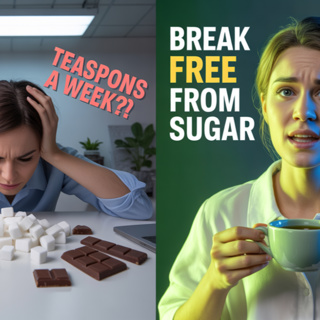
How to Cut Sugar by 78% in 30 Days

How to Cut Sugar by 78% in 30 Days

How to Cut Sugar by 78% in 30 Days.

Sugar is hijacking your brain — but you can take control back faster than you think.Most people want to quit sugar… but at 3 p.m., stressed and tired, the biscuits in the break room somehow win.

In this episode, addiction specialist and lifestyle medicine practitioner Dr. Fergal Armstrong reveals why your willpower isn’t the problem — and how a simple, research-backed strategy can help you cut sugar by up to 78% in just 30 days.

You’ll discover:Why the average person is unknowingly consuming around 400 teaspoons of sugar per weekThe massive gap between intention and action when trying to quit sugarHow implementation planning (a powerful psychology tool) rewires your brain for better choices

The three-step system: clear daily sugar goals, if-then action plans, and relapse-proof coping strategiesReal-world examples you can copy today to reduce sugar cravings, emotional eating, and mindless snackingThis isn’t another “just use willpower” video.

You’ll learn a science-based approach used in clinical research to:

Bring your intake in line with World Health Organisation sugar guidelinesImprove your confidence in managing cravings, stress, and social pressure

Build sustainable healthy habits around food, energy, and moodIf you’ve tried to reduce sugar before and felt like you failed, this episode will show you what was missing — and how to finally create a realistic, compassionate plan that works with your brain, not against it.

👉 Watch now to learn the 3-step formula to break free from sugar — for good.

And if you find this helpful, subscribe for more evidence-based insights on addiction, nutrition, and metabolic health.


Chapters00:00 – The shocking truth: 400 teaspoons of sugar a week

00:19 – The 78% reduction study and why willpower isn’t enough

00:47 – Step 1: Setting clear sugar goals using WHO guidelines

01:15 – Hidden sugars in “healthy” foods you eat every day

01:19 – Step 2: Implementation plans – the power of if-then thinking

01:55 – Real-life if-then examples for cravings and supermarket traps

02:00 – Step 3: Coping plans and why relapse is part of the cycle

02:20 – Identifying your personal triggers: stress, boredom, social pressure

02:34 – How this method cut cravings by 60% and doubled confidence

02:57 – Sugar, the brain, and rewiring your neural pathways

03:21 – Your 3-day action challenge to break free from sugar

Avsnitt(238)

Dopamine, Relapse, and Recovery: Why Addiction Needs Long-Term Management

Dopamine, Relapse, and Recovery: Why Addiction Needs Long-Term Management

A lot of people still think addiction recovery is just about willpower.But addiction neuroscience tells a different story: dopamine, the reward system, and relapse risk all help explain why recovery o...

25 Mars 5min
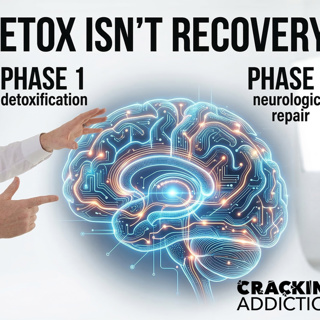
Why You Can Be Detoxed and Still Addicted

Why You Can Be Detoxed and Still Addicted

Addiction neuroscience, dopamine, cravings: detox ends withdrawal, but it does not end addiction.The MythA common myth in addiction recovery is that once detox is over, the problem is solved. Many peo...

18 Mars 5min
Relapse Happens to Everyone: Here's the Science Why - Addiction Basics 06

Relapse Happens to Everyone: Here's the Science Why - Addiction Basics 06

Dr. Fergal Armstrong reframes relapse in addiction, explaining why it's not a personal failure but a common part of the recovery journey, comparable to chronic illnesses. Understanding the neuroscienc...

11 Mars 5min
The Science of Withdrawal: What's Actually Happening? - Addiction Basics #5

The Science of Withdrawal: What's Actually Happening? - Addiction Basics #5

Withdrawal is one of the most feared parts of addiction recovery.But neuroscience shows something important:Withdrawal isn’t a failure of willpower — it’s the brain restoring balance after long-term c...

4 Mars 5min

Addiction vs Dependence vs Tolerance: The Critical Medical Difference

Addiction vs Dependence vs Tolerance: The Critical Medical Difference

🚨 TOLERANCE ≠ ADDICTION 🚨Most people — even healthcare professionals — use these terms incorrectly.And that confusion is hurting patients.In this episode, we break down:🧠 The real definition of add...

25 Feb 5min

Why Buprenorphine Is Safer Than Full Opioid Agonists

Why Buprenorphine Is Safer Than Full Opioid Agonists

Most people think methadone is the only real option for opioid addiction.Wrong.Buprenorphine — especially long-acting injectable depot — is flipping the entire system upside down.No daily pharmacy vis...

23 Feb 28min

How Cravings Work: Limbic System vs Prefrontal Cortex - Addiction Basics EP3

How Cravings Work: Limbic System vs Prefrontal Cortex - Addiction Basics EP3

Addiction neuroscience explains why wanting to quit isn’t the same as being able to quit. Dopamine reshapes the brain’s reward system.In Episode 3 of Addiction Basics, we tackle one of the most painfu...

18 Feb 6min
Dopamine and Addiction: The Science of Cravings - Addiction Basics EP2

Dopamine and Addiction: The Science of Cravings - Addiction Basics EP2

Addiction neuroscience explained. Dopamine, cravings, brain recovery, and neuroplasticity — backed by research.If you’ve ever wondered how addiction works in the brain, this is the science most people...

12 Feb 6min

Populärt inom Hälsa

somna-med-henrik
rss-bara-en-till-om-missbruk-medberoende-2
rss-jossan-nina
inga-beiga-morsor
sexnoveller-deluxe
not-fanny-anymore
alska-oss
angestpodden
johannes-hansen-podcast
vinterpasset
rss-vuxna-pa-latsas
sa-in-i-sjalen
sova-med-dan-horning
rss-the-house-podcast-3
rss-viktmedicinpodden
tyngre-radio
brottarbroder
rss-sjalsligt-avkladd
smartare-fitness-podden
rss-basta-livet