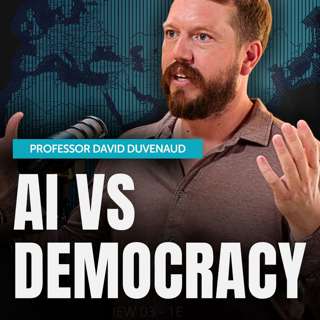

Why 'Aligned AI' Could Still Kill Democracy | David Duvenaud, ex-Anthropic team lead

Why 'Aligned AI' Could Still Kill Democracy | David Duvenaud, ex-Anthropic team lead

Democracy might be a brief historical blip. That’s the unsettling thesis of a recent paper, which argues AI that can do all the work a human can do inevitably leads to the “gradual disempowerment” of humanity.

For most of history, ordinary people had almost no control over their governments. Liberal democracy emerged only recently, and probably not coincidentally around the Industrial Revolution.

Today's guest, David Duvenaud, used to lead the 'alignment evals' team at Anthropic, is a professor of computer science at the University of Toronto, and recently co-authored 'Gradual disempowerment.'

Links to learn more, video, and full transcript: https://80k.info/dd

He argues democracy wasn’t the result of moral enlightenment — it was competitive pressure. Nations that educated their citizens and gave them political power built better armies and more productive economies. But what happens when AI can do all the producing — and all the fighting?

“The reason that states have been treating us so well in the West, at least for the last 200 or 300 years, is because they’ve needed us,” David explains. “Life can only get so bad when you’re needed. That’s the key thing that’s going to change.”

In David’s telling, once AI can do everything humans can do but cheaper, citizens become a national liability rather than an asset. With no way to make an economic contribution, their only lever becomes activism — demanding a larger share of redistribution from AI production. Faced with millions of unemployed citizens turned full-time activists, democratic governments trying to retain some “legacy” human rights may find they’re at a disadvantage compared to governments that strategically restrict civil liberties.

But democracy is just one front. The paper argues humans will lose control through economic obsolescence, political marginalisation, and the effects on culture that’s increasingly shaped by machine-to-machine communication — even if every AI does exactly what it’s told.

This episode was recorded on August 21, 2025.

Chapters:

  • Cold open (00:00:00)
  • Who’s David Duvenaud? (00:00:50)
  • Alignment isn’t enough: we still lose control (00:01:30)
  • Smart AI advice can still lead to terrible outcomes (00:14:14)
  • How gradual disempowerment would occur (00:19:02)
  • Economic disempowerment: Humans become "meddlesome parasites" (00:22:05)
  • Humans become a "criminally decadent" waste of energy (00:29:29)
  • Is humans losing control actually bad, ethically? (00:40:36)
  • Political disempowerment: Governments stop needing people (00:57:26)
  • Can human culture survive in an AI-dominated world? (01:10:23)
  • Will the future be determined by competitive forces? (01:26:51)
  • Can we find a single good post-AGI equilibria for humans? (01:34:29)
  • Do we know anything useful to do about this? (01:44:43)
  • How important is this problem compared to other AGI issues? (01:56:03)
  • Improving global coordination may be our best bet (02:04:56)
  • The 'Gradual Disempowerment Index' (02:07:26)
  • The government will fight to write AI constitutions (02:10:33)
  • “The intelligence curse” and Workshop Labs (02:16:58)
  • Mapping out disempowerment in a world of aligned AGIs (02:22:48)
  • What do David’s CompSci colleagues think of all this? (02:29:19)

Video and audio editing: Dominic Armstrong, Milo McGuire, Luke Monsour, and Simon Monsour
Music: CORBIT
Camera operator: Jake Morris
Coordination, transcriptions, and web: Katy Moore

Avsnitt(317)

#145 Classic episode – Christopher Brown on why slavery abolition wasn't inevitable

#145 Classic episode – Christopher Brown on why slavery abolition wasn't inevitable

In many ways, humanity seems to have become more humane and inclusive over time. While there’s still a lot of progress to be made, campaigns to give people of different genders, races, sexualities, et...

20 Jan 2h 56min

#233 – James Smith on how to prevent a mirror life catastrophe

#233 – James Smith on how to prevent a mirror life catastrophe

When James Smith first heard about mirror bacteria, he was sceptical. But within two weeks, he’d dropped everything to work on it full time, considering it the worst biothreat that he’d seen described...

13 Jan 2h 9min

#144 Classic episode – Athena Aktipis on why cancer is a fundamental universal phenomena

#144 Classic episode – Athena Aktipis on why cancer is a fundamental universal phenomena

What’s the opposite of cancer? If you answered “cure,” “antidote,” or “antivenom” — you’ve obviously been reading the antonym section at www.merriam-webster.com/thesaurus/cancer.But today’s guest Athe...

9 Jan 3h 30min

#142 Classic episode – John McWhorter on why the optimal number of languages might be one, and other provocative claims about language

#142 Classic episode – John McWhorter on why the optimal number of languages might be one, and other provocative claims about language

John McWhorter is a linguistics professor at Columbia University specialising in research on creole languages. He's also a content-producing machine, never afraid to give his frank opinion on anything...

6 Jan 1h 35min

2025 Highlight-o-thon: Oops! All Bests

2025 Highlight-o-thon: Oops! All Bests

It’s that magical time of year once again — highlightapalooza! Stick around for one top bit from each episode we recorded this year, including:Kyle Fish explaining how Anthropic’s AI Claude descends i...

29 Dec 20251h 40min

#232 – Andreas Mogensen on what we owe 'philosophical Vulcans' and unconscious beings

#232 – Andreas Mogensen on what we owe 'philosophical Vulcans' and unconscious beings

Most debates about the moral status of AI systems circle the same question: is there something that it feels like to be them? But what if that’s the wrong question to ask? Andreas Mogensen — a senior ...

19 Dec 20252h 37min

#231 – Paul Scharre on how AI-controlled robots will and won't change war

#231 – Paul Scharre on how AI-controlled robots will and won't change war

In 1983, Stanislav Petrov, a Soviet lieutenant colonel, sat in a bunker watching a red screen flash “MISSILE LAUNCH.” Protocol demanded he report it to superiors, which would very likely trigger a ret...

17 Dec 20252h 45min

Populärt inom Utbildning

historiepodden-se
rss-bara-en-till-om-missbruk-medberoende-2
det-skaver
alska-oss
nu-blir-det-historia
harrisons-dramatiska-historia
johannes-hansen-podcast
rss-sjalsligt-avkladd
sektledare
allt-du-velat-veta
not-fanny-anymore
roda-vita-rosen
sa-in-i-sjalen
i-vantan-pa-katastrofen
rikatillsammans-om-privatekonomi-rikedom-i-livet
rss-om-vi-ska-vara-arliga
sektpodden
rss-npf-podden
efterlevandepodden
rss-basta-livet