Drago Anguelov — Robustness, Safety, and Scalability at Waymo

Drago Anguelov — Robustness, Safety, and Scalability at Waymo

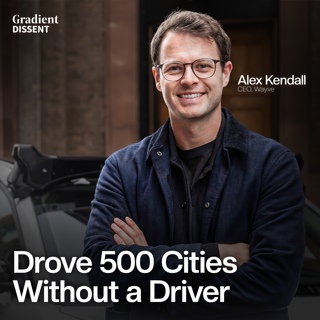
Drago Anguelov is a Distinguished Scientist and Head of Research at Waymo, an autonomous driving technology company and subsidiary of Alphabet Inc.

We begin by discussing Drago's work on the original Inception architecture, winner of the 2014 ImageNet challenge and introduction of the inception module. Then, we explore milestones and current trends in autonomous driving, from Waymo's release of the Open Dataset to the trade-offs between modular and end-to-end systems.

Drago also shares his thoughts on finding rare examples, and the challenges of creating scalable and robust systems.

Show notes (transcript and links): http://wandb.me/gd-drago-anguelov

---

⏳ Timestamps:

0:00 Intro

0:45 The story behind the Inception architecture

13:51 Trends and milestones in autonomous vehicles

23:52 The challenges of scalability and simulation

30:19 Why LiDar and mapping are useful

35:31 Waymo Via and autonomous trucking

37:31 Robustness and unsupervised domain adaptation

40:44 Why Waymo released the Waymo Open Dataset

49:02 The domain gap between simulation and the real world

56:40 Finding rare examples

1:04:34 The challenges of production requirements

1:08:36 Outro

---

Connect with Drago & Waymo

📍 Drago on LinkedIn: https://www.linkedin.com/in/dragomiranguelov/

📍 Waymo on Twitter: https://twitter.com/waymo/

📍 Careers at Waymo: https://waymo.com/careers/

---

Links:

📍 Inception v1: https://arxiv.org/abs/1409.4842

📍 "SPG: Unsupervised Domain Adaptation for 3D Object Detection via Semantic Point Generation", Qiangeng Xu et al. (2021), https://arxiv.org/abs/2108.06709

📍 "GradTail: Learning Long-Tailed Data Using Gradient-based Sample Weighting", Zhao Chen et al. (2022), https://arxiv.org/abs/2201.05938

---

💬 Host: Lukas Biewald

📹 Producers: Cayla Sharp, Angelica Pan, Lavanya Shukla

---

Subscribe and listen to our podcast today!

👉 Apple Podcasts: http://wandb.me/apple-podcasts​​

👉 Google Podcasts: http://wandb.me/google-podcasts​

👉 Spotify: http://wandb.me/spotify​

Avsnitt(131)

Why Physical AI Needed a Completely New Data Stack

Why Physical AI Needed a Completely New Data Stack

The future of AI is physical. In this episode, Lukas Biewald talks to Nikolaus West, CEO of Rerun, about why the breakthrough required to get AI out of the lab and into the messy real world is blocked by poor data tooling. Nikolaus explains how Rerun solved this by adopting an Entity Component System (ECS), a data model built for games, to handle complex, multimodal, time-aware sensor data. This is the technology that makes solving previously impossible tasks, like flexible manipulation, suddenly feel "boring." Connect with us here: Nikolaus West: https://www.linkedin.com/in/nikolauswest/Rerun: https://www.linkedin.com/company/rerun-io/Lukas Biewald: https://www.linkedin.com/in/lbiewald/Weights & Biases: https://www.linkedin.com/company/wandb/

16 Dec 1h

The Engineering Behind the World’s Most Advanced Video AI

The Engineering Behind the World’s Most Advanced Video AI

Is video AI a viable path toward AGI? Runway ML founder Cristóbal Valenzuela joins Lukas Biewald just after Gen 4.5 reached the #1 position on the Video Arena Leaderboard, according to community voting on Artificial Analysis. Lukas examines how a focused research team at Runway outpaced much larger organizations like Google and Meta in one of the most compute-intensive areas of machine learning.Cristóbal breaks down the architecture behind Gen 4.5 and explains the role of “taste” in model development. He details the engineering improvements in motion and camera control that solve long-standing issues like the restrictive “tripod look,” and shares why video models are starting to function as simulation engines with applications beyond media generation.Connect with us here:Cristóbal Valenzuela: https://www.linkedin.com/in/cvalenzuelabRunway: https://www.linkedin.com/company/runwayml/Lukas Biewald: https://www.linkedin.com/in/lbiewald/Weights & Biases: https://www.linkedin.com/company/wandb/

1 Dec 14min

The CEO Behind the Fastest-Growing AI Inference Company | Tuhin Srivastava

The CEO Behind the Fastest-Growing AI Inference Company | Tuhin Srivastava

In this episode of Gradient Dissent, Lukas Biewald talks with Tuhin Srivastava, CEO and founder of Baseten, one of the fastest-growing companies in the AI inference ecosystem. Tuhin shares the real story behind Baseten’s rise and how the market finally aligned with the infrastructure they’d spent years building.They get into the core challenges of modern inference, including why dedicated deployments matter, how runtime and infrastructure bottlenecks stack up, and what makes serving large models fundamentally different from smaller ones.Tuhin also explains how vLLM, TensorRT-LLM, and SGLang differ in practice, what it takes to tune workloads for new chips like the B200, and why reliability becomes harder as systems scale. The conversation dives into company-building, from killing product lines to avoiding premature scaling while navigating a market that shifts every few weeks.Connect with us here: Tuhin Srivastva: https://www.linkedin.com/in/tuhin-srivastava/ Lukas Biewald: https://www.linkedin.com/in/lbiewald/Weights & Biases: https://www.linkedin.com/company/wandb/

18 Nov 59min

The Startup Powering The Data Behind AGI

The Startup Powering The Data Behind AGI

In this episode of Gradient Dissent, Lukas Biewald talks with the CEO & founder of Surge AI, the billion-dollar company quietly powering the next generation of frontier LLMs. They discuss Surge's origin story, why traditional data labeling is broken, and how their research-focused approach is reshaping how models are trained.You’ll hear why inter-annotator agreement fails in high-complexity tasks like poetry and math, why synthetic data is often overrated, and how Surge builds rich RL environments to stress-test agentic reasoning. They also go deep on what kinds of data will be critical to future progress in AI—from scientific discovery to multimodal reasoning and personalized alignment.It’s a rare, behind-the-scenes look into the world of high-quality data generation at scale—straight from the team most frontier labs trust to get it right.Timestamps: 00:00 – Intro: Who is Edwin Chen? 03:40 – The problem with early data labeling systems 06:20 – Search ranking, clickbait, and product principles 10:05 – Why Surge focused on high-skill, high-quality labeling 13:50 – From Craigslist workers to a billion-dollar business 16:40 – Scaling without funding and avoiding Silicon Valley status games 21:15 – Why most human data platforms lack real tech 25:05 – Detecting cheaters, liars, and low-quality labelers 28:30 – Why inter-annotator agreement is a flawed metric 32:15 – What makes a great poem? Not checkboxes 36:40 – Measuring subjective quality rigorously 40:00 – What types of data are becoming more important 44:15 – Scientific collaboration and frontier research data 47:00 – Multimodal data, Argentinian coding, and hyper-specificity 50:10 – What's wrong with LMSYS and benchmark hacking 53:20 – Personalization and taste in model behavior 56:00 – Synthetic data vs. high-quality human data Follow Weights & Biases:https://twitter.com/weights_biases https://www.linkedin.com/company/wandb

16 Sep 56min

Arvind Jain on Building Glean and the Future of Enterprise AI

Arvind Jain on Building Glean and the Future of Enterprise AI

In this episode of Gradient Dissent, Lukas Biewald sits down with Arvind Jain, CEO and founder of Glean. They discuss Glean's evolution from solving enterprise search to building agentic AI tools that understand internal knowledge and workflows. Arvind shares how his early use of transformer models in 2019 laid the foundation for Glean’s success, well before the term "generative AI" was mainstream.They explore the technical and organizational challenges behind enterprise LLMs—including security, hallucination suppression—and when it makes sense to fine-tune models. Arvind also reflects on his previous startup Rubrik and explains how Glean’s AI platform aims to reshape how teams operate, from personalized agents to ever-fresh internal documentation.Follow Arvind Jain: https://x.com/jainarvindFollow Weights & Biases: https://x.com/weights_biasesTimestamps: [00:01:00] What Glean is and how it works [00:02:39] Starting Glean before the LLM boom [00:04:10] Using transformers early in enterprise search [00:06:48] Semantic search vs. generative answers [00:08:13] When to fine-tune vs. use out-of-box models [00:12:38] The value of small, purpose-trained models [00:13:04] Enterprise security and embedding risks[00:16:31] Lessons from Rubrik and starting Glean [00:19:31] The contrarian bet on enterprise search [00:22:57] Culture and lessons learned from Google [00:25:13] Everyone will have their own AI-powered "team" [00:28:43] Using AI to keep documentation evergreen [00:31:22] AI-generated churn and risk analysis [00:33:55] Measuring model improvement with golden sets[00:36:05] Suppressing hallucinations with citations [00:39:22] Agents that can ping humans for help [00:40:41] AI as a force multiplier, not a replacement [00:42:26] The enduring value of hard work

5 Aug 43min

How DeepL Built a Translation Powerhouse with AI with CEO Jarek Kutylowski

How DeepL Built a Translation Powerhouse with AI with CEO Jarek Kutylowski

In this episode of Gradient Dissent, Lukas Biewald talks with Jarek Kutylowski, CEO and founder of DeepL, an AI-powered translation company. Jarek shares DeepL’s journey from launching neural machine translation in 2017 to building custom data centers and how small teams can not only take on big players like Google Translate but win.They dive into what makes translation so difficult for AI, why high-quality translations still require human context, and how DeepL tailors models for enterprise use cases. They also discuss the evolution of speech translation, compute infrastructure, training on curated multilingual datasets, hallucinations in models, and why DeepL avoids fine-tuning for each individual customer. It’s a fascinating behind-the-scenes look at one of the most advanced real-world applications of deep learning.Timestamps: [00:00:00] Introducing Jarek and DeepL’s mission [00:01:46] Competing with Google Translate & LLMs [00:04:14] Pretraining vs. proprietary model strategy [00:06:47] Building GPU data centers in 2017 [00:08:09] The value of curated bilingual and monolingual data [00:09:30] How DeepL measures translation quality [00:12:27] Personalization and enterprise-specific tuning[00:14:04] Why translation demand is growing [00:16:16] ROI of incremental quality gains [00:18:20] The role of human translators in the future [00:22:48] Hallucinations in translation models [00:24:05] DeepL’s work on speech translation [00:28:22] The broader impact of global communication [00:30:32] Handling smaller languages and language pairs [00:32:25] Multi-language model consolidation [00:35:28] Engineering infrastructure for large-scale inference [00:39:23] Adapting to evolving LLM landscape & enterprise needs

8 Juli 42min

GitHub CEO Thomas Dohmke on Copilot and the Future of Software Development

GitHub CEO Thomas Dohmke on Copilot and the Future of Software Development

In this episode of Gradient Dissent, Lukas Biewald sits down with Thomas Dohmke, CEO of GitHub, to talk about the future of software engineering in the age of AI. They discuss how GitHub Copilot was built, why agents are reshaping developer workflows, and what it takes to make tools that are not only powerful but also fun.Thomas shares his experience leading GitHub through its $7.5B acquisition by Microsoft, the unexpected ways it accelerated innovation, and why developer happiness is crucial to productivity. They explore what still makes human engineers irreplaceable and how the next generation of developers might grow up coding alongside AI.Follow Thomas Dohmke: https://www.linkedin.com/in/ashtom/Follow Weights & Biases:https://twitter.com/weights_biases https://www.linkedin.com/company/wandb

10 Juni 1h 9min

From Pharma to AGI Hype, and Developing AI in Finance: Martin Shkreli’s Journey

From Pharma to AGI Hype, and Developing AI in Finance: Martin Shkreli’s Journey

In this episode of Gradient Dissent, Lukas Biewald talks with Martin Shkreli — the infamous "pharma bro" turned founder — about his path from hedge fund manager and pharma CEO to convicted felon and now software entrepreneur. Shkreli shares his side of the drug pricing controversy, reflects on his prison experience, and explains how he rebuilt his life and business after being "canceled."They dive deep into AI and drug discovery, where Shkreli delivers a strong critique of mainstream approaches. He also talks about his latest venture in finance software, building Godel Terminal “a Vim for traders", and why he thinks the AI hype cycle is just beginning. It's a wide-ranging and candid conversation with one of the most controversial figures in tech and biotech.Follow Martin Shkreli on TwitterGodel Terminal: https://godelterminal.com/Follow Weights & Biases on Twitterhttps://www.linkedin.com/company/wandb Join the Weights & Biases Discord Server:https://discord.gg/CkZKRNnaf3

20 Maj 1h 30min

Populärt inom Business & ekonomi

badfluence
framgangspodden
varvet
rss-jossan-nina
rss-borsens-finest
uppgang-och-fall
dynastin
bathina-en-podcast
avanzapodden
svd-tech-brief
24fragor
fill-or-kill
rss-svart-marknad
affarsvarlden
rss-inga-dumma-fragor-om-pengar
kapitalet-en-podd-om-ekonomi
rss-veckans-trade
ekonomiekot-extra
market-makers
borsmorgon