Iconic Red Kangaroo

Iconic Red Kangaroo

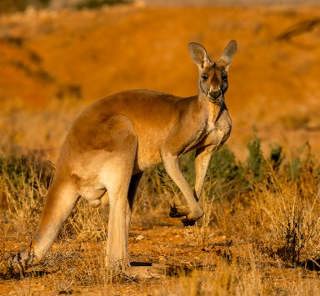
This episode is brought to you by BetterHelp. Give online therapy a try at betterhelp.com/CREATURES and get on your way to being your best self. First released in 2020, we are going back to this oldie, the Red Kangaroo! Was such a fun episode and we learned so much! **We also learned that Aussies do eat Kangaroo, so please excuse our American ignorance!!** But so much to love with this species. Red Kangaroo History The term ‘kangaroo’ comes from the Aboriginal word “gangarru”, from the Guugu Yimithirr language, which is spoken in far north Queensland. Kangaroos are marsupials, whose evolution dates back nearly 125 million years. Marsupials first arrived in Australia around 70 million years ago. Australian marsupials evolved in many ways to meet the challenges of drier habitats over the last 15 million years. Teeth, for example, reflect adaptive changes from browsing (on woody vegetation in moist climates) to grazing (on grasses in arid climates). Kangaroo ancestors were quadrupedal (walking on four legs most of the time) in forested habitats and became progressively more bipedal as habitats dried out and opened up. An example of an early kangaroo can be found in the rainforests of Queensland. There lives the tiny clambering musky rat-kangaroo, weighing not much more than half a kilogram. This species is a living fossil, having been around for tens of millions of years. There are over 60 species of Kangaroos that belong to the Family of Macropodidae (Macropods- large foot). These can be broken down into: Wallabies- smaller of the typical “kangaroo” Wallaroos- size in between wallabies and kangaroos Tree Kangaroos- smaller tree-dwelling kangaroos Kangaroos- largest of all the species and considered the “true” kangaroo Red Kangaroos range over most of Australia in the semi-arid plains, grasslands, woodlands and open forests. You can learn more by visiting our website HERE ------------------------------------------------------------- Another thank you to all our Patreon supporters. You too can join for one cup of "good" coffee a month. With your pledge you can support your favorite podcast on Patreon and give back to conservation. With the funds we receive each month, we are have been sending money to conservation organizations monthly. We now send a check to every organization we cover, as we feel they all are deserving of our support. Thank you so much for your support and for supporting animal conservation. Please considering supporting us at Patreon HERE. We also want to thank you to all our listeners. We are giving back to every conservation organization we cover and you make that possible. We are committed to donating large portions of our revenue (at minimum 25%) to every organization we cover each week. Thank you for helping us to grow, and for helping to conserve our wildlife. Please contact us at advertising@airwavemedia.com if you would like to advertise on our podcast You can also visit our website HERE. Learn more about your ad choices. Visit megaphone.fm/adchoices

Avsnitt(589)

Migration Collapse: The Alarm Bells Are Ringing

Migration Collapse: The Alarm Bells Are Ringing

Chris reframes migration as a planet-connecting system that moves energy and nutrients and keeps ecosystems in sync—now facing a growing “migration collapse,” where patterns break down before species ...

8 Apr 52min

Meerkats: The Tiny Sentinels Guarding the Desert (Revisited)

Meerkats: The Tiny Sentinels Guarding the Desert (Revisited)

In this re-release, Chris and Angie highlight why Meerkats may be small, but their world is anything but simple. Native to the arid regions of southern Africa, these highly social mammals live in tigh...

6 Apr 1h 2min

De-Extinction: A Scientist’s Perspective from Inside a Cloning Lab

De-Extinction: A Scientist’s Perspective from Inside a Cloning Lab

Chris draws on his PhD-era experience at Texas A&M—including meeting Dewey, the world’s first cloned deer—to unpack de-extinction and why cloning is far harder and less efficient than headlines sugges...

1 Apr 58min

Living Nightmares of the Deep: Anglerfish (Revisited)

Living Nightmares of the Deep: Anglerfish (Revisited)

Chris and Angie venture into the darkest depths of the ocean to meet one of the most bizarre and misunderstood creatures on Earth—the anglerfish. In this episode, we explore how these deep-sea preda...

30 Mars 1h 25min

Secrets of the Bees with Dr. Sammy Ramsey

Secrets of the Bees with Dr. Sammy Ramsey

Chris welcomes Dr. Sammy Ramsey (“Dr. Bugs”), entomologist at the University of Colorado Boulder, to discuss Secrets of the Bees (National Geographic, Disney+/Hulu). They explore surprising bee inte...

25 Mars 40min

Monarch Butterfly- Revisited (Making a Comeback!)

Monarch Butterfly- Revisited (Making a Comeback!)

Bringing back an older episode, but a classic! This week, great news as Monarch Butterfly winter populations have regained 60% of their population numbers vs previous years! Once again, conservation i...

23 Mars 1h 31min

Masters of Disguise: The Incredible Sea Dragons (From the Vault)

Masters of Disguise: The Incredible Sea Dragons (From the Vault)

This was our 50th episode we did back in 2018. How far we have come over the years. Sea dragons are among the most extraordinary fish on Earth, found only in the temperate coastal waters of southern...

16 Mars 1h 9min

The State of Nature in 2026: Crisis, Comebacks, and What Happens Next

The State of Nature in 2026: Crisis, Comebacks, and What Happens Next

Chris reflects on the state of nature in 2026, where conservation is defined by both loss and recovery. While habitat fragmentation, climate warming, coral bleaching, and Arctic instability continue, ...

11 Mars 47min

Populärt inom Vetenskap

p3-dystopia
dumma-manniskor
allt-du-velat-veta
svd-nyhetsartiklar
ufo-sverige
kapitalet-en-podd-om-ekonomi
det-morka-psyket
rss-vetenskapsradion
rss-ufo-bortom-rimligt-tvivel-2
rss-spraket
sexet
rss-vetenskapsradion-2
halsorevolutionen
paranormalt-med-caroline-giertz
medicinvetarna
dumforklarat
bildningspodden
rss-odla
naturmorgon
doden-hjarnan-kemisten