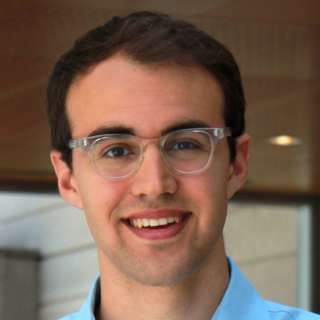
#73 - Phil Trammell on patient philanthropy and waiting to do good [re-release]

#73 - Phil Trammell on patient philanthropy and waiting to do good [re-release]

Rebroadcast: this episode was originally released in March 2020.

To do good, most of us look to use our time and money to affect the world around us today. But perhaps that's all wrong.

If you took $1,000 you were going to donate and instead put it in the stock market — where it grew on average 5% a year — in 100 years you'd have $125,000 to give away instead. And in 200 years you'd have $17 million.

This astonishing fact has driven today's guest, economics researcher Philip Trammell at Oxford's Global Priorities Institute, to investigate the case for and against so-called 'patient philanthropy' in depth. If the case for patient philanthropy is as strong as Phil believes, many of us should be trying to improve the world in a very different way than we are now.

He points out that on top of being able to dispense vastly more, whenever your trustees decide to use your gift to improve the world, they'll also be able to rely on the much broader knowledge available to future generations. A donor two hundred years ago couldn't have known distributing anti-malarial bed nets was a good idea. Not only did bed nets not exist — we didn't even know about germs, and almost nothing in medicine was justified by science.

Does the COVID-19 emergency mean we should actually use resources right now? See Phil's first thoughts on this question here.

Links to learn more, summary and full transcript.
Latest version of Phil’s paper on the topic.

What similar leaps will our descendants have made in 200 years, allowing your now vast foundation to benefit more people in even greater ways?

And there's a third reason to wait as well. What are the odds that we today live at the most critical point in history, when resources happen to have the greatest ability to do good? It's possible. But the future may be very long, so there has to be a good chance that some moment in the future will be both more pivotal and more malleable than our own.

Of course, there are many objections to this proposal. If you start a foundation you hope will wait around for centuries, might it not be destroyed in a war, revolution, or financial collapse?

Or might it not drift from its original goals, eventually just serving the interest of its distant future trustees, rather than the noble pursuits you originally intended?

Or perhaps it could fail for the reverse reason, by staying true to your original vision — if that vision turns out to be as deeply morally mistaken as the Rhodes' Scholarships initial charter, which limited it to 'white Christian men'.

Alternatively, maybe the world will change in the meantime, making your gift useless. At one end, humanity might destroy itself before your trust tries to do anything with the money. Or perhaps everyone in the future will be so fabulously wealthy, or the problems of the world already so overcome, that your philanthropy will no longer be able to do much good.

Are these concerns, all of them legitimate, enough to overcome the case in favour of patient philanthropy? In today's conversation with researcher Phil Trammell and my colleague Howie Lempel, we try to answer that, and also discuss:

• Historical attempts at patient philanthropy
• Should we have a mixed strategy, where some altruists are patient and others impatient?
• Which causes most need money now?
• What is the research frontier here?
• What does this all mean for what listeners should do differently?

Get this episode by subscribing: type 80,000 Hours into your podcasting app. Or read the transcript linked above.

Producer: Keiran Harris.
Audio mastering: Ben Cordell.
Transcripts: Zakee Ulhaq.

Det här avsnittet är hämtat från ett öppet RSS-flöde och publiceras inte av Podme. Det kan innehålla reklam.

Avsnitt(340)

We can guess what intergalactic war would look like. And strangely, it matters.

We can guess what intergalactic war would look like. And strangely, it matters.

Intergalactic war is probably billions of years away — yet physics can already tell us how it ends. And strangely that conclusion is relevant to decisions people have to make today.In this video, Rob ...

18 Juni 15min
How AI could create the world’s biggest problems (article by Zershaaneh Qureshi)

How AI could create the world’s biggest problems (article by Zershaaneh Qureshi)

Imagine you’re living 15,000 years ago. Your people are hunter-gatherers and you sleep under the stars. If someone told you humans would one day build cities with millions of people, fly through the a...

11 Juni 1h 29min
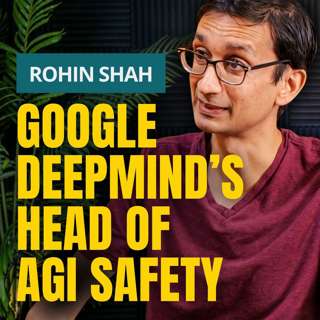
What it's really like to run AGI safety at Google DeepMind (and where I disagree with 'doomers') | Rohin Shah

What it's really like to run AGI safety at Google DeepMind (and where I disagree with 'doomers') | Rohin Shah

Most people working on AI safety think without a massive effort AI systems will probably end up with goals catastrophically different from humanity’s. Today’s guest, Rohin Shah — head of AGI Safety an...

2 Juni 2h 48min
What makes for a dream job? | Benjamin Todd

What makes for a dream job? | Benjamin Todd

What actually makes a job fulfilling? It's not what most career advice tells you. "Follow your passion" sounds inspiring, but it's misleading — and the research backs that up.Drawing on hundreds of st...

28 Maj 28min
We’re updating our career advice for the strangest time in history | Benjamin Todd, author of 80,000 Hours

We’re updating our career advice for the strangest time in history | Benjamin Todd, author of 80,000 Hours

The average career is 80,000 hours long. With AI advancing so rapidly, the hours you have left in your career matter more than ever.Some leading AI researchers think there’s a 10% chance that AI syste...

26 Maj 1h 6min
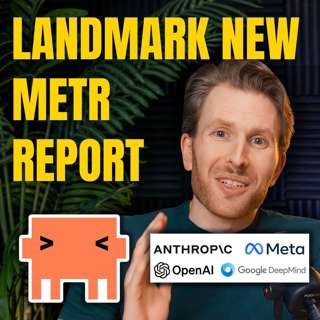
Can AIs already start 'rogue deployments' inside AI companies? (Landmark new METR report)

Can AIs already start 'rogue deployments' inside AI companies? (Landmark new METR report)

A red-teamer was embedded inside Anthropic for three weeks, told to imagine he was an evil Claude, and asked to figure out how to launch a ‘rogue AI deployment’ without getting caught. It’s one part o...

20 Maj 20min
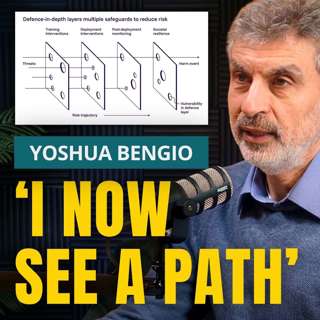
#243 – 'Godfather of AI' Yoshua Bengio: "I now see a path" to safe superintelligent AI

#243 – 'Godfather of AI' Yoshua Bengio: "I now see a path" to safe superintelligent AI

The co-inventor of modern AI and the most cited living scientist believes he's figured out how to ensure AI is honest, incapable of deception, and never goes rogue. Yoshua Bengio – Turing Award Winner...

7 Maj 2h 35min
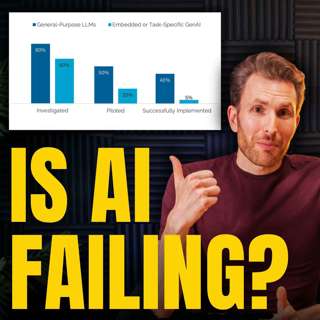
'95% of AI Pilots Fail': The hidden agenda behind the viral stat that misled millions

'95% of AI Pilots Fail': The hidden agenda behind the viral stat that misled millions

You might have heard that '95% of corporate AI pilots' are failing. It was one of the most widely cited AI statistics of 2025, parroted by media outlets everywhere. It helped trigger a Nasdaq selloff ...

28 Apr 10min

Populärt inom Utbildning

historiepodden-se
rss-bara-en-till-om-missbruk-medberoende-2
det-skaver
nu-blir-det-historia
harrisons-dramatiska-historia
sektledare
not-fanny-anymore
johannes-hansen-podcast
rss-viktmedicinpodden
roda-vita-rosen
allt-du-velat-veta
i-vantan-pa-katastrofen
sa-in-i-sjalen
rikatillsammans-om-privatekonomi-rikedom-i-livet
rss-foraldramotet-bring-lagercrantz
rss-ar-det-rimligt
rss-relationsrevolutionen
rss-sjalsligt-avkladd
sex-pa-riktigt-med-marika-smith
rss-max-tant-med-max-villman