#102 – Tom Moynihan on why prior generations missed some of the biggest priorities of all

#102 – Tom Moynihan on why prior generations missed some of the biggest priorities of all

It can be tough to get people to truly care about reducing existential risks today. But spare a thought for the longtermist of the 17th century: they were surrounded by people who thought extinction was literally impossible.

Today’s guest Tom Moynihan, intellectual historian and author of the book X-Risk: How Humanity Discovered Its Own Extinction, says that until the 18th century, almost everyone — including early atheists — couldn’t imagine that humanity or life could simply disappear because of an act of nature.

Links to learn more, summary and full transcript.

This is largely because of the prevalence of the ‘principle of plenitude’, which Tom defines as saying:

“Whatever can happen will happen. In its stronger form it says whatever can happen will happen reliably and recurrently. And in its strongest form it says that all that can happen is happening right now. And that's the way things will be forever.”

This has the implication that if humanity ever disappeared for some reason, then it would have to reappear. So why would you ever worry about extinction?

Here are 4 more commonly held beliefs from generations past that Tom shares in the interview:

All regions of matter that can be populated will be populated: In other words, there are aliens on every planet, because it would be a massive waste of real estate if all of them were just inorganic masses, where nothing interesting was going on. This also led to the idea that if you dug deep into the Earth, you’d potentially find thriving societies.
Aliens were human-like, and shared the same values as us: they would have the same moral beliefs, and the same aesthetic beliefs. The idea that aliens might be very different from us only arrived in the 20th century.
Fossils were rocks that had gotten a bit too big for their britches and were trying to act like animals: they couldn’t actually move, so becoming an imprint of an animal was the next best thing.
All future generations were contained in miniature form, Russian-doll style, in the sperm of the first man: preformation was the idea that within the ovule or the sperm of an animal is contained its offspring in miniature form, and the French philosopher Malebranche said, well, if one is contained in the other one, then surely that goes on forever.

And here are another three that weren’t held widely, but were proposed by scholars and taken seriously:

Life preceded the existence of rocks: Living things, like clams and mollusks, came first, and they extruded the earth.
No idea can be wrong: Nothing we can say about the world is wrong in a strong sense, because at some point in the future or the past, it has been true.
Maybe we were living before the Trojan War: Aristotle said that we might actually be living before Troy, because it — like every other event — will repeat at some future date. And he said that actually, the set of possibilities might be so narrow that it might be safer to say that we actually live before Troy.

But Tom tries to be magnanimous when faced with these incredibly misguided worldviews.

In this nearly four-hour long interview, Tom and Rob cover all of these ideas, as well as:

• How we know people really believed such things
• How we moved on from these theories
• How future intellectual historians might view our beliefs today
• The distinction between ‘apocalypse’ and ‘extinction’
• Utopias and dystopias
• Big ideas that haven’t flowed through into all relevant fields yet
• Intellectual history as a possible high-impact career
• And much more

Chapters:

  • Rob’s intro (00:00:00)
  • The interview begins (00:01:45)
  • Principle of Plenitude (00:04:02)
  • How do we know they really believed this? (00:13:20)
  • Religious conceptions of time (00:24:01)
  • How to react to wacky old ideas (00:29:18)
  • The Copernican revolution (00:36:55)
  • Fossils (00:42:30)
  • How we got past these theories (00:51:19)
  • Intellectual history (01:01:45)
  • Future historians looking back to today (01:13:11)
  • Could plenitude actually be true? (01:27:38)
  • What is vs. what ought to be (01:36:43)
  • Apocalypse vs. extinction (01:45:56)
  • The history of probability (02:00:52)
  • Utopias and dystopias (02:12:11)
  • How Tom has changed his mind since writing the book (02:28:58)
  • Are we making progress? (02:35:00)
  • Big ideas that haven’t flowed through to all relevant fields yet (02:52:07)
  • Failed predictions (02:59:01)
  • Intellectual history as high-impact career (03:06:56)
  • Communicating progress (03:15:07)
  • What careers in history actually look like (03:23:03)
  • Tom’s next major project (03:43:06)
  • One of the funniest things past generations believed (03:51:50)


Producer: Keiran Harris.
Audio mastering: Ben Cordell.
Transcriptions: Sofia Davis-Fogel.

Det här avsnittet är hämtat från ett öppet RSS-flöde och publiceras inte av Podme. Det kan innehålla reklam.

Avsnitt(340)

We can guess what intergalactic war would look like. And strangely, it matters.

We can guess what intergalactic war would look like. And strangely, it matters.

Intergalactic war is probably billions of years away — yet physics can already tell us how it ends. And strangely that conclusion is relevant to decisions people have to make today.In this video, Rob ...

18 Juni 15min

How AI could create the world’s biggest problems (article by Zershaaneh Qureshi)

How AI could create the world’s biggest problems (article by Zershaaneh Qureshi)

Imagine you’re living 15,000 years ago. Your people are hunter-gatherers and you sleep under the stars. If someone told you humans would one day build cities with millions of people, fly through the a...

11 Juni 1h 29min
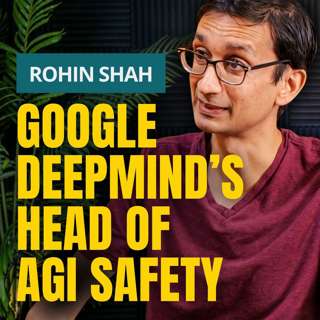
What it's really like to run AGI safety at Google DeepMind (and where I disagree with 'doomers') | Rohin Shah

What it's really like to run AGI safety at Google DeepMind (and where I disagree with 'doomers') | Rohin Shah

Most people working on AI safety think without a massive effort AI systems will probably end up with goals catastrophically different from humanity’s. Today’s guest, Rohin Shah — head of AGI Safety an...

2 Juni 2h 48min

What makes for a dream job? | Benjamin Todd

What makes for a dream job? | Benjamin Todd

What actually makes a job fulfilling? It's not what most career advice tells you. "Follow your passion" sounds inspiring, but it's misleading — and the research backs that up.Drawing on hundreds of st...

28 Maj 28min
We’re updating our career advice for the strangest time in history | Benjamin Todd, author of 80,000 Hours

We’re updating our career advice for the strangest time in history | Benjamin Todd, author of 80,000 Hours

The average career is 80,000 hours long. With AI advancing so rapidly, the hours you have left in your career matter more than ever.Some leading AI researchers think there’s a 10% chance that AI syste...

26 Maj 1h 6min
Can AIs already start 'rogue deployments' inside AI companies? (Landmark new METR report)

Can AIs already start 'rogue deployments' inside AI companies? (Landmark new METR report)

A red-teamer was embedded inside Anthropic for three weeks, told to imagine he was an evil Claude, and asked to figure out how to launch a ‘rogue AI deployment’ without getting caught. It’s one part o...

20 Maj 20min
#243 – 'Godfather of AI' Yoshua Bengio: "I now see a path" to safe superintelligent AI

#243 – 'Godfather of AI' Yoshua Bengio: "I now see a path" to safe superintelligent AI

The co-inventor of modern AI and the most cited living scientist believes he's figured out how to ensure AI is honest, incapable of deception, and never goes rogue. Yoshua Bengio – Turing Award Winner...

7 Maj 2h 35min
'95% of AI Pilots Fail': The hidden agenda behind the viral stat that misled millions

'95% of AI Pilots Fail': The hidden agenda behind the viral stat that misled millions

You might have heard that '95% of corporate AI pilots' are failing. It was one of the most widely cited AI statistics of 2025, parroted by media outlets everywhere. It helped trigger a Nasdaq selloff ...

28 Apr 10min

Populärt inom Utbildning

historiepodden-se
rss-bara-en-till-om-missbruk-medberoende-2
det-skaver
nu-blir-det-historia
harrisons-dramatiska-historia
sektledare
not-fanny-anymore
johannes-hansen-podcast
rss-viktmedicinpodden
roda-vita-rosen
allt-du-velat-veta
i-vantan-pa-katastrofen
sa-in-i-sjalen
rikatillsammans-om-privatekonomi-rikedom-i-livet
rss-foraldramotet-bring-lagercrantz
rss-ar-det-rimligt
rss-relationsrevolutionen
rss-sjalsligt-avkladd
sex-pa-riktigt-med-marika-smith
rss-max-tant-med-max-villman