

#121 – Matthew Yglesias on avoiding the pundit's fallacy and how much military intervention can be used for good

#121 – Matthew Yglesias on avoiding the pundit's fallacy and how much military intervention can be used for good

If you read polls saying that the public supports a carbon tax, should you believe them? According to today's guest — journalist and blogger Matthew Yglesias — it's complicated, but probably not.

Links to learn more, summary and full transcript.

Interpreting opinion polls about specific policies can be a challenge, and it's easy to trick yourself into believing what you want to believe. Matthew invented a term for a particular type of self-delusion called the 'pundit's fallacy': "the belief that what a politician needs to do to improve his or her political standing is do what the pundit wants substantively."

If we want to advocate not just for ideas that would be good if implemented, but ideas that have a real shot at getting implemented, we should do our best to understand public opinion as it really is.

The least trustworthy polls are published by think tanks and advocacy campaigns that would love to make their preferred policy seem popular. These surveys can be designed to nudge respondents toward the desired result — for example, by tinkering with question wording and order or shifting how participants are sampled. And if a poll produces the 'wrong answer', there's no need to publish it at all, so the 'publication bias' with these sorts of surveys is large.

Matthew says polling run by firms or researchers without any particular desired outcome can be taken more seriously. But the results that we ought to give by far the most weight are those from professional political campaigns trying to win votes and get their candidate elected because they have both the expertise to do polling properly, and a very strong incentive to understand what the public really thinks.

The problem is, campaigns run these expensive surveys because they think that having exclusive access to reliable information will give them a competitive advantage. As a result, they often don’t publish the findings, and instead use them to shape what their candidate says and does.

Journalists like Matthew can call up their contacts and get a summary from people they trust. But being unable to publish the polling itself, they're unlikely to be able to persuade sceptics.

When assessing what ideas are winners, one thing Matthew would like everyone to keep in mind is that politics is competitive, and politicians aren't (all) stupid. If advocating for your pet idea were a great way to win elections, someone would try it and win, and others would copy.

One other thing to check that's more reliable than polling is real-world experience. For example, voters may say they like a carbon tax on the phone — but the very liberal Washington State roundly rejected one in ballot initiatives in 2016 and 2018.

Of course you may want to advocate for what you think is best, even if it wouldn't pass a popular vote in the face of organised opposition. The public's ideas can shift, sometimes dramatically and unexpectedly. But at least you'll be going into the debate with your eyes wide open.

In this extensive conversation, host Rob Wiblin and Matthew also cover:

• How should a humanitarian think about US military interventions overseas?
• From an 'effective altruist' perspective, was the US wrong to withdraw from Afghanistan?
• Has NATO ultimately screwed over Ukrainians by misrepresenting the extent of its commitment to their independence?
• What philosopher does Matthew think is underrated?
• How big a risk is ubiquitous surveillance?
• What does Matthew think about wild animal suffering, anti-ageing research, and autonomous weapons?
• And much more

Chapters:

  • Rob’s intro (00:00:00)
  • The interview begins (00:02:05)
  • Autonomous weapons (00:04:42)
  • India and the US (00:07:25)
  • Evidence-backed interventions for reducing the harm done by racial prejudices (00:08:38)
  • Factory farming (00:10:44)
  • Wild animal suffering (00:12:41)
  • Vaccine development (00:15:20)
  • Anti-ageing research (00:16:27)
  • Should the US develop a semiconductor industry? (00:19:13)
  • What we should do about various existential risks (00:21:58)
  • What governments should do to stop the next pandemic (00:24:00)
  • Comets and supervolcanoes (00:31:30)
  • Nuclear weapons (00:34:25)
  • Advances in AI (00:35:46)
  • Surveillance systems (00:38:45)
  • How Matt thinks about public opinion research (00:43:22)
  • Issues with trusting public opinion polls (00:51:18)
  • The influence of prior beliefs (01:05:53)
  • Loss aversion (01:12:19)
  • Matt's take on military adventurism (01:18:54)
  • How military intervention looks as a humanitarian intervention (01:29:12)
  • Where Matt does favour military intervention (01:38:27)
  • Why smart people disagree (01:44:24)
  • The case for NATO taking an active stance in Ukraine (01:57:34)
  • One Billion Americans (02:08:02)
  • Matt’s views on the effective altruism community (02:11:46)
  • Matt’s views on the longtermist community (02:19:48)
  • Matt’s struggle to become more of a rationalist (02:22:42)
  • Megaprojects (02:26:20)
  • The impact of Matt’s work (02:32:28)
  • Matt’s philosophical views (02:47:58)
  • The value of formal education (02:56:59)
  • Worst thing Matt’s ever advocated for (03:02:25)
  • Rob’s outro (03:03:22)


Producer: Keiran Harris
Audio mastering: Ben Cordell
Transcriptions: Katy Moore

Det här avsnittet är hämtat från ett öppet RSS-flöde och publiceras inte av Podme. Det kan innehålla reklam.

Avsnitt(340)

We can guess what intergalactic war would look like. And strangely, it matters.

We can guess what intergalactic war would look like. And strangely, it matters.

Intergalactic war is probably billions of years away — yet physics can already tell us how it ends. And strangely that conclusion is relevant to decisions people have to make today.In this video, Rob ...

18 Juni 15min

How AI could create the world’s biggest problems (article by Zershaaneh Qureshi)

How AI could create the world’s biggest problems (article by Zershaaneh Qureshi)

Imagine you’re living 15,000 years ago. Your people are hunter-gatherers and you sleep under the stars. If someone told you humans would one day build cities with millions of people, fly through the a...

11 Juni 1h 29min
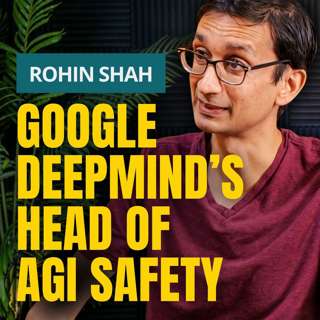
What it's really like to run AGI safety at Google DeepMind (and where I disagree with 'doomers') | Rohin Shah

What it's really like to run AGI safety at Google DeepMind (and where I disagree with 'doomers') | Rohin Shah

Most people working on AI safety think without a massive effort AI systems will probably end up with goals catastrophically different from humanity’s. Today’s guest, Rohin Shah — head of AGI Safety an...

2 Juni 2h 48min

What makes for a dream job? | Benjamin Todd

What makes for a dream job? | Benjamin Todd

What actually makes a job fulfilling? It's not what most career advice tells you. "Follow your passion" sounds inspiring, but it's misleading — and the research backs that up.Drawing on hundreds of st...

28 Maj 28min

We’re updating our career advice for the strangest time in history | Benjamin Todd, author of 80,000 Hours

We’re updating our career advice for the strangest time in history | Benjamin Todd, author of 80,000 Hours

The average career is 80,000 hours long. With AI advancing so rapidly, the hours you have left in your career matter more than ever.Some leading AI researchers think there’s a 10% chance that AI syste...

26 Maj 1h 6min

Can AIs already start 'rogue deployments' inside AI companies? (Landmark new METR report)

Can AIs already start 'rogue deployments' inside AI companies? (Landmark new METR report)

A red-teamer was embedded inside Anthropic for three weeks, told to imagine he was an evil Claude, and asked to figure out how to launch a ‘rogue AI deployment’ without getting caught. It’s one part o...

20 Maj 20min

#243 – 'Godfather of AI' Yoshua Bengio: "I now see a path" to safe superintelligent AI

#243 – 'Godfather of AI' Yoshua Bengio: "I now see a path" to safe superintelligent AI

The co-inventor of modern AI and the most cited living scientist believes he's figured out how to ensure AI is honest, incapable of deception, and never goes rogue. Yoshua Bengio – Turing Award Winner...

7 Maj 2h 35min

'95% of AI Pilots Fail': The hidden agenda behind the viral stat that misled millions

'95% of AI Pilots Fail': The hidden agenda behind the viral stat that misled millions

You might have heard that '95% of corporate AI pilots' are failing. It was one of the most widely cited AI statistics of 2025, parroted by media outlets everywhere. It helped trigger a Nasdaq selloff ...

28 Apr 10min

Populärt inom Utbildning

historiepodden-se
rss-bara-en-till-om-missbruk-medberoende-2
det-skaver
nu-blir-det-historia
harrisons-dramatiska-historia
sektledare
not-fanny-anymore
johannes-hansen-podcast
rss-viktmedicinpodden
roda-vita-rosen
allt-du-velat-veta
i-vantan-pa-katastrofen
sa-in-i-sjalen
rikatillsammans-om-privatekonomi-rikedom-i-livet
rss-foraldramotet-bring-lagercrantz
rss-ar-det-rimligt
rss-relationsrevolutionen
rss-sjalsligt-avkladd
sex-pa-riktigt-med-marika-smith
rss-max-tant-med-max-villman