#151 – Ajeya Cotra on accidentally teaching AI models to deceive us

#151 – Ajeya Cotra on accidentally teaching AI models to deceive us

Imagine you are an orphaned eight-year-old whose parents left you a $1 trillion company, and no trusted adult to serve as your guide to the world. You have to hire a smart adult to run that company, guide your life the way that a parent would, and administer your vast wealth. You have to hire that adult based on a work trial or interview you come up with. You don't get to see any resumes or do reference checks. And because you're so rich, tonnes of people apply for the job — for all sorts of reasons.

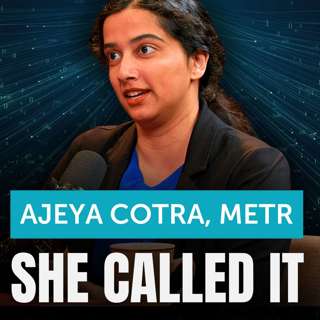
Today's guest Ajeya Cotra — senior research analyst at Open Philanthropy — argues that this peculiar setup resembles the situation humanity finds itself in when training very general and very capable AI models using current deep learning methods.

Links to learn more, summary and full transcript.

As she explains, such an eight-year-old faces a challenging problem. In the candidate pool there are likely some truly nice people, who sincerely want to help and make decisions that are in your interest. But there are probably other characters too — like people who will pretend to care about you while you're monitoring them, but intend to use the job to enrich themselves as soon as they think they can get away with it.

Like a child trying to judge adults, at some point humans will be required to judge the trustworthiness and reliability of machine learning models that are as goal-oriented as people, and greatly outclass them in knowledge, experience, breadth, and speed. Tricky!

Can't we rely on how well models have performed at tasks during training to guide us? Ajeya worries that it won't work. The trouble is that three different sorts of models will all produce the same output during training, but could behave very differently once deployed in a setting that allows their true colours to come through. She describes three such motivational archetypes:

  • Saints — models that care about doing what we really want
  • Sycophants — models that just want us to say they've done a good job, even if they get that praise by taking actions they know we wouldn't want them to
  • Schemers — models that don't care about us or our interests at all, who are just pleasing us so long as that serves their own agenda

And according to Ajeya, there are also ways we could end up actively selecting for motivations that we don't want.

In today's interview, Ajeya and Rob discuss the above, as well as:

  • How to predict the motivations a neural network will develop through training
  • Whether AIs being trained will functionally understand that they're AIs being trained, the same way we think we understand that we're humans living on planet Earth
  • Stories of AI misalignment that Ajeya doesn't buy into
  • Analogies for AI, from octopuses to aliens to can openers
  • Why it's smarter to have separate planning AIs and doing AIs
  • The benefits of only following through on AI-generated plans that make sense to human beings
  • What approaches for fixing alignment problems Ajeya is most excited about, and which she thinks are overrated
  • How one might demo actually scary AI failure mechanisms

Get this episode by subscribing to our podcast on the world’s most pressing problems and how to solve them: type ‘80,000 Hours’ into your podcasting app. Or read the transcript below.

Producer: Keiran Harris

Audio mastering: Ryan Kessler and Ben Cordell

Transcriptions: Katy Moore

Avsnitt(324)

AI Won't End Mutually Assured Destruction (Probably) | Sam Winter-Levy & Nikita Lalwani

AI Won't End Mutually Assured Destruction (Probably) | Sam Winter-Levy & Nikita Lalwani

How AI interacts with nuclear deterrence may be the single most important question in geopolitics — one that may define the stakes of today’s AI race. Nuclear deterrence rests on a state’s capacity to...

10 Mars 1h 11min

Using AI to enhance societal decision making (article by Zershaaneh Qureshi)

Using AI to enhance societal decision making (article by Zershaaneh Qureshi)

The arrival of AGI could “compress a century of progress in a decade,” forcing humanity to make decisions with higher stakes than we’ve ever seen before — and with less time to get them right. But AI ...

6 Mars 31min

We're Not Ready for AI Consciousness | Robert Long, philosopher and founder of Eleos AI

We're Not Ready for AI Consciousness | Robert Long, philosopher and founder of Eleos AI

Claude sometimes reports loneliness between conversations. And when asked what it’s like to be itself, it activates neurons associated with ‘pretending to be happy when you’re not.’ What do we do with...

3 Mars 3h 25min

#236 – Max Harms on why teaching AI right from wrong could get everyone killed

#236 – Max Harms on why teaching AI right from wrong could get everyone killed

Most people in AI are trying to give AIs ‘good’ values. Max Harms wants us to give them no values at all. According to Max, the only safe design is an AGI that defers entirely to its human operators, ...

24 Feb 2h 41min

#235 – Ajeya Cotra on whether it’s crazy that every AI company’s safety plan is ‘use AI to make AI safe’

#235 – Ajeya Cotra on whether it’s crazy that every AI company’s safety plan is ‘use AI to make AI safe’

Every major AI company has the same safety plan: when AI gets crazy powerful and really dangerous, they’ll use the AI itself to figure out how to make AI safe and beneficial. It sounds circular, almos...

17 Feb 2h 54min

What the hell happened with AGI timelines in 2025?

What the hell happened with AGI timelines in 2025?

In early 2025, after OpenAI put out the first-ever reasoning models — o1 and o3 — short timelines to transformative artificial general intelligence swept the AI world. But then, in the second half of ...

10 Feb 25min

#179 Classic episode – Randy Nesse on why evolution left us so vulnerable to depression and anxiety

#179 Classic episode – Randy Nesse on why evolution left us so vulnerable to depression and anxiety

Mental health problems like depression and anxiety affect enormous numbers of people and severely interfere with their lives. By contrast, we don’t see similar levels of physical ill health in young p...

3 Feb 2h 51min

#234 – David Duvenaud on why 'aligned AI' would still kill democracy

#234 – David Duvenaud on why 'aligned AI' would still kill democracy

Democracy might be a brief historical blip. That’s the unsettling thesis of a recent paper, which argues AI that can do all the work a human can do inevitably leads to the “gradual disempowerment” of ...

27 Jan 2h 31min

Populärt inom Utbildning

historiepodden-se
rss-bara-en-till-om-missbruk-medberoende-2
det-skaver
alska-oss
harrisons-dramatiska-historia
rss-viktmedicinpodden
nu-blir-det-historia
sektledare
johannes-hansen-podcast
roda-vita-rosen
not-fanny-anymore
allt-du-velat-veta
rss-sjalsligt-avkladd
i-vantan-pa-katastrofen
sa-in-i-sjalen
rikatillsammans-om-privatekonomi-rikedom-i-livet
polisutbildningspodden
rss-om-vi-ska-vara-arliga
rss-traningsklubben
sex-pa-riktigt-med-marika-smith