#112 Classic episode – Carl Shulman on the common-sense case for existential risk work and its practical implications

#112 Classic episode – Carl Shulman on the common-sense case for existential risk work and its practical implications

Preventing the apocalypse may sound like an idiosyncratic activity, and it sometimes is justified on exotic grounds, such as the potential for humanity to become a galaxy-spanning civilisation.

But the policy of US government agencies is already to spend up to $4 million to save the life of a citizen, making the death of all Americans a $1,300,000,000,000,000 disaster.

According to Carl Shulman, research associate at Oxford University’s Future of Humanity Institute, that means you don’t need any fancy philosophical arguments about the value or size of the future to justify working to reduce existential risk — it passes a mundane cost-benefit analysis whether or not you place any value on the long-term future.

Rebroadcast: this episode was originally released in October 2021.

Links to learn more, summary, and full transcript.

The key reason to make it a top priority is factual, not philosophical. That is, the risk of a disaster that kills billions of people alive today is alarmingly high, and it can be reduced at a reasonable cost. A back-of-the-envelope version of the argument runs:

  • The US government is willing to pay up to $4 million (depending on the agency) to save the life of an American.
  • So saving all US citizens at any given point in time would be worth $1,300 trillion.
  • If you believe that the risk of human extinction over the next century is something like one in six (as Toby Ord suggests is a reasonable figure in his book The Precipice), then it would be worth the US government spending up to $2.2 trillion to reduce that risk by just 1%, in terms of American lives saved alone.
  • Carl thinks it would cost a lot less than that to achieve a 1% risk reduction if the money were spent intelligently. So it easily passes a government cost-benefit test, with a very big benefit-to-cost ratio — likely over 1000:1 today.

This argument helped NASA get funding to scan the sky for any asteroids that might be on a collision course with Earth, and it was directly promoted by famous economists like Richard Posner, Larry Summers, and Cass Sunstein.

If the case is clear enough, why hasn’t it already motivated a lot more spending or regulations to limit existential risks — enough to drive down what any additional efforts would achieve?

Carl thinks that one key barrier is that infrequent disasters are rarely politically salient. Research indicates that extra money is spent on flood defences in the years immediately following a massive flood — but as memories fade, that spending quickly dries up. Of course the annual probability of a disaster was the same the whole time; all that changed is what voters had on their minds.

Carl suspects another reason is that it’s difficult for the average voter to estimate and understand how large these respective risks are, and what responses would be appropriate rather than self-serving. If the public doesn’t know what good performance looks like, politicians can’t be given incentives to do the right thing.

It’s reasonable to assume that if we found out a giant asteroid were going to crash into the Earth one year from now, most of our resources would be quickly diverted into figuring out how to avert catastrophe.

But even in the case of COVID-19, an event that massively disrupted the lives of everyone on Earth, we’ve still seen a substantial lack of investment in vaccine manufacturing capacity and other ways of controlling the spread of the virus, relative to what economists recommended.

Carl expects that all the reasons we didn’t adequately prepare for or respond to COVID-19 — with excess mortality over 15 million and costs well over $10 trillion — bite even harder when it comes to threats we’ve never faced before, such as engineered pandemics, risks from advanced artificial intelligence, and so on.

Today’s episode is in part our way of trying to improve this situation. In today’s wide-ranging conversation, Carl and Rob also cover:

  • A few reasons Carl isn’t excited by ‘strong longtermism’
  • How x-risk reduction compares to GiveWell recommendations
  • Solutions for asteroids, comets, supervolcanoes, nuclear war, pandemics, and climate change
  • The history of bioweapons
  • Whether gain-of-function research is justifiable
  • Successes and failures around COVID-19
  • The history of existential risk
  • And much more

Producer: Keiran Harris
Audio mastering: Ben Cordell
Transcriptions: Katy Moore

Avsnitt(325)

Why automating human labour will break our political system | Rose Hadshar, Forethought

Why automating human labour will break our political system | Rose Hadshar, Forethought

The most important political question in the age of advanced AI might not be who wins elections. It might be whether elections continue to matter at all.That’s the view of Rose Hadshar, researcher at ...

17 Mars 2h 14min

#238 – Sam Winter-Levy and Nikita Lalwani on how AGI won't end mutually assured destruction (probably)

#238 – Sam Winter-Levy and Nikita Lalwani on how AGI won't end mutually assured destruction (probably)

How AI interacts with nuclear deterrence may be the single most important question in geopolitics — one that may define the stakes of today’s AI race. Nuclear deterrence rests on a state’s capacity to...

10 Mars 1h 11min

Using AI to enhance societal decision making (article by Zershaaneh Qureshi)

Using AI to enhance societal decision making (article by Zershaaneh Qureshi)

The arrival of AGI could “compress a century of progress in a decade,” forcing humanity to make decisions with higher stakes than we’ve ever seen before — and with less time to get them right. But AI ...

6 Mars 31min

#237 – Robert Long on how we're not ready for AI consciousness

#237 – Robert Long on how we're not ready for AI consciousness

Claude sometimes reports loneliness between conversations. And when asked what it’s like to be itself, it activates neurons associated with ‘pretending to be happy when you’re not.’ What do we do with...

3 Mars 3h 25min

#236 – Max Harms on why teaching AI right from wrong could get everyone killed

#236 – Max Harms on why teaching AI right from wrong could get everyone killed

Most people in AI are trying to give AIs ‘good’ values. Max Harms wants us to give them no values at all. According to Max, the only safe design is an AGI that defers entirely to its human operators, ...

24 Feb 2h 41min

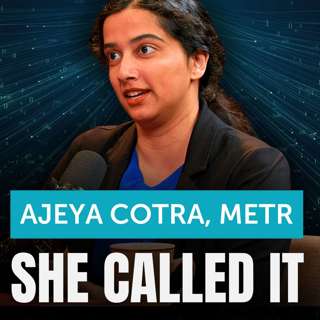
#235 – Ajeya Cotra on whether it’s crazy that every AI company’s safety plan is ‘use AI to make AI safe’

#235 – Ajeya Cotra on whether it’s crazy that every AI company’s safety plan is ‘use AI to make AI safe’

Every major AI company has the same safety plan: when AI gets crazy powerful and really dangerous, they’ll use the AI itself to figure out how to make AI safe and beneficial. It sounds circular, almos...

17 Feb 2h 54min

What the hell happened with AGI timelines in 2025?

What the hell happened with AGI timelines in 2025?

In early 2025, after OpenAI put out the first-ever reasoning models — o1 and o3 — short timelines to transformative artificial general intelligence swept the AI world. But then, in the second half of ...

10 Feb 25min

#179 Classic episode – Randy Nesse on why evolution left us so vulnerable to depression and anxiety

#179 Classic episode – Randy Nesse on why evolution left us so vulnerable to depression and anxiety

Mental health problems like depression and anxiety affect enormous numbers of people and severely interfere with their lives. By contrast, we don’t see similar levels of physical ill health in young p...

3 Feb 2h 51min

Populärt inom Utbildning

historiepodden-se
rss-bara-en-till-om-missbruk-medberoende-2
det-skaver
alska-oss
harrisons-dramatiska-historia
nu-blir-det-historia
sektledare
rss-viktmedicinpodden
johannes-hansen-podcast
not-fanny-anymore
roda-vita-rosen
i-vantan-pa-katastrofen
rss-sjalsligt-avkladd
allt-du-velat-veta
rss-basta-livet
rss-om-vi-ska-vara-arliga
sa-in-i-sjalen
rss-max-tant-med-max-villman
rikatillsammans-om-privatekonomi-rikedom-i-livet
rss-pa-insidan-med-bjorn-rudman