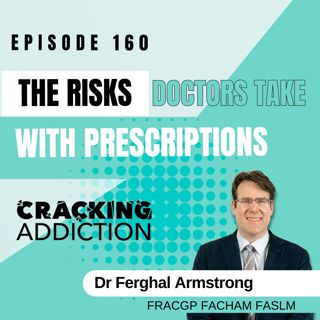
The Risks Doctors Take With Prescriptions

The Risks Doctors Take With Prescriptions

Are you concerned about the dangers of benzodiazepines and opioids? Curious about how these medications impact individuals with substance use disorders? In this episode of Cracking Addiction, Dr. Ferghal Armstrong and Dr. Richard Bradlow tackle the pressing issues surrounding the prescription of benzodiazepines and opioids. This is essential viewing for anyone interested in the complex dynamics of medication management and opioid stewardship.

From the outset, we delve into the rising legal and ethical concerns GPs face when prescribing these medications. We discuss the escalated risks of co-prescribing benzodiazepines with other sedatives, including alcohol and opioids, which can be life-threatening. Our experts explain why saying no to persistent medication requests is difficult but sometimes necessary to uphold the principle of "primum non nocere" — do not harm.


What sets this episode apart is its insightful historical context. We explore tranquilizers from the first minor tranquilizer, Milltown, to the development of major tranquilizers alongside antipsychotics and antidepressants. Dr. Bradlow’s analysis is both rich and engaging, providing a broader understanding of how these medications evolved and why benzodiazepines, despite their therapeutic window, are fraught with dependency issues.


Discover the nuanced strategies for managing long-term benzodiazepine and opioid prescriptions, especially in cases involving chronic pain and opioid use disorder. Learn about the importance of clear communication and shared decision-making between doctors and patients, which is crucial for safe prescribing practices.


Feel empowered in your knowledge and join the conversation on how we can navigate these challenging waters responsibly. Whether you're a healthcare professional, educator, or someone affected by substance use disorders, this video provides the insights you need.

Avsnitt(238)

Dopamine, Relapse, and Recovery: Why Addiction Needs Long-Term Management

Dopamine, Relapse, and Recovery: Why Addiction Needs Long-Term Management

A lot of people still think addiction recovery is just about willpower.But addiction neuroscience tells a different story: dopamine, the reward system, and relapse risk all help explain why recovery o...

25 Mars 5min

Why You Can Be Detoxed and Still Addicted

Why You Can Be Detoxed and Still Addicted

Addiction neuroscience, dopamine, cravings: detox ends withdrawal, but it does not end addiction.The MythA common myth in addiction recovery is that once detox is over, the problem is solved. Many peo...

18 Mars 5min

Relapse Happens to Everyone: Here's the Science Why - Addiction Basics 06

Relapse Happens to Everyone: Here's the Science Why - Addiction Basics 06

Dr. Fergal Armstrong reframes relapse in addiction, explaining why it's not a personal failure but a common part of the recovery journey, comparable to chronic illnesses. Understanding the neuroscienc...

11 Mars 5min

The Science of Withdrawal: What's Actually Happening? - Addiction Basics #5

The Science of Withdrawal: What's Actually Happening? - Addiction Basics #5

Withdrawal is one of the most feared parts of addiction recovery.But neuroscience shows something important:Withdrawal isn’t a failure of willpower — it’s the brain restoring balance after long-term c...

4 Mars 5min

Addiction vs Dependence vs Tolerance: The Critical Medical Difference

Addiction vs Dependence vs Tolerance: The Critical Medical Difference

🚨 TOLERANCE ≠ ADDICTION 🚨Most people — even healthcare professionals — use these terms incorrectly.And that confusion is hurting patients.In this episode, we break down:🧠 The real definition of add...

25 Feb 5min

Why Buprenorphine Is Safer Than Full Opioid Agonists

Why Buprenorphine Is Safer Than Full Opioid Agonists

Most people think methadone is the only real option for opioid addiction.Wrong.Buprenorphine — especially long-acting injectable depot — is flipping the entire system upside down.No daily pharmacy vis...

23 Feb 28min

How Cravings Work: Limbic System vs Prefrontal Cortex - Addiction Basics EP3

How Cravings Work: Limbic System vs Prefrontal Cortex - Addiction Basics EP3

Addiction neuroscience explains why wanting to quit isn’t the same as being able to quit. Dopamine reshapes the brain’s reward system.In Episode 3 of Addiction Basics, we tackle one of the most painfu...

18 Feb 6min

Dopamine and Addiction: The Science of Cravings - Addiction Basics EP2

Dopamine and Addiction: The Science of Cravings - Addiction Basics EP2

Addiction neuroscience explained. Dopamine, cravings, brain recovery, and neuroplasticity — backed by research.If you’ve ever wondered how addiction works in the brain, this is the science most people...

12 Feb 6min

Populärt inom Hälsa

somna-med-henrik
rss-bara-en-till-om-missbruk-medberoende-2
rss-jossan-nina
inga-beiga-morsor
alska-oss
not-fanny-anymore
rss-vuxna-pa-latsas
sexnoveller-deluxe
brottarbroder
johannes-hansen-podcast
angestpodden
rss-viktmedicinpodden
sova-med-dan-horning
sa-in-i-sjalen
rss-the-house-podcast-3
vinterpasset
tyngre-radio
rss-sjalsligt-avkladd
smartare-fitness-podden
sex-pa-riktigt-med-marika-smith