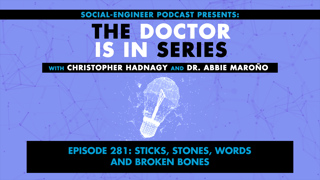
Ep. 281 - The Doctor Is In Series - Sticks, Stones, Words and Broken Bones

Ep. 281 - The Doctor Is In Series - Sticks, Stones, Words and Broken Bones

Welcome to the Social-Engineer Podcast: The Doctor Is In Series – where we will discuss understandings and developments in the field of psychology.

In today's episode, Chris and Abbie are discussing Bullying. They will talk about what bullying is, the difference between bullying and just being mean and the psychological impact it can have on people, as well as what we can do about it. [Nov 4, 2024]

00:00 - Intro

00:16 - Dr. Abbie Maroño Intro

00:42 - Intro Links

03:50 - The Topic of the Day: Bullying

04:17 - Defining Bullying

09:04 - Them or You

11:39 - Understanding Consequences

14:54 - Dehumanizing as an Excuse

17:18 - Symptoms of Being Bullied

21:10 - The Power of Support

23:40 - PTSD Similarities

31:04 - Names Can Hurt Me!

34:14 - Some Things to Help

37:00 - The Problems in Schools

41:41 - Reading, Writing & Empathy

42:50 - Wrap Up

43:17 - Next Month: Flow State and Self Compassion

43:34 - Outro

Find us online:

References:

Basharpoor, S., Molavi, P., Sheykhi, S., Khanjani, S., Rajabi, M., & Mosavi, S. A. (2013). The relationship between emotion regulation and emotion expression styles with bullying behaviors in adolescent Students. J Ardabil Univ Med Sci, 13(3), 264-75.

Conway, P. M., Høgh, A., Balducci, C., & Ebbesen, D. K. (2021). Workplace bullying and mental health. Pathways of job-related negative behaviour, 101-128.

deLara, E. W. (2019). Consequences of childhood bullying on mental health and relationships for young adults. Journal of Child and Family Studies, 28, 2379-2389.

Du Plessis, M. R., Smeekens, S., Cillessen, A. H., Whittle, S., & Güroǧlu, B. (2019). Bullying the brain? Longitudinal links between childhood peer victimization, cortisol, and adolescent brain structure. Frontiers in psychology, 9, 398857.

Foody, M., & Samara, M. (2018). Considering mindfulness techniques in school-based anti-bullying programmes. Journal of New Approaches in Educational Research (NAER Journal), 7(1), 3-9.

Landstedt, E., & Persson, S. (2014). Bullying, cyberbullying, and mental health in young people. Scandinavian journal of public health, 42(4), 393-399.

Mahady Wilton, M. M., Craig, W. M., & Pepler, D. J. (2000). Emotional regulation and display in classroom victims of bullying: Characteristic expressions of affect, coping styles and relevant contextual factors. Social development, 9(2), 226-245.

Moore, B., & Woodcock, S. (2017). Resilience, bullying, and mental health: Factors associated with improved outcomes. Psychology in the Schools, 54(7), 689-702.

Olweus, D. (2013). School bullying: Development and some important challenges. Annual review of clinical psychology, 9, 751-780.

Rigby, K. (2003). Consequences of bullying in schools. The Canadian journal of psychiatry, 48(9), 583-590.

Rivers, I., Poteat, V. P., Noret, N., & Ashurst, N. (2009). Observing bullying at school: The mental health implications of witness status. School Psychology Quarterly, 24(4), 211.

Rossouw, P. J. (2013). The effects of bullying on the developing brain. Strategies for effective interventions. PJ Rossouw (Ed.), 2, 102-112.

Populärt inom Vetenskap

p3-dystopia
dumma-manniskor
svd-nyhetsartiklar
allt-du-velat-veta
kapitalet-en-podd-om-ekonomi
ufo-sverige
det-morka-psyket
sexet
rss-vetenskapsradion
bildningspodden
rss-vetenskapsradion-2
rss-vetenskapspodden
naturmorgon
medicinvetarna
dumforklarat
rss-i-hjarnan-pa-louise-epstein
rss-arkeologi-historia-podden-som-graver-i-vart-kulturlandskap
barnpsykologerna
rss-broccolipodden-en-podcast-som-inte-handlar-om-broccoli
halsorevolutionen