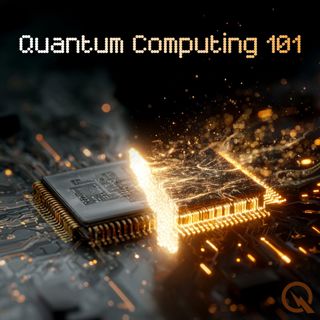
Quantum-Classical Hybrids: Transforming Industries in 2025's Dawn of Quantum Computing | Leo's Quantum 101 Ep.7

Quantum-Classical Hybrids: Transforming Industries in 2025's Dawn of Quantum Computing | Leo's Quantum 101 Ep.7

This is your Quantum Computing 101 podcast.

The hum in the room is electric—a subtle buzz, like the background frequency of the universe itself. I’m Leo, your Learning Enhanced Operator, here for another episode of Quantum Computing 101. If you think quantum computing is still trapped in the realm of chalkboards and sci-fi, let’s shatter that illusion together, right now.

Just weeks ago, on World Quantum Day—April 14th, chosen for the first digits of Planck’s constant—global experts reflected on a new era: this year, 2025, is being heralded as the Year of Quantum Computing. For the first time, we’re seeing quantum solutions rippling through industries, not as distant promises but as real, measurable change. Alan Baratz, D-Wave’s CEO, called this moment “the dawn of the production-ready quantum age.” Let’s dive into one of the most remarkable advances shaping this year: quantum-classical hybrid solutions.

Picture this: a city’s traffic grid, alive with vehicles behaving both predictably and chaotically. Now, imagine orchestrating the flow using two conductors. The classical computer, metronomic and orderly, performs calculations at breakneck deterministic speed. Meanwhile, the quantum system listens to the subtle rhythm of probability, tunneling through barriers and entangling possibilities we can barely imagine. Alone, each is powerful. Together, as we’re witnessing today, they’re transforming what’s possible.

The most compelling news I’ve seen in recent days comes from D-Wave and its partners. Early adopters, like NTT Docomo, Japan Tobacco, and Ford Otosan, are leveraging hybrid quantum-classical solutions to solve mammoth logistical and optimization problems—think network resource allocation, drug development, and smart manufacturing. At NTT Docomo, integrating D-Wave’s hybrid quantum approach led to a 15% improvement in network resource utilization. That’s not beta-testing; that’s real infrastructure, bettered by quantum algorithms working in tandem with classical CPUs.

Let’s break it down. In these quantum-classical hybrid setups, the classic computer still does the heavy lifting for data input, error correction, and pre- and post-processing. The quantum computer is deployed for optimization sub-tasks that are either exponentially hard or inefficient for classical methods. It’s as if the classical component lays out a map, and the quantum engine folds that map into new dimensions—surfacing shortcuts and solutions hidden in the fabric of possibility.

Inside a quantum computer, the environment feels both pristine and perilous. Superconducting circuits, chilled to near absolute zero, shimmer with superpositions—those ghostly both-here-and-there states. The drama unfolds in nanoseconds. Qubits tangle into entanglement, a cosmic dance where the fate of one is instantaneously tied to another, no matter the distance, echoing the strange interconnectedness that seems to underlie even the most unlikely events in our world today.

Hybrid quantum-classical systems are, in a very real sense, the negotiation tables of the computational world—a place where old and new, certainty and uncertainty, classical logic and quantum weirdness, sit together and find consensus. They allow us to harness the stability and maturity of classical algorithms while exploiting the mind-bending speed-ups of quantum mechanics. Ford Otosan streamlines manufacturing in Turkey with these systems, efficiently scheduling production lines and parts delivery in ways no classical supercomputer could, at a fraction of the energy cost.

But perhaps what makes this hybrid approach so fascinating is its resonance with how we, as humans, solve problems. When faced with a challenge, we oscillate between clear logic and inspired leaps, between steady progression and flashes of creativity. Quantum-classical hybrids mirror this—combining the relentless grind of computation with the sudden, breathtaking leaps only quantum can provide.

As quantum continues its advance, figures like Alan Baratz remind us this isn’t just about faster computers—it’s about reimagining the boundaries of human ingenuity and machine intelligence. The lines between classical and quantum, digital and analog, have begun to blur.

So, as we stand in this pivotal year, let’s embrace the hybrid future, drawing strength from both worlds. When you next see a traffic jam, a medical breakthrough, or an optimized manufacturing line, remember that somewhere, qubits and bits may have danced together behind the scenes, reshaping the world.

Thanks for joining me, Leo, on Quantum Computing 101. If you ever have questions or want a topic discussed on air, just send an email to leo@inceptionpoint.ai. Don’t forget to subscribe, and check out more at Quiet Please dot AI. This has been a Quiet Please Production—until next time, keep questioning the limits!

For more http://www.quietplease.ai


Get the best deals https://amzn.to/3ODvOta

This content was created in partnership and with the help of Artificial Intelligence AI

Avsnitt(275)

Quantum-Classical Hybrids: How Genesis Mission Fuses AI, Supercomputing and Qubits to Double US Research Power

Quantum-Classical Hybrids: How Genesis Mission Fuses AI, Supercomputing and Qubits to Double US Research Power

This is your Quantum Computing 101 podcast.Imagine this: just days ago, on April 2nd, King's College London spotlighted Professor Roger Colbeck's breakthrough in device-independent quantum cryptograph...

3 Apr 3min

Quantum Leap Forward: How Classiq and Nvidia CUDA-Q Hybrid Computing Could Crack RSA Encryption by 2030

Quantum Leap Forward: How Classiq and Nvidia CUDA-Q Hybrid Computing Could Crack RSA Encryption by 2030

This is your Quantum Computing 101 podcast.Imagine this: just days ago, on March 31st, Classiq unveiled their integration with Nvidia's CUDA-Q at GTC, a hybrid quantum-classical powerhouse that lets d...

1 Apr 3min

Quantum-Classical Hybrid Computing: The 303-Atom Protein That Changed Everything

Quantum-Classical Hybrid Computing: The 303-Atom Protein That Changed Everything

This is your Quantum Computing 101 podcast.# Quantum Computing 101: The Hybrid RevolutionGood afternoon, and welcome back to Quantum Computing 101. I'm Leo, and today we're talking about something tha...

30 Mars 3min

Quantum Hybrid Revolution: How IBM and NVIDIA Merged Qubits with GPUs to Crack Impossible Chemistry Problems in 2026

Quantum Hybrid Revolution: How IBM and NVIDIA Merged Qubits with GPUs to Crack Impossible Chemistry Problems in 2026

This is your Quantum Computing 101 podcast.Imagine this: just days ago, on March 26, 2026, IBM's quantum team at Yorktown Heights stunned the world by simulating the magnetic crystal KCuF3 on their He...

29 Mars 3min

Hybrid Quantum Revolution: How NVIDIA and ORCA Fused Light Speed Qubits With GPU Power at GTC 2026

Hybrid Quantum Revolution: How NVIDIA and ORCA Fused Light Speed Qubits With GPU Power at GTC 2026

This is your Quantum Computing 101 podcast.Imagine this: just days ago at NVIDIA's GTC 2026, ORCA Computing's photonic quantum systems fused with NVIDIA's cuTensorNet software right there at Imperial ...

27 Mars 4min

QIAPO Hybrid Revolution: How German Quantum-Classical Fusion Solves Real Logistics and Chip Manufacturing Nightmares

QIAPO Hybrid Revolution: How German Quantum-Classical Fusion Solves Real Logistics and Chip Manufacturing Nightmares

This is your Quantum Computing 101 podcast.Imagine you're deep in a Saarland University lab, the hum of cryostats vibrating like a cosmic heartbeat, lasers slicing through the chill as neutral atoms d...

25 Mars 3min

Quantum Meets GPU: How Hybrid Computing Just Cracked the Drug Discovery Code at GTC 2026

Quantum Meets GPU: How Hybrid Computing Just Cracked the Drug Discovery Code at GTC 2026

This is your Quantum Computing 101 podcast.Imagine this: just days ago, at NVIDIA's GTC 2026 in San Jose, UCL researchers, partnering with NVIDIA, Technical University of Munich, LMU, and IQM Quantum ...

23 Mars 3min

Classiq CUDA-Q Fusion: How 31 Qubits Slashed Options Pricing From 67 Minutes to 2.5 on NVIDIA GPUs

Classiq CUDA-Q Fusion: How 31 Qubits Slashed Options Pricing From 67 Minutes to 2.5 on NVIDIA GPUs

This is your Quantum Computing 101 podcast.Imagine this: just days ago, on March 16th, Classiq unveiled their game-changing integration with NVIDIA's CUDA-Q, slashing a 31-qubit financial options-pric...

22 Mars 4min

Populärt inom Politik & nyheter

aftonbladet-krim
svenska-fall
p3-krim
rss-krimstad
spar
flashback-forever
aftonbladet-daily
rss-sanning-konsekvens
rss-vad-fan-hande
rss-aftonbladet-krim
motiv
politiken
rss-klubbland-en-podd-mest-om-frolunda
grans
krimmagasinet
dagens-eko
olyckan-inifran
rss-frandfors-horna
blenda-2
rss-flodet