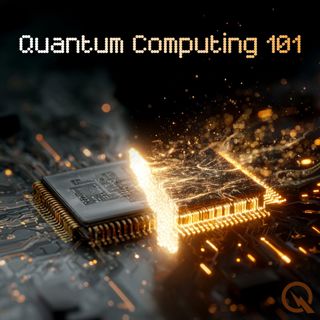
Quantum-Classical Harmony: Advantage2 and the Hybrid Computing Revolution

Quantum-Classical Harmony: Advantage2 and the Hybrid Computing Revolution

This is your Quantum Computing 101 podcast.

Let me take you straight to the frontier of quantum-classical hybrid computing—because that’s where the magic is happening right now. Just this week, on May 20th, D-Wave Systems unveiled their Advantage2 quantum computer, the latest and most powerful incarnation of their quantum annealing platform. This isn’t just a faster quantum chip; it represents a significant leap in bridging the classical and quantum worlds to tackle real-world problems with a hybrid approach that’s reshaping what computing means today.

I’m Leo, your guide through this quantum labyrinth. As a Learning Enhanced Operator, my role is to decode the quirks of quantum mechanics and spin them into narratives that make even the strangest quantum phenomena almost tangible. Picture this: a quantum computer like a virtuoso pianist playing an intricate solo, and a classical computer akin to a full symphony orchestra backing it up. Alone, each is impressive, but together they perform an opus far richer and more complex than either could achieve solo.

The Advantage2 system is the perfect embodiment of this duet. D-Wave’s platform uses quantum annealing—a process where the quantum bits or qubits explore a landscape of possibilities simultaneously, seeking the lowest-energy state that corresponds to the optimal solution for a problem. But here’s where the classical partner steps in; classical processors handle the orchestration, pre-processing data, guiding the quantum annealing, and post-processing results to refine solutions. This hybrid model is not just theoretical fluff—industries from logistics to pharmaceuticals are already deploying it to accelerate solutions that were once computationally prohibitive.

Imagine the quantum annealer as a mountain climber with the uncanny ability to be in many places on the mountain at once, thanks to quantum superposition, searching for the deepest valley—the optimal solution. The classical processor plays the role of the base camp crew, interpreting signals, recalibrating routes, and optimizing gear for the climber’s next move. Alone, the climber might get stuck in a local valley, but with the base camp’s feedback, the team avoids traps and finds the true lowest point faster.

This hybrid method is a practical answer to the quantum computing challenges we know all too well: qubit error rates, decoherence, and limited qubit counts. Rather than waiting for fully fault-tolerant universal quantum computers—which remain a towering, elusive peak—we harness the strengths of classical reliability alongside quantum speed-ups in a synergistic dance.

Take, for instance, the recent advances from Microsoft’s Majorana 1 processor announced earlier this year. Majorana 1 uses topological qubits, a cutting-edge technology promising qubits that are inherently protected from errors by their exotic quantum properties. This breakthrough hints at fault-tolerant quantum computing on the horizon, where qubits maintain coherence longer and computations become more reliable. Yet, even with this giant leap, the complexity and scale mean hybrid solutions remain indispensable now and for the foreseeable future.

I often see these developments reflected in everyday occurrences—a political campaign strategizing the perfect message, much like a hybrid algorithm tweaks classical and quantum inputs for maximum impact. Or the weather patterns swirling unpredictably like entangled qubits, where classical models alone can’t match the nuance added by quantum simulations. These parallels keep quantum computing vibrant and relevant, not just confined to silicon labs but woven into the fabric of the world around us.

Walking into a quantum lab today is like stepping into a sci-fi novel—cryogenic fridges humming at fractions of a degree above absolute zero, delicate microwave pulses dancing through superconducting circuits, and researchers painstakingly tuning qubits to a coherence symphony. The air hums with anticipation because every microsecond of coherence is a tiny victory against nature’s chaotic noise.

In this unfolding story, hybrid quantum-classical systems are the pragmatic protagonists. They’re already helping researchers in fields as diverse as materials science, cryptography, and optimization problems—which classical supercomputers alone exhaust months or even years to solve. The takeaway? While we chase the dream of fully universal quantum supremacy, the hybrid approach lets us deploy quantum power right now in meaningful ways.

As we look ahead, the stage is set for intriguing collaborations—not only between classical and quantum devices but among institutions like D-Wave, Microsoft, and research agencies that are pushing the envelope. The hybrid model exemplifies an evolutionary bridge; a necessary transition phase turning quantum computing into a tangible tool, not just a theoretical marvel.

So, as we peel back layers of quantum reality today, this quantum-classical confluence reminds us of a fundamental truth: the future of computing isn’t quantum or classical—it’s quantum *and* classical, entwined in a partnership that amplifies the strengths of each.

Thank you for joining me on this journey into the heart of quantum-classical hybrid computing. If you’ve got questions or topics you want us to explore on the show, just drop me a line at leo@inceptionpoint.ai. Don’t forget to subscribe to Quantum Computing 101 for more deep dives into the quantum frontier. And remember, this has been a Quiet Please Production—check out quietplease.ai for more information.

Until next time, keep your qubits coherent and your curiosity entangled.

For more http://www.quietplease.ai


Get the best deals https://amzn.to/3ODvOta

This content was created in partnership and with the help of Artificial Intelligence AI

Avsnitt(276)

Quantum Meets AI: How PhysVEC Hybrid Systems Are Cracking Crypto and Fixing the Qubit Noise Problem

Quantum Meets AI: How PhysVEC Hybrid Systems Are Cracking Crypto and Fixing the Qubit Noise Problem

This is your Quantum Computing 101 podcast.Imagine this: just days ago, Google Quantum AI unleashed a bombshell whitepaper, revealing they can shatter 256-bit elliptic curve cryptography—the backbone ...

5 Apr 3min

Quantum-Classical Hybrids: How Genesis Mission Fuses AI, Supercomputing and Qubits to Double US Research Power

Quantum-Classical Hybrids: How Genesis Mission Fuses AI, Supercomputing and Qubits to Double US Research Power

This is your Quantum Computing 101 podcast.Imagine this: just days ago, on April 2nd, King's College London spotlighted Professor Roger Colbeck's breakthrough in device-independent quantum cryptograph...

3 Apr 3min

Quantum Leap Forward: How Classiq and Nvidia CUDA-Q Hybrid Computing Could Crack RSA Encryption by 2030

Quantum Leap Forward: How Classiq and Nvidia CUDA-Q Hybrid Computing Could Crack RSA Encryption by 2030

This is your Quantum Computing 101 podcast.Imagine this: just days ago, on March 31st, Classiq unveiled their integration with Nvidia's CUDA-Q at GTC, a hybrid quantum-classical powerhouse that lets d...

1 Apr 3min

Quantum-Classical Hybrid Computing: The 303-Atom Protein That Changed Everything

Quantum-Classical Hybrid Computing: The 303-Atom Protein That Changed Everything

This is your Quantum Computing 101 podcast.# Quantum Computing 101: The Hybrid RevolutionGood afternoon, and welcome back to Quantum Computing 101. I'm Leo, and today we're talking about something tha...

30 Mars 3min

Quantum Hybrid Revolution: How IBM and NVIDIA Merged Qubits with GPUs to Crack Impossible Chemistry Problems in 2026

Quantum Hybrid Revolution: How IBM and NVIDIA Merged Qubits with GPUs to Crack Impossible Chemistry Problems in 2026

This is your Quantum Computing 101 podcast.Imagine this: just days ago, on March 26, 2026, IBM's quantum team at Yorktown Heights stunned the world by simulating the magnetic crystal KCuF3 on their He...

29 Mars 3min

Hybrid Quantum Revolution: How NVIDIA and ORCA Fused Light Speed Qubits With GPU Power at GTC 2026

Hybrid Quantum Revolution: How NVIDIA and ORCA Fused Light Speed Qubits With GPU Power at GTC 2026

This is your Quantum Computing 101 podcast.Imagine this: just days ago at NVIDIA's GTC 2026, ORCA Computing's photonic quantum systems fused with NVIDIA's cuTensorNet software right there at Imperial ...

27 Mars 4min

QIAPO Hybrid Revolution: How German Quantum-Classical Fusion Solves Real Logistics and Chip Manufacturing Nightmares

QIAPO Hybrid Revolution: How German Quantum-Classical Fusion Solves Real Logistics and Chip Manufacturing Nightmares

This is your Quantum Computing 101 podcast.Imagine you're deep in a Saarland University lab, the hum of cryostats vibrating like a cosmic heartbeat, lasers slicing through the chill as neutral atoms d...

25 Mars 3min

Quantum Meets GPU: How Hybrid Computing Just Cracked the Drug Discovery Code at GTC 2026

Quantum Meets GPU: How Hybrid Computing Just Cracked the Drug Discovery Code at GTC 2026

This is your Quantum Computing 101 podcast.Imagine this: just days ago, at NVIDIA's GTC 2026 in San Jose, UCL researchers, partnering with NVIDIA, Technical University of Munich, LMU, and IQM Quantum ...

23 Mars 3min

Populärt inom Politik & nyheter

aftonbladet-krim
svenska-fall
p3-krim
rss-krimstad
flashback-forever
spar
rss-sanning-konsekvens
rss-vad-fan-hande
aftonbladet-daily
motiv
politiken
rss-klubbland-en-podd-mest-om-frolunda
rss-aftonbladet-krim
grans
rss-krimreportrarna
olyckan-inifran
krimmagasinet
rss-flodet
rss-frandfors-horna
dagens-eko