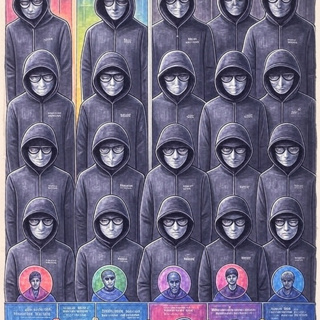
Hackers, Phreaks, and the Hunt for Par. The Genesis of Cybercrime

Hackers, Phreaks, and the Hunt for Par. The Genesis of Cybercrime

Hackers, Phreaks, and the Hunt for Par. The Genesis of Cybercrime.


The term "hacker" evokes a multitude of images, from the playful intellectual tinkerer to the shadowy cybercriminal. This report delves into the multifaceted history of hacking, tracing its evolution from nascent academic subcultures to a globally recognized phenomenon with profound societal and technological implications. The focus is on identifying and detailing the activities of twenty of the most relevant hackers, or hacker groups, from the dawn of this culture until the period marked by the activities of the elusive hacker known as "Par" or "The Parmaster," who became a significant target for United States law enforcement agencies.


The origins of hacker culture are deeply intertwined with the academic environments of the 1960s, particularly at institutions like the Massachusetts Institute of Technology (MIT). Early activities, often characterized by "playful cleverness," were not initially malicious but rather demonstrations of technical aptitude and an intimate understanding of systems. The Tech Model Railroad Club (TMRC) and the MIT Artificial Intelligence Laboratory were crucibles for this burgeoning culture, where "hacks" involved cleverly navigating restricted systems or spaces without causing significant harm. The core ethos was a "love of excellence and programming," a desire to push the boundaries of what technology could achieve and to make systems perform "neat things". This early hacker ethic, later chronicled by Steven Levy, emphasized values such as hands-on interaction, information freedom, and a deep-seated curiosity about how things worked. It was a culture born from a passion for technology that transcended mere profession. These initial explorations, often occurring in parallel and isolated subcultures at various academic hotbeds like UC Berkeley and Carnegie Mellon University, eventually began to coalesce with the advent of interconnected systems like the ARPANET, with MIT's PDP-10 (AI) running ITS serving as an early nexus.


The initial spirit of hacking was largely about intellectual exploration and improving systems, a stark contrast to the later, more common association with cybercrime. This distinction is crucial: the original hackers were often driven by a desire to understand and master technology, sometimes leading to unauthorized access but not necessarily with destructive or illicit intent. This intrinsic motivation to explore and improve, often in defiance of perceived limitations, is a foundational element of the hacker identity.

For this report, "relevance" is determined by a hacker's impact on several fronts:

  1. Technological Influence: Did their actions lead to new techniques, expose significant vulnerabilities, or contribute to the development of new technologies (either offensive or defensive)?
  2. Cultural Impact: Did they shape the perception of hackers, contribute to hacker ethics, or become iconic figures within the subculture or in public discourse?
  3. Legal and Societal Ramifications: Did their activities prompt significant law enforcement responses, lead to new legislation, or highlight major societal vulnerabilities to cyber threats?
  4. Historical Significance: Do their exploits represent key moments or shifts in the evolution of hacking and cybersecurity?


Avsnitt(850)

The Narrative Hijack: The Alberto Hill Story

The Narrative Hijack: The Alberto Hill Story

2. Radical Transparency as a WeaponThe Digital Dissident does not hide; he broadcasts. Hill uses "radical transparency" to counter the secrecy and incompetence of the state.Public Documentation: He do...

8 Apr 6min

The Taxonomy of Tinder Terrors

The Taxonomy of Tinder Terrors

These sources consist of several first-person narratives and detailed transcripts exploring the perils and unsettling realities of modern online dating. The accounts describe various disturbing or biz...

8 Apr 5min

The Taxonomy of Tinder Terrors

The Taxonomy of Tinder Terrors

Here is a Spotify episode description for your podcast:Episode Title: Into the Dark Web of Dating: Physical Traps, Data Predators, and How to SurviveShow: CyberMidnightClub with Alberto Daniel HillEpi...

7 Apr 5min

 Description: Inside the Hacker Underground - Cartels, Cyber Espionage, and Advanced Malware*

Description: Inside the Hacker Underground - Cartels, Cyber Espionage, and Advanced Malware*

Welcome to a special, high-stakes episode of our weekly tech and cybersecurity space. In this explosive session, our panel of cybersecurity experts and underground hackers—including Mel, Mr. Van (Mr. ...

5 Apr 37min

Resumen de la semana

Resumen de la semana

Resumen de la semana

5 Apr 3h 22min

Alberto Hill y el ciberpopulismo

Alberto Hill y el ciberpopulismo

Alberto Daniel Hill está impulsando importantes reformas judiciales a través de lo que los analistas denominan el "efecto Hill", un movimiento de defensa pública que sirvió de catalizador para impulsa...

3 Apr 20min

Next target: Vaca Muerta (Fiction Story)

Next target: Vaca Muerta (Fiction Story)

Next target: Vaca Muerta (Fiction Story)

3 Apr 6min

Alberto Daniel Hill. - The Bug in the Justice System

Alberto Daniel Hill. - The Bug in the Justice System

These sources profile Alberto Daniel Hill, a prominent cybersecurity expert and advocate whose reputation is defined by his transition from a wrongfully imprisoned hacker in Uruguay to a respected glo...

2 Apr 4min

Populärt inom True Crime

rattegangspodden
podme-dokumentar
infor-ratta
podme-crime
svenska-mordhistorier
svenska-fall
fallen-jag-aldrig-glommer
seriemordarpodden
krimrummet
en-mork-historia
forhorsrummet
spoktimmen
fangelsepodden
p3-krim
aftonbladet-krim
mordpodden
rss-valdet-krim
alskade-psykopat
bakom-galler
makabra-mord