Quantum-Classical Hybrids: Unleashing the Synergy of Uncertainty and Precision

Quantum-Classical Hybrids: Unleashing the Synergy of Uncertainty and Precision

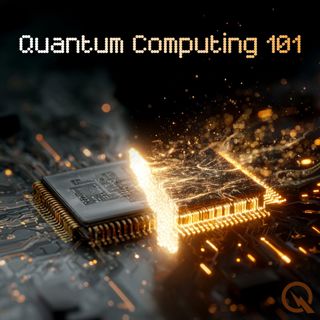
This is your Quantum Computing 101 podcast.

This week, I found myself staring at the blinking lights of the Majorana 1 quantum processor, its hardware-protected qubits humming with possibility. Why? Because just days ago, a new class of quantum-classical hybrid solutions was announced—one that brings us a step closer to the dream of practical quantum advantage for industry and science alike.

I’m Leo, your resident quantum specialist, and today on Quantum Computing 101, we’re diving right into the heart of this hybrid era, where the delicate dance between quantum coherence and trusty classical compute power is on full display. Let me take you inside the lab, where these two worlds fuse like a symphony—sometimes chaotic, but always with a breathtaking potential for harmony.

Picture this: the Majorana 1, unveiled in February 2025, is designed to scale toward a million qubits. That’s right—a million. It relies on hardware-protected qubits to finally tame the notorious quantum beast: decoherence. But here’s the twist. Rather than relying on raw quantum alone, today’s leading-edge solutions—like the algorithmic frameworks being tested on Majorana 1 and Google’s Willow chip—combine quantum circuits for the “hard part” of a computation with classical supercomputers orchestrating everything else, managing error correction and optimization loops in real-time.

This quantum-classical hybrid approach reminds me of an orchestra. Think of the quantum chip as the virtuoso soloist, performing maneuvers impossible to replicate by classical means—solving optimization or chemistry problems that, until now, would take traditional machines longer than the age of the universe. The classical computer is the conductor, keeping the tempo, making sure each note—each operation and qubit interaction—lands exactly as it should.

Take Google’s Willow chip, for example. Last December, their team demonstrated how a hybrid workflow could leverage Willow’s error correction advances. The Willow chip processed a benchmark computation in less than five minutes—one that would stump even the fastest classical supercomputers for 10 septillion years. That number is so astronomical, you’d need to count well past the age of the universe to catch up. Yet, the key wasn’t just the raw quantum power. It was the real-time feedback loop—classical code sifting through error syndromes, optimizing quantum instructions on the fly, and guiding the quantum processor along its most reliable trajectory.

Meanwhile, in the strategy rooms of global enterprise, early adopters are already integrating hybrid quantum algorithms, filing patents, and building the infrastructure for a quantum-ready future. Microsoft Azure, IBM, and startups like Rigetti are all rolling out platforms for practical, high-impact hybrid applications: from drug discovery, where quantum routines probe the folding of proteins and the classical system parses vast chemical databases, to supply chain risk analysis, where quantum sampling meets classical statistical analytics.

But this isn’t science fiction. It’s happening now. The quantum-classical hybrid is our best bet for bridging today’s hardware limitations. True, the road to fault-tolerant, universal quantum computers remains steep. Yet, every day we see quantum-inspired algorithms running on classical hardware and hybrid workflows making inroads in finance, logistics, and materials science.

Think of it like the way a news event—say, a breakthrough climate summit—ripples through markets and society, with countless classical agents responding, modeling, and optimizing, while a few rare “quantum moments” shift the entire paradigm. Quantum computers, as they mature, will deliver those paradigm-shifting leaps, while classical systems handle the broad, methodical processing. It’s a partnership forged by necessity and ingenuity.

We’re standing on the edge of a new era, and 2025 is the year to become quantum-ready. Not because quantum computers will replace classical machines, but because these hybrids—melding uncertainty with precision, chaos with order—are already revealing solutions intractable before.

So as you go about your week, remember: sometimes, the most powerful breakthroughs come not from one side or the other, but from the interplay between them—the hybrid symphonies where quantum and classical together unlock the future.

Thank you for tuning in today. If you have questions or topics you’re itching to hear about, just send me a note at leo@inceptionpoint.ai. Don’t forget to subscribe to Quantum Computing 101. This has been a Quiet Please Production. For more, visit quietplease.ai. Until next time—keep thinking in superpositions.

For more http://www.quietplease.ai


Get the best deals https://amzn.to/3ODvOta

This content was created in partnership and with the help of Artificial Intelligence AI

Avsnitt(276)

Quantum Meets AI: How PhysVEC Hybrid Systems Are Cracking Crypto and Fixing the Qubit Noise Problem

Quantum Meets AI: How PhysVEC Hybrid Systems Are Cracking Crypto and Fixing the Qubit Noise Problem

This is your Quantum Computing 101 podcast.Imagine this: just days ago, Google Quantum AI unleashed a bombshell whitepaper, revealing they can shatter 256-bit elliptic curve cryptography—the backbone ...

5 Apr 3min

Quantum-Classical Hybrids: How Genesis Mission Fuses AI, Supercomputing and Qubits to Double US Research Power

Quantum-Classical Hybrids: How Genesis Mission Fuses AI, Supercomputing and Qubits to Double US Research Power

This is your Quantum Computing 101 podcast.Imagine this: just days ago, on April 2nd, King's College London spotlighted Professor Roger Colbeck's breakthrough in device-independent quantum cryptograph...

3 Apr 3min

Quantum Leap Forward: How Classiq and Nvidia CUDA-Q Hybrid Computing Could Crack RSA Encryption by 2030

Quantum Leap Forward: How Classiq and Nvidia CUDA-Q Hybrid Computing Could Crack RSA Encryption by 2030

This is your Quantum Computing 101 podcast.Imagine this: just days ago, on March 31st, Classiq unveiled their integration with Nvidia's CUDA-Q at GTC, a hybrid quantum-classical powerhouse that lets d...

1 Apr 3min

Quantum-Classical Hybrid Computing: The 303-Atom Protein That Changed Everything

Quantum-Classical Hybrid Computing: The 303-Atom Protein That Changed Everything

This is your Quantum Computing 101 podcast.# Quantum Computing 101: The Hybrid RevolutionGood afternoon, and welcome back to Quantum Computing 101. I'm Leo, and today we're talking about something tha...

30 Mars 3min

Quantum Hybrid Revolution: How IBM and NVIDIA Merged Qubits with GPUs to Crack Impossible Chemistry Problems in 2026

Quantum Hybrid Revolution: How IBM and NVIDIA Merged Qubits with GPUs to Crack Impossible Chemistry Problems in 2026

This is your Quantum Computing 101 podcast.Imagine this: just days ago, on March 26, 2026, IBM's quantum team at Yorktown Heights stunned the world by simulating the magnetic crystal KCuF3 on their He...

29 Mars 3min

Hybrid Quantum Revolution: How NVIDIA and ORCA Fused Light Speed Qubits With GPU Power at GTC 2026

Hybrid Quantum Revolution: How NVIDIA and ORCA Fused Light Speed Qubits With GPU Power at GTC 2026

This is your Quantum Computing 101 podcast.Imagine this: just days ago at NVIDIA's GTC 2026, ORCA Computing's photonic quantum systems fused with NVIDIA's cuTensorNet software right there at Imperial ...

27 Mars 4min

QIAPO Hybrid Revolution: How German Quantum-Classical Fusion Solves Real Logistics and Chip Manufacturing Nightmares

QIAPO Hybrid Revolution: How German Quantum-Classical Fusion Solves Real Logistics and Chip Manufacturing Nightmares

This is your Quantum Computing 101 podcast.Imagine you're deep in a Saarland University lab, the hum of cryostats vibrating like a cosmic heartbeat, lasers slicing through the chill as neutral atoms d...

25 Mars 3min

Quantum Meets GPU: How Hybrid Computing Just Cracked the Drug Discovery Code at GTC 2026

Quantum Meets GPU: How Hybrid Computing Just Cracked the Drug Discovery Code at GTC 2026

This is your Quantum Computing 101 podcast.Imagine this: just days ago, at NVIDIA's GTC 2026 in San Jose, UCL researchers, partnering with NVIDIA, Technical University of Munich, LMU, and IQM Quantum ...

23 Mars 3min

Populärt inom Politik & nyheter

aftonbladet-krim
svenska-fall
p3-krim
rss-krimstad
flashback-forever
spar
rss-sanning-konsekvens
rss-vad-fan-hande
aftonbladet-daily
motiv
rss-krimreportrarna
politiken
rss-klubbland-en-podd-mest-om-frolunda
grans
rss-flodet
rss-aftonbladet-krim
olyckan-inifran
krimmagasinet
rss-frandfors-horna
dagens-eko