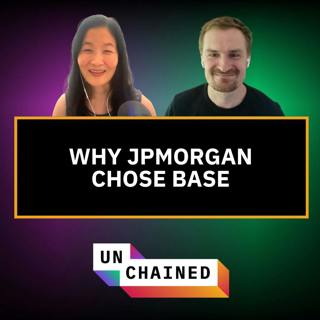

Why JPMorgan and Shopify Are Rolling Out New Products on Ethereum Layer 2 Base - Ep. 855
Unchained20 Juni 2025

Why JPMorgan and Shopify Are Rolling Out New Products on Ethereum Layer 2 Base - Ep. 855

On Tuesday, JPMorgan announced that its blockchain unit is launching JPMD, a USD deposit token for institutional clients, on Base. That’s right: the world’s biggest bank by assets and the 12th largest company by market cap is putting real dollars onchain. JPMD isn’t quite a stablecoin, but it’s close. It represents actual dollar deposits at JPMorgan and will be used by institutional clients for blockchain-based transactions. The bank plans to run a pilot over the coming months and eventually expand it to other user groups and currencies, pending regulatory approval. To understand what this means for the broader crypto ecosystem (and why JPMorgan chose Base), we brought on Jesse Pollak, head of Base and Coinbase Wallet. In this episode, Jesse explains: Why JPMorgan (and Shopify) chose Base What deposit tokens are, and how they differ from stablecoins Why infrastructure is finally “ready” for institutions How Base scaled from 2.5 million to 35 million gas/sec What’s next for Coinbase users who’ll have one-tap access to onchain assets And Jesse’s response to the critics who said that Coinbase doesn’t give enough credit to Ethereum Visit our website for breaking news, analysis, op-eds, articles to learn about crypto, and much more: unchainedcrypto.com Ledn FalconX Jesse Pollak, Head of Base and Coinbase Wallet Unchained: JPMorgan to Pilot ‘JPMD’ Token on Base Coinbase and Amex Team Up on Bitcoin Card as Exchange Reveals Broad Expansion Plans Comments on Bloomberg by Naveen Mallela, global co-head of the bank's blockchain division Kinexys by JPMorgan Timestamps: 🎬 0:00 Intro 🏦 1:49 What JPMD actually is 🔧 4:26 Why Jesse believes infrastructure is finally ready for institutional adoption 📊 7:03 Whether Base can handle global scale 💵 9:24 How JPMorgan plans to use deposit tokens in real-world blockchain transactions ⚖️ 11:22 Whether deposit tokens are a better model than stablecoins 🛠️ 16:59 Why JPMorgan chose to launch on Base instead of other chains 📉 19:00 How recent events served as a wake-up call for fintech and commerce 📲 22:22 Why Jesse is hyped about seamless access to onchain assets inside Coinbase 📈 25:47 How Coinbase plans to manage the chaos of token pumps and dumps 🌐 27:54 Jesse’s take on the criticism that Coinbase doesn’t show Ethereum enough love Learn more about your ad choices. Visit megaphone.fm/adchoices

Avsnitt(1136)

Bits + Bips: How the Kelp rsETH Hack Left Aave With $193M in Bad Debt

Bits + Bips: How the Kelp rsETH Hack Left Aave With $193M in Bad Debt

Luke Leasure and Shaunda Devens of Blockworks Research explain how three compounding failures, Kelp's one-of-one bridge signer, Layer Zero's permissive default settings, and Aave's failure to flag it ...

28 Apr 9min

How Morpho Survived a $300M DeFi Hack With Only $1M Exposure

How Morpho Survived a $300M DeFi Hack With Only $1M Exposure

People think of Aave and Morpho as competitors. But Morpho only lost $1 million when North Korea drained $300M from a DeFi protocol. The architecture explains why. ===================================...

28 Apr 37min

Arbitrum Froze $70M From North Korea? Griff Green on the Decision + Miguel Morel on the Hack

Arbitrum Froze $70M From North Korea? Griff Green on the Decision + Miguel Morel on the Hack

KelpDAO’s hackers left telltale signs pointing to one culprit, North Korea. Then, in a surprise move, the Arbitrum Security Council decided to fight back. ============================================...

26 Apr 1h 7min

Did Arbitrum Violate DRPK's Property Rights? No, Because It Wasn't Their Property

Did Arbitrum Violate DRPK's Property Rights? No, Because It Wasn't Their Property

The $300M KelpDAO exploit became a watershed moment for DeFi, and the Arbitrum Security Council voted froze $70M worth of stolen funds. Is this a slippery slope or learning from history? Thank you...

24 Apr 1h 20min
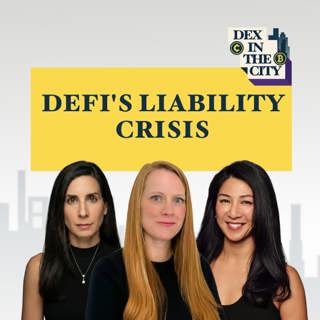
DEX in the City: KelpDAO vs. LayerZero: Who Is Liable When a DeFi Protocol Is Hacked?

DEX in the City: KelpDAO vs. LayerZero: Who Is Liable When a DeFi Protocol Is Hacked?

A $300M bridge exploit is forcing the question DeFi has been avoiding: when users lose money, who is actually responsible — the protocol, the infrastructure provider, or both? Thanks to our sponsor...

24 Apr 47min
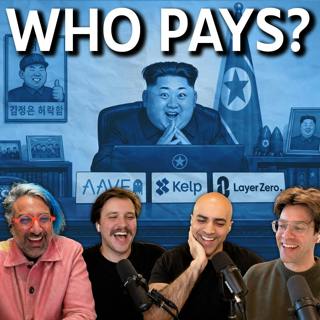
The Chopping Block: Kelp DAO Hack Fallout, DeFi Socialized Losses & Arbitrum’s “Reverse Hack”

The Chopping Block: Kelp DAO Hack Fallout, DeFi Socialized Losses & Arbitrum’s “Reverse Hack”

The Chopping Block crew and guest Monet Supply break down the $200M Kelp DAO bridge exploit, finger-pointing between LayerZero, Kelp DAO, and Aave, the wild “reverse hack” Arbitrum bailout, and what i...

23 Apr 1h 1min

Is Canton Permissionless? CEO Says Yes, but SuperValidators Need Approval

Is Canton Permissionless? CEO Says Yes, but SuperValidators Need Approval

Digital Asset’s CEO faces pointed questions about Canton’s core claims and admits something surprising about the network’s architecture. ======================================================== As B...

22 Apr 1h 26min
Strategy's Preferred Stock Is Now a Stablecoin. And DeFi Has a Security Problem.

Strategy's Preferred Stock Is Now a Stablecoin. And DeFi Has a Security Problem.

The $290 million Kelp DAO hack, attributed to North Korea's Lazarus Group, has DeFi TVL down $13 billion in 48 hours. Do DeFi's foundational assumptions need to change? --- Heads up! If you haven’t...

22 Apr 1h

Populärt inom Politik & nyheter

aftonbladet-krim
svenska-fall
p3-krim
rss-krimstad
flashback-forever
aftonbladet-daily
politiken
rss-krimreportrarna
spar
rss-vad-fan-hande
rss-sanning-konsekvens
motiv
blenda-2
rss-flodet
rss-frandfors-horna
dagens-eko
svd-ledarredaktionen
grans
olyckan-inifran
rss-aftonbladet-krim