Episode 74 Opioid Misuse in Emergency Medicine

Episode 74 Opioid Misuse in Emergency Medicine

Pain leads to suffering. Opioid misuse leads to suffering. We strive to avoid both for our patients. On the one hand, treating pain is one of the most important things we do in emergency medicine to help our patients and we need to be aggressive in getting our patients' pain under control in a timely, effective, sustained and safe fashion. This was the emphasis 10-20 years ago after studies showed that we were poor at managing pain and our patients were suffering. On the other hand, opioid dependence, addiction, abuse and misuse are an enormous public health issue. Opioid misuse in Emergency Medicine has become a major problem in North America over the past 10 years at least partly as a reaction to the years that we were being told that we were failing at pain management. As Dr. Reuben Strayer said in his SMACC talk on the topic: “Opioid misuse explodes in our face on nearly every shift, splattering the entire department with pain and suffering, and addiction and malingering and cursing and threats and hospital security, and miosis and apnea and naloxone and cardiac arrest.” So how do we strike a balance between managing pain effectively and providing the seed for perpetuating a drug addiction or feeding a pre-existing drug addiction? How do we best take care of our patients who you suspect might have an opiod misuse problem? To help us sort through this difficult conundrum we have Dr. David Juurlink, a toxicologist and Dr. Reuben Strayer an EM physician, who both a special interest in opioid misuse. Written Summary & blog post prepared by Keerat Grewal, edited by Anton Helman, December 2015 Cite this podcast as: Juurlink, D, Strayer, R, Helman, A. Opioid Misuse in Emergency Medicine. Emergency Medicine Cases. December, 2015. https://emergencymedicinecases.com/opioid-misuse-emergency-medicine/. Accessed [date]. Here are some numbers that may surprise you: In a recent ED study on opioid prescribing patterns in Annals of EM, 17% of patients in the US were prescribed opioids on discharge from EDs. In Ontario, about 10 people die accidentally from prescription opioids every week. Between 1990 and 2010, drug overdose deaths in the US increased by almost four fold, eclipsing the rate of death from motor vehicle collisions in 2009. This was driven by deaths related to prescription opioids, which now kill more people than heroin and cocaine combined. Opioids are the most prescribed class of medication in the US. In 2010, one out of every eight deaths among persons aged 25 to 34 years was opioid-related. Four out of 5 new heroin users report that their initial drug was a prescription opioid. In Ontario, three times the people died from opiate overdose than from HIV in 2011. Fig 1: Opioid sales, admissions, and deaths in the U.S. Who is at risk for Opioid Misuse in Emergency Medicine? All ED patients are at risk for opiod misuse, regardless of their risk factors. Even opioid-naive patients with no risk factors for opioid misuse are at risk for developing opioid misuse problems. Nonetheless, their are particular risk factors, red and yellow flags that should raise your suspicion for pre-existing opioid misuse and help guide management. (see Figure 2 and 3) Patients at particularly high risk for opioid misuse include: Young age (< 40 years old) Psychiatric history Substance abuse history Benzodiazepine use Fig 2: Red & Yellow Flags for Opioid Misuse (courtesy of Dr. R. Strayer) Fig 3: Risk Stratification for Opioid Misuse (courtesy of Dr. R. Strayer) Trajectories of Opioid Use in Emergency Medicine There are various trajectories that patients who are prescribed opioids may follow (see Figure 4). We must consider the risks of prescribing opioids to opioid naive patients, and their risk of opioid misuse. As previously described, even among patients thought to be ‘low risk’ for opioid misuse, some of these patients will develop risky drug behaviours with opioids. Fig 4: Opioid Use Trajectories (courtesy of Dr. R. Strayer) Opioid-Induced Hyperalgesia Opioid-induced hyperalgesia is a phenomenon that develops in patients who are started on opioids for a condition such as back pain, arthritis, or fibromyalgia, and as the dose is increased, rather than their perceived pain decreasing as might be expected, patients develop marked hyperalgesia. The pathophysiology of this phenomenon is not well understood. Opioid Misuse Harm Reduction Strategies in the ED Categories of harm reduction: Prevent opioid misuse and dependency in opioid naïve patients Reduce the number of opioid pills in the community that are available for misuse and abuse Reduce harm and move towards recovery in patients who have evidence of opioid misuse Key harm reduction techniques: Avoid prescribing extended release, long acting preparations of opioids. These types of opioids have been shown to have double the potential for overdose (1). Avoid prescribing opioids to patients who are already taking sedatives, particularly benzodiazepines (2). Avoid prescribing opioids to patients with alcohol dependency, or patients who are regular benzodiazepine or sedative users, especially if they have a known substance abuse history or history of mental illness. Avoid oxycodone (i.e. percocet or percodan). Oxycodone tends to have a side effect of euphoria, therefore, it is more habit forming than oral morphine (3). If prescribing opioids, prescribe a small number of pills to last the patient 2-3 days. Opioid dependence can develop within 5 days, and will usually develop within 14 days (4). If you know the patient is an IV drug user, do not give them oral opioids. There is a risk that these patients will crush the tablets and use them intravenously, which can result in infectious and thrombotic complications (5). Tell patients to discard unused pills immediately, especially if they have adolescents living with them. Many people start their drug addiction in adolescence by experimenting with parent’s opioid prescription pills. Non-medical use of opioids in Ontario is ranked as the 3rd drug of choice for students, and 67% of adolescents report getting these pills from home. Communication Strategies to Use in Patients with Opioid Misuse in Emergency Medicine First, Gather Data: Before seeing the patient, gather as much information as possible regarding the patient, including: previous ED visits, pharmacy refills, ‘double-doctoring’, etc. Set Expectations: Talk to patients about statistics, risks and benefits of opioids. “My job is to manage your pain, at the same time, I manage the potential for some pain medications to harm you” Transfer the Blame: Do not blame the patient for opioid misuse. “Prescription pain medications, even when used as directed, can cause patients to become dependent, and I’m concerned that the pills we prescribed for you in the past, even though you were using them appropriately, you many now be dependent on them.” “We can help you break free of that dependence” Ensure patients know that their medical concerns are taken seriously: “I want to make sure that there is nothing dangerous causing your pain, because that is our main responsibility in the emergency room. I want to relieve your symptoms and make you as comfortable as I can.” “I will not use opioids to control your pain, because I think opioids will make your condition worse, even if it makes you feel better in the short term.” “I think using opioids will be harmful to you, so if you want treatment for your pain I am going to try to treat your pain with other types of medicines” Alternatives to Opioids in Patients who Present to the ED with Acute on Chronic Pain Nerve blocks NSAIDs Ketamine: 0.3mg/kg, 20-30mg for most adults, as an IV drip over 10-20 minutes. Droperidol: available in the U.S. In Canada, other antipsychotics, such as haloperidol, may be helpful. Intravenous lidocaine: 1-3 mg/kg bolus followed by 1-3 mg/kg/h. Gabapentin: for neuropathic pain. For a discussion on the literature on the opioid-sparing effects of Ketamine go to Journal Jam 4 Pain Management Strategies for Specific Conditions Consider alternatives to opioids for common presenting complaints. Some treatment strategies our experts suggest for common complaints are listed below. Mechanical Back Pain: Local anesthetics (i.e. bupivacaine 0.5%, 10cc IM injected directly into the point of maximal pain). Migraines: Opioids are known not to be useful for improving the pain associated with migraine headaches, and are not routinely recommended. Medications options include: metoclopramide, prochlorperazine, NSAIDs, ergot, tryptans and high flow oxygen (8). Low dose propofol for refractory headaches has been reported to be effective in reducing the pain associated migraine headaches in case series (9). Dental Pain: Dental block. Fracture Pain: Combination of acetaminophen and ibuprofen. Sickle Cell Patients: Pain management in Sickle Cell patients is often challenging. Consider low dose IV ketamine for those patients in whom you suspect opiod misuse. For an in-depth discussion on managment of Sicle Cell Anemia in the ED go to Episode 68: Management of Sickle Cell Disease in Emergency Medicine Chronic Abdominal Pain: Haldol, ketamine. NOTE: These strategies do not apply to palliative and end of life care. See Episode 70 for a discussion of opioid use in palliative care and end of life care. Precautions for Prescribing Opioids in Chronic Non-Cancer Pain in the Acute Setting Adapted from Canadian guideline for safe and effective use of opioids for chronic noncancer pain, 2011 (10) In general prescribing opioids for chronic pain in the ED should be avoided when possible. If you do prescribe opioids to these patients, consider the following actions: Contact the patient’s pharmacy: if you are unable to obtain pharmacy records, or if the patient’s history is inconsistent with information from the pharmacy, do not prescribe opioids. Inform the patient that this is a one-time only prescription,

Avsnitt(389)

Ep 212 PECARN Febrile Young Infant Prediction Tool: When To Safely Forgo LP and Empiric Antibiotics

Ep 212 PECARN Febrile Young Infant Prediction Tool: When To Safely Forgo LP and Empiric Antibiotics

If you’ve been practicing EM for more than a decade, your approach to the febrile young infant has (appropriately) evolved. For years, the default was LP + empiric antibiotics + admission for almost e...

27 Jan 47min
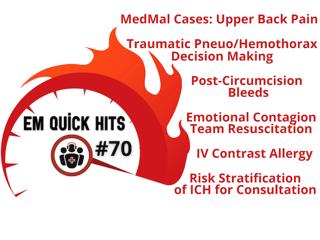
EM Quick Hits 70 MedMal Cases Upper Back Pain, Traumatic Pneumothorax/Hemothorax Decision Making, Risk Stratification of ICH for Consultation, Post-Circumcision Bleeds, IV Contrast Allergy, Emotional Contagion

EM Quick Hits 70 MedMal Cases Upper Back Pain, Traumatic Pneumothorax/Hemothorax Decision Making, Risk Stratification of ICH for Consultation, Post-Circumcision Bleeds, IV Contrast Allergy, Emotional Contagion

In this month's EM Quick Hits podcast: Mike Weinstock discusses with Anton a case of upper back pain in this month's Medmal Cases, Andrew Petrosoniak on traumatic pneumothorax and hemothorax decision ...

13 Jan 1h 6min
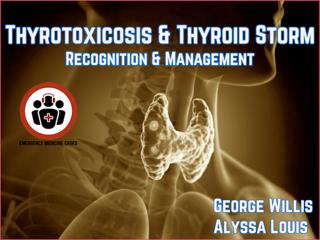
Ep 211 Thyrotoxicosis and Thyroid Storm: Recognition and Management

Ep 211 Thyrotoxicosis and Thyroid Storm: Recognition and Management

In this Part 2 of our 2-part podcast series on thyroid emergencies Anton, Dr. George Willis and Dr. Alyssa Louis answer questions such as: When a patient presents with “sepsis without a source,” what ...

30 Dec 20251h 13min
Ep 210 Decompensated Hypothyroidism Recognition and Management

Ep 210 Decompensated Hypothyroidism Recognition and Management

In the ED, we regularly care for sick patients presenting acutely with abnormal vital signs, altered mental status, and end organ dysfunction. Oftentimes, the culprit ends up being sepsis, or overdose...

16 Dec 20251h 12min
EM Quick Hits 69 Pediatric Urinary Retention & Acute Transverse Myelitis, Post-Dural Puncture Headache, Med Mal Cases: Clenched Fist Injury, IV Thrombolysis for Minor Stroke, EM Leadership Spotlight #4

EM Quick Hits 69 Pediatric Urinary Retention & Acute Transverse Myelitis, Post-Dural Puncture Headache, Med Mal Cases: Clenched Fist Injury, IV Thrombolysis for Minor Stroke, EM Leadership Spotlight #4

On this month's EM Quick Hits podcast: Deborah Schonfeld on the differential diagnosis and work up of pediatric urinary retention & acute transverse myelitis, Jesse McLaren on his Tryptic Approach to ...

2 Dec 20251h 32min
Ep 209 Nondisabling Stroke Recognition and Management

Ep 209 Nondisabling Stroke Recognition and Management

In this Part 2 or our 2-part podcast update on ED stroke management with Dr. Katie Lin and Dr. Walter Himmel we explore non-disabling strokes, where symptoms are mild enough that patients can continue...

11 Nov 20251h 19min
Ep 208 Paradigm Shift in Ischemic Stroke Management Part 1: Disabling Strokes

Ep 208 Paradigm Shift in Ischemic Stroke Management Part 1: Disabling Strokes

We are amidst a paradigm shift in the emergency management of acute ischemic stroke. The traditional way of categorizing ischemic strokes as 'minor' vs 'major' is no longer relevant to what we do in t...

28 Okt 20251h 36min
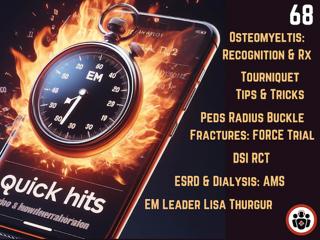
EM Quick Hits 68 Osteomyelitis, Tourniquet Technique, Pediatric Distal Radius Buckle Fractures, DSI RCT, AMS in ESRD & Dialysis, EM Leadership Spotlight #3

EM Quick Hits 68 Osteomyelitis, Tourniquet Technique, Pediatric Distal Radius Buckle Fractures, DSI RCT, AMS in ESRD & Dialysis, EM Leadership Spotlight #3

On this month's EM Quick Hits podcast: Dr. Isaac Bogoch on recognition and management of osteomyelitis in the ED, Dr. Anand Swaminathan on tourniquet tips and tricks. Dr. Andrew Tagg on managing pedia...

7 Okt 20251h 25min

Populärt inom Utbildning

rss-bara-en-till-om-missbruk-medberoende-2
det-skaver
historiepodden-se
nu-blir-det-historia
alska-oss
harrisons-dramatiska-historia
johannes-hansen-podcast
rss-viktmedicinpodden
allt-du-velat-veta
sektledare
not-fanny-anymore
rss-sjalsligt-avkladd
roda-vita-rosen
rss-max-tant-med-max-villman
sa-in-i-sjalen
rss-npf-podden
i-vantan-pa-katastrofen
rikatillsammans-om-privatekonomi-rikedom-i-livet
rss-basta-livet
sex-pa-riktigt-med-marika-smith