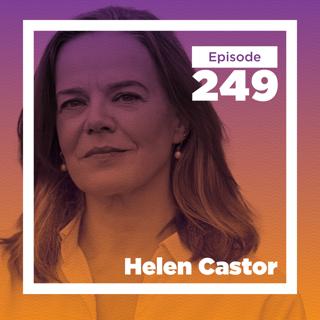

Helen Castor on Medieval Power and Personalities

Helen Castor on Medieval Power and Personalities

Helen Castor is a British historian and BBC broadcaster who left Cambridge because she wanted to write narrative history focused on individuals rather than the analytical style typical of academia. As someone interested in individual psychology and the functioning of power, Castor finds medieval England offers the perfect setting because its sophisticated power structures exist in "bare bones" without the "great apparatus of state," bringing individual power plays into sharper relief. Her latest book, The Eagle and the Hart, exemplifies this approach by examining Richard II and Henry IV as individuals whose personal choices became constitutional precedents that echo through English history.

Tyler and Helen explore what English government could and couldn't do in the 14th century, why landed nobles obeyed the king, why parliament chose to fund wars with France, whether England could have won the Hundred Years' War, the constitutional precedents set by Henry IV's deposition of Richard II, how Shakespeare's Richard II scandalized Elizabethan audiences, Richard's superb artistic taste versus Henry's lack, why Chaucer suddenly becomes possible in this period, whether Richard II's fatal trip to Ireland was like Captain Kirk beaming down to a hostile planet, how historians continue to discover new evidence about the period, how Shakespeare's Henriad influences our historical understanding, Castor's most successful work habits, what she finds fascinating about Asimov's I, Robot, the subject of her next book, and more.

Read a full transcript enhanced with helpful links, or watch the full video on the new dedicated Conversations with Tyler channel.

Recorded April 2nd, 2025.

Help keep the show ad free by donating today!

Other ways to connect

Photo Credit: Stuart Simpson

Det här avsnittet är hämtat från ett öppet RSS-flöde och publiceras inte av Podme. Det kan innehålla reklam.

Avsnitt(303)

Luis Garicano on Spain, Europe, and the Future of Work

Luis Garicano on Spain, Europe, and the Future of Work

Luis Garicano has one of the more unusual résumés in economics: trained at the University of Chicago Booth School under Gary Becker, Kevin Murphy, and Sherwin Rosen, he left academia for a stint as a ...

30 Sep 50min

Gita Gopinath on Trade, Currencies, and Economic Transformation

Gita Gopinath on Trade, Currencies, and Economic Transformation

Gita Gopinath has spent the last several years inside the room where the world's monetary plumbing gets fixed — or doesn't. As first deputy managing director of the IMF and, before that, the Fund's ch...

23 Sep 55min

Annie Lowrey on the Time Tax, Fraud, and Rationing by Paperwork

Annie Lowrey on the Time Tax, Fraud, and Rationing by Paperwork

Annie Lowrey's new book, The Time Tax, argues that the most regressive levy in American life is the hours each of us must spend on hold, in waiting rooms, and filling out forms a competent state would...

16 Sep 56min

Jared Diamond on Leaders, Luck, and Irreplaceability

Jared Diamond on Leaders, Luck, and Irreplaceability

Is leadership overrated? That's one simple reading of what Jared Diamond argues in his new book. Asked by Tyler to name the least replaceable leader in human history, Jared declines to name one — not ...

9 Sep 52min

Michael Moritz on Origin Stories, Exile, and Obsessive Curiosity

Michael Moritz on Origin Stories, Exile, and Obsessive Curiosity

Michael Moritz has written books through every phase of his life: the first history of Apple and an account of Chrysler's near-death while he was a journalist at Time, a study of Alex Ferguson's Manch...

2 Sep 41min

Luke Burgis on Mimetic Desire, Catholicism, and the Age of Social Contagion

Luke Burgis on Mimetic Desire, Catholicism, and the Age of Social Contagion

Luke Burgis left Wall Street after two years, founded a few successful companies in his twenties, then walked away to spend three years in a Roman seminary on the path to the priesthood. He now runs t...

19 Aug 52min

Daron Acemoglu on Liberalism, Automation, and the Educated Elite

Daron Acemoglu on Liberalism, Automation, and the Educated Elite

Daron Acemoglu returns for his second appearance with a new book, What Happened to Liberal Democracy?, which Tyler reads as an attempt to redefine and revitalize liberalism for our times. Where Daron'...

12 Aug 55min

Julia Ioffe on Russian Women, Missing Men, and the Roots of Autocracy

Julia Ioffe on Russian Women, Missing Men, and the Roots of Autocracy

Julia Ioffe left the USSR as a child and came back as an adult journalist to find that the confident, credentialed women she remembered from her Soviet childhood had largely been supplanted by those c...

5 Aug 55min
Populärt inom Utbildning

historiepodden-se
rss-bara-en-till-om-beroende-medberoende
det-skaver
rss-dr-bjorklund
nu-blir-det-historia
not-fanny-anymore
harrisons-dramatiska-historia
rss-viktmedicinpodden
johannes-hansen-podcast
allt-du-velat-veta
roda-vita-rosen
i-vantan-pa-katastrofen
rss-foraldramotet-bring-lagercrantz
rss-ai-med-jonas-benjamin
rikatillsammans-om-privatekonomi-rikedom-i-livet
sektledare
sa-in-i-sjalen
rss-basta-livet
rss-beratta-alltid-det-har
rss-max-tant-med-max-villman