Premium
99 kr/ månad
- Tillgång till alla Premium-poddar
- Reklamfritt premium-innehåll
- Avsluta när du vill
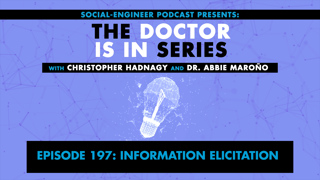
Welcome to the Social-Engineer Podcast: The Doctor Is In Series – where we will discuss understandings and developments in the field of psychology.
In today's episode, Chris and Abbie are discussing: Information Elicitation. We will discuss what it is, why it's so important to use 'science-based interviewing', and why approaches that encourage cooperation are better than manipulation of information retrieval. [Feb 6, 2023]
00:00 – Intro
00:20 – Dr. Abbie Maroño Intro
00:54 – Intro Links
03:58 – The Topic of the Day: Information Elicitation
05:41 – How does your scientific research affect practitioners?
06:47 – Start with the Brain
07:32 – Elicitation: A Scientific Definition
09:36 – Weaponizing Elicitation
11:17 – It's Easier Than You Think
13:40 – The Perils of Poker Face
16:41 – Being on the Defensive
19:17 – Me, You, and Us
21:28 – The Verbal Approaches
25:16 – Collaboration is Key!
30:37 – An Effective Approach: Subliminal Priming
32:00 – "They'll Become What They're Called"
33:33 – This Applies to Life
35:07 – Make it Conversational
36:56 – The Scharff Technique
40:48 – Forensic vs Clinical
43:23 – Last Week on "24"
45:01 – Tips for the Boss: Shame Doesn't Work
49:41 – This is the Hardest Part
51:46 – Wrap Up & Outro
Find us online:
References:
Kong, Y., & Schoenebeck, G. (2019). An information theoretic framework for designing information elicitation mechanisms that reward truth-telling. ACM Transactions on Economics and Computation (TEAC), 7(1), 1-33.
Lakin, J. L., Jefferis, V. E., Cheng, C. M., & Chartrand, T. L. (2003). The chameleon effect as social glue: Evidence for the evolutionary significance of nonconscious mimicry. Journal of nonverbal behavior, 27(3), 145-162.
Tschacher, W., Rees, G. M., & Ramseyer, F. (2014). Nonverbal synchrony and affect in dyadic interactions. Frontiers in psychology, 5, 1323.
Brandon, S. E., Wells, S., & Seale, C. (2018). Science‐based interviewing:
Information elicitation. Journal of Investigative Psychology and Offender Profiling, 15(2), 133-148.
Kong, Y., Schoenebeck, G., Tao, B., & Yu, F. Y. (2020, April). Information elicitation mechanisms for statistical estimation. In Proceedings of the AAAI Conference on Artificial Intelligence (Vol. 34, No. 02, pp. 2095-2102).
Shaw, D. J., Vrij, A., Leal, S., Mann, S., Hillman, J., Granhag, P. A., & Fisher, R. P. (2015). Mimicry and investigative interviewing: Using deliberate mimicry to elicit information and cues to deceit. Journal of Investigative Psychology and
Offender Profiling, 12(3), 217-230.
Baddeley, M. C., Curtis, A., & Wood, R. (2004). An introduction to prior information derived from probabilistic judgements: elicitation of knowledge, cognitive bias and herding. Geological Society, London, Special Publications, 239(1), 15-27.
Deeb, H., Vrij, A., Leal, S., & Burkhardt, J. (2021). The effects of sketching while narrating on information elicitation and deception detection in multiple interviews. Acta Psychologica, 213, 103236.
Boone, R. T., & Buck, R. (2003). Emotional expressivity and trustworthiness: The role of nonverbal behavior in the evolution of cooperation. Journal of Nonverbal Behavior, 27(3), 163-182.
Culpepper, P. D. (2018). Creating cooperation. In Creating Cooperation. Cornell University Press.
Brimbal, L., Dianiska, R. E., Swanner, J. K., & Meissner, C. A. (2019). Enhancing cooperation and disclosure by manipulating affiliation and developing rapport in investigative interviews. Psychology, Public Policy, and Law, 25(2), 107.
Granhag, P. A., Oleszkiewicz, S., Strömwall, L. A., & Kleinman, S. M. (2015).
Eliciting intelligence with the Scharff technique: Interviewing more and less cooperative and capable sources. Psychology, Public Policy, and Law, 21(1), 100.
Vallano, J. P., & Schreiber Compo, N. (2015). Rapport-building with cooperative witnesses and criminal suspects: A theoretical and empirical review. Psychology, Public Policy, and Law, 21(1), 85.
Rilling, J. K., Gutman, D. A., Zeh, T. R., Pagnoni, G., Berns, G. S., & Kilts, C. D. (2002). A neural basis for social cooperation. Neuron, 35(2), 395-405.
Fehr, E., & Rockenbach, B. (2004). Human altruism: economic, neural, and evolutionary perspectives. Current opinion in neurobiology, 14(6), 784-790.
Krill, A. L., & Platek, S. M. (2012). Working together may be better: Activation of reward centers during a cooperative maze task. PloS one, 7(2), e30613.
Prova 14 dagar kostnadsfritt

Lyssna på dina favoritpoddar och ljudböcker på ett och samma ställe.
Njut av handplockade tips som passar din smak – utan ändlöst scrollande.
Fortsätt lyssna där du slutade – även offline.


99 kr/ månad
129 kr/ månad















Obegränsad lyssning på alla dina favoritpoddar och ljudböcker