World Benzodiazepine Awareness Day 2018 - Part 1 - Nicole Lamberson, Josef Witt-Doerring, Chris Paige

World Benzodiazepine Awareness Day 2018 - Part 1 - Nicole Lamberson, Josef Witt-Doerring, Chris Paige

This week on MIA Radio, we present a special episode of the podcast to join in the many events being held for World Benzodiazepine Awareness Day, July 11, 2018.

In part 1, we chat with W-BAD Lead Operations Volunteer and Virginia Representative Nicole Lamberson who talks about the events being held for W-BAD. We hear from psychiatrist Dr Josef Witt-Doerring, who talks about a recent paper he co-authored entitled "Online Communities for Drug Withdrawal: What Can We Learn?". We also hear from therapist and campaigner Chris Paige who discusses his own experiences taking and withdrawing from benzodiazepines. Finally, in part 2 of the interview, we get to chat with Robert Whitaker, science journalist and author of the books Mad in America and Anatomy of an Epidemic.

First, I am very fortunate to have had the chance to talk with Nicole Lamberson. Nicole is Lead Operations Volunteer and Virginia Representative for W-BAD and she has kindly taken time out of her busy preparations to talk about how she became involved with W-BAD, some of the events and campaigns being held around the world and how people can get involved.

Nicole has an immense passion for benzodiazepine awareness and its victims and hopes that her efforts ultimately spare many others from taking this painful, senseless, and totally preventable iatrogenic "journey".

We discuss:
  • How Nicole first became involved with W-BAD.
  • How discovering personal testimonies encouraged her to reach out to find out more about an awareness day held on the birthday of Dr Heather Ashton - July 11.
  • What it feels like to be part of the benzodiazepine community.
  • How there is is still no medical consensus about the effects of both taking and withdrawing from benzodiazepines.
  • The W-BAD T-shirt campaign, which was organised in partnership with the Benzodiazepine Information Coalition and As Prescribed, an in-production documentary by Holly Hardman.
  • Pamphlet distributions happening in Auckland, Paris, Boston and Torrington.
  • That Wayne Douglas, W-BAD founder is on the Dr Peter Breggin hour on July 11 at 4pm New York time.
  • That people can visit W-BAD events to find out more.
  • That on social media, people can follow events using @WorldBenzoDay and the hashtag #WorldBenzoDay.
  • That people can participate in many ways and that one of the most important ways to participate is to submit reports of adverse effects and withdrawal reactions to the appropriate regulator, links to which can be found on the W-BAD website.
  • How important it is to share stories and personal experiences.
  • That W-BAD is for anybody, not just those who are damaged by the drugs but also for families and friends and those recovered too.
Relevant links:

W-BAD

[IN]VISIBLE T-shirt campaign

How to participate in W-BAD

Benzodiazepine Information Coalition

As Prescribed by Holly Hardman (documentary film in production)

International Task Force on Benzodiazepines

Dr Heather Ashton

The 2017 W-BAD podcast featuring Professor Malcolm Lader, Jocelyn Pedersen and Barry Haslam.

Next, we chat with psychiatrist Dr Josef Witt-Doerring. Josef trained in Queensland, Australia before becoming a psychiatric resident at Baylor College of Medicine, Houston, Texas. He co-authored a paper published in Psychiatric Times entitled "Online Communities for Drug Withdrawal: What Can We Learn?" which received praise for openly addressing the issues of dependence and withdrawal and identifying the support activity that goes on in forums like Benzo Buddies and Surviving Antidepressants.

We discuss:
  • What led Dr Witt-Doerring to become a psychiatric trainee after attending medical school in Queensland, Australia.
  • How reading Anatomy of an Epidemic led to an awareness of some of the consequences of psychiatric drug use from a critical perspective.
  • What led to his research into online support forums for those who are seeking support for psychiatric drug withdrawal.
  • That Josef was surprised at the amount of support activity in online forums like Benzo Buddies and Surviving Antidepressants.
  • How the paper that Josef co-authored on learning from online communities found a great deal of support both amongst colleagues and patient advocacy organisations.
  • How he feels that there is a general lack of awareness of dependence and withdrawal issues because the messages can be drowned out by more strident communications in marketing or promotional material.
  • That the idea of 'treatment resistant' conditions is probably much more on a general doctors mind than adverse reactions or protracted withdrawal experiences.
  • How Josef's experiences have influenced his approach to prescribing central nervous system drugs.
  • That he would like to think that if a doctor and patient can talk frankly and openly about the pros and cons of treatment, then that is likely to lead to a better relationship and a better outcome.
  • That there is a dearth of support services for people struggling with the drugs, particularly at the end of treatment.
  • How academic detailing programmes could help raise awareness and disseminate information that would lead to doctors being more confident about de-prescribing.
  • How the language of addiction and dependence can sometimes be a barrier to recognition of drug withdrawal issues.
  • That it may be better to look through a neurological injury lens rather than an addiction lens both in terms of understanding experiences but also to enable better treatment and support options.
  • That the community of those affected should continue to share their stories and to raise petitions with professional organisations, such as the boards that licence psychiatrists and OBGYN's.
  • How, because of the huge variation in patient experience, it would be very difficult to mandate short-term prescribing.
Relevant links:

Online Communities for Drug Withdrawal: What Can We Learn?

Benzo Buddies

Benzodiazepine Information Coalition

Surviving Antidepressants

Malcolm Lader: Anxiety or depression during withdrawal of hypnotic treatments

Our next guest is Chris Paige. Chris has a bit of an 'inside' perspective to add to the conversation for World Benzodiazepine Awareness Day in that he is a licensed therapist of over 20 years who was iatrogenically injured by a prescribed benzodiazepine. Chris has practised in a variety of settings including hospitals, schools, and foster homes and has taught at the undergraduate and graduate level.

He has presented papers at national and international conferences, appeared on Dateline NBC for his work with children of divorce and had his own national magazine column called 'On The Couch with Chris Paige'. Chris is on the board the Benzodiazepine Information Coalition, a non-profit organization that advocates for greater understanding of the potentially devastating effects of commonly prescribed benzodiazepines as well as prevention of patient injury through medical recognition, informed consent, and education. Chris currently resides and practices in Florida.

We discuss:
  • How Chris first came to be prescribed a benzodiazepine in 2000.
  • His recollections of being prescribed Klonopin (Clonazepam) for anxiety, taking between 1 and 2 milligrams per day.
  • How, after three years use, he started to notice tremors and memory loss.
  • That a neurologist explained that his symptoms may be medication related and advised a taper but gave no specific instructions.
  • How Chris came off the Klonopin fairly rapidly but didn't find it too difficult at the time.
  • How, some years later, he was given an antibiotic for a prostate infection but rapidly developed psychiatric symptoms including anxiety, agitation and insomnia.
  • That this led Chris to consult a doctor for some Klonopin tablets to manage this and that he took a total of 16 milligrams over the next 10 weeks.
  • That he understands now that the antibiotic and the Klonopin compete at the same receptor in the brain, leading immediately to a tolerance to the drug.
  • That because of this tolerance he became more sleepless, more agitated and more anxious and working was becoming increasingly difficult.
  • How he came to be in a five-day detox programme in Vermont, where they took him off one and a quarter milligrams of Klonopin in just five days.
  • How Chris realised that the detox approach was not right and wanted to leave.
  • How the detox programme decided to replace the Klonopin with four different psychiatric drugs, two of which he has now ceased with two still to taper.
  • That he felt that his brain and nervous system were severely shocked by making such rapid medication changes.
  • How this led to Chris being admitted to psychiatric hospital which he describes as "possibly one of the most humiliating experiences he has ever endured."
  • How Chris felt when experiencing akathisia which was a relentless compulsion to move and gave him a feeling as if his whole body was being electrocuted and that he had been lit on fire.
  • That he initially felt supported by friends and family but that quickly eroded when he didn't get better or accept harmful and dangerous treatment advice.
  • That this led to the misunderstanding of his injury and it being mislabeled as an addiction problem.
  • That ultimately the only places he found validation and support were online support forums.
  • The losses that Chris endured during his struggles including his health, his psychotherapy practice and even his reputation.
  • That Chris's message is that there is hope for the future and the importance of reconnecting with the simple things in life.
  • The lack of acknowledgement of the impact of trauma on a person's life.
Relevant links:

Benzodiazepine Information Coalition

Chris's profile at BIC

In part 2 of this podcast, we will hear from science journalist and author Robert Whitaker.

Avsnitt(290)

Examining Psychiatric Medication Tapering and Withdrawal: The Evolving Role of Pharmacists — A Conversation with Agnes Higgins and Cathal Cadogan

Examining Psychiatric Medication Tapering and Withdrawal: The Evolving Role of Pharmacists — A Conversation with Agnes Higgins and Cathal Cadogan

Welcome to the Mad in America podcast, my name is James. Today, we are discussing the experiences of people who have attempted to stop taking psychiatric drugs. These experiences are captured in a sur...

1 Apr 32min
Spiritual Emergency and the Collective Work of Staying Alive: An Interview with Nisha Gupta

Spiritual Emergency and the Collective Work of Staying Alive: An Interview with Nisha Gupta

Nisha Gupta is an existential phenomenologist, a depth psychotherapist, a creativity scholar, and an artist. She's an Associate Professor of Psychology at the University of West Georgia and earned her...

25 Mars 48min
The Political Systems Driving Abuse in Psychiatry: An Interview with Human Rights Lawyer Alicia Ely Yamin

The Political Systems Driving Abuse in Psychiatry: An Interview with Human Rights Lawyer Alicia Ely Yamin

Alicia Ely Yamin is the Director of the Global Health and Rights Project and a lecturer at Harvard Law School. She's also an adjunct senior lecturer on health policy and management at the Harvard T.H....

18 Mars 45min
History, Eugenics, and an Inquiry into Mad Consciousness: A Conversation With Susanne Paola Antonetta

History, Eugenics, and an Inquiry into Mad Consciousness: A Conversation With Susanne Paola Antonetta

Susanne Paola Antonetta is an accomplished writer and poet, the author of numerous books, and in 2001 her book Body Toxic: An Environmental Memoir, won a prestigious American Book Award. Her latest bo...

11 Mars 49min
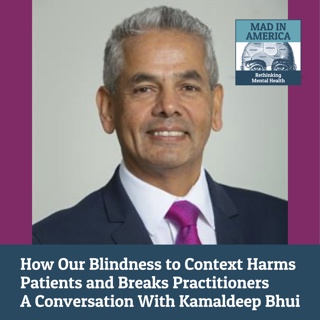
How Our Blindness to Context Harms Patients and Breaks Practitioners: A Conversation With Kamaldeep Bhui

How Our Blindness to Context Harms Patients and Breaks Practitioners: A Conversation With Kamaldeep Bhui

Kamaldeep Bhui is Professor of Psychiatry at the University of Oxford and Honorary Professor at Queen Mary University of London. He is internationally recognized for his groundbreaking work on cultura...

4 Mars 51min
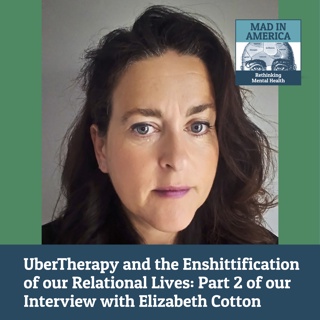
UberTherapy and the Enshittification of our Relational Lives: Part 2 of our Interview with Elizabeth Cotton

UberTherapy and the Enshittification of our Relational Lives: Part 2 of our Interview with Elizabeth Cotton

Elizabeth Cotton is Associate Professor of Responsible Business at the University of Leicester and the founder of Surviving Work, which carries out socially engaged research on mental health and work....

18 Feb 39min
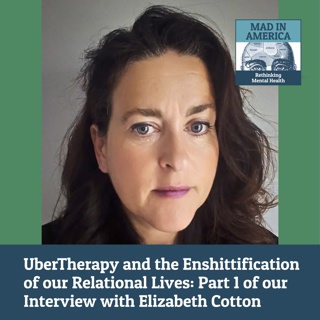
UberTherapy and the Enshittification of our Relational Lives: Part 1 of our Interview with Elizabeth Cotton

UberTherapy and the Enshittification of our Relational Lives: Part 1 of our Interview with Elizabeth Cotton

Elizabeth Cotton is Associate Professor of Responsible Business at the University of Leicester and the founder of Surviving Work, which carries out socially engaged research on mental health and work....

11 Feb 46min
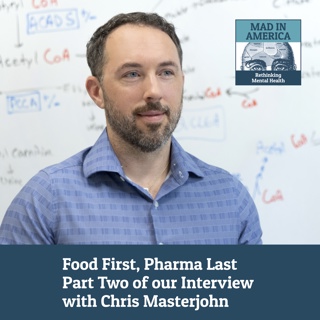
Food First, Pharma Last - Part Two of our Interview with Chris Masterjohn

Food First, Pharma Last - Part Two of our Interview with Chris Masterjohn

This week, we are joined by Chris Masterjohn, PhD. Chris is a nutritional scientist, a former professor, and the founder of Mitome. With a PhD in nutritional science and years of research in mitochond...

28 Jan 44min

Populärt inom Hälsa

somna-med-henrik
rss-bara-en-till-om-missbruk-medberoende-2
inga-beiga-morsor
rss-jossan-nina
alska-oss
rss-vuxna-pa-latsas
angestpodden
sexnoveller-deluxe
johannes-hansen-podcast
giggles-med-wiggles
sova-med-dan-horning
rss-viktmedicinpodden
not-fanny-anymore
sag-det-bara
vinterpasset
rss-sjalsligt-avkladd
brottarbroder
sa-in-i-sjalen
rss-the-house-podcast-3
rss-beratta-alltid-det-har