Jim van Os - Towards Resilience and Possibilities and Away from Diseases and Symptoms

Jim van Os - Towards Resilience and Possibilities and Away from Diseases and Symptoms

This week on MIA Radio, we interview Professor Jim van Os. Professor van Os is Chairman of the Division of Neuroscience at Utrecht University Medical Centre, Utrecht, The Netherlands, and Visiting Professor of Psychiatric Epidemiology at King's College, Institute of Psychiatry in London. He trained in Psychiatry in Casablanca, Bordeaux and the Institute of Psychiatry and the Maudsley Royal Hospital in London.

We last spoke with Jim for the podcast in August 2017 and this time we focus on a recent paper written by Jim and co-authors that was published in the journal World Psychiatry in January 2019. The paper is entitled 'The diagnosis evidence-based group-level symptom-reduction model as organizing principle for mental health care. Time for change?'

In this episode we discuss:
  • What the diagnosis evidence-based group-level symptom-reduction model is and how it currently informs mainstream mental healthcare.
  • How mental health funding and mental health professional partners work together to monitor and assess the effects of current evidence-based interventions.
  • How this curative medical model is attractive, but often fails to work for patients.
  • That the focus on biological, brain-based diseases and symptoms conflicts with the experience of people who are attempting to develop a narrative view of their difficulties and suffering.
  • That the paper is an attempt to start a discussion about building a synthesis between the diagnosis, symptom-based medical world and the lived experience of individual people.
  • How the creation of specific and discrete diagnoses has reinforced the symptom-led approach to mental health and has also necessitated the stratification of doctors into silos of expertise.
  • How Jim favors a spectrum-based approach over a fixed diagnosis and that an example is autism spectrum disorder as described in DSM V.
  • The limitations of using 'target symptom reduction' as an outcome measure for mental health.
  • That symptom reduction can be beneficial in the short-term but is not a good long-term measure of recovery.
  • That the paper attempts to make clear how important individual experiences are and the need to be sensitive to the existential domain, saying "restoration of health is not the goal, it is the means to enable a person to find and pursue meaningful goals, accordingly, the person's existential values become central".
  • That the evidence suggests that any treatment effect or improvement is often down to meaningful interaction rather than the specific expertise of the treating professional.
  • That, in many countries, we still see a huge gulf between mental healthcare and social care which remain separate and remote from each other and that this separation is not how the person experiences their world.
  • The importance of including lived experience in the evidence base, particularly because randomized controlled trials, considered the gold standard of evidence, are often not conclusive in the field of mental health.
  • That, in mental health, evidence shows that 30% to 40% of the response is down to placebo and the expectation of being helped.
  • That the desire is to make the existential domain the primary lens through which to view human experience and to respond to mental or emotional suffering.
  • That, arguably, 'love is the most powerful evidence-based treatment in mental health'.

Relevant links:

Professor Jim van Os

The evidence-based group-level symptom-reduction model as the organizing principle for mental health care: time for change?

Tedx: Maastricht, Connecting to Madness

ISPS Liverpool Conference Jim Van Os Keynote Address

Schizophrenia does not exist

© Mad in America 2019

Avsnitt(293)

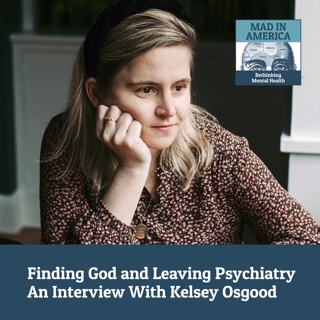
Finding God and Leaving Psychiatry: An Interview With Kelsey Osgood

Finding God and Leaving Psychiatry: An Interview With Kelsey Osgood

Kelsey Osgood is the author of How to Disappear Completely: on Modern Anorexia, which was chosen for the Barnes and Noble Discover Great Writers New Program. Her work has appeared online and in print ...

22 Apr 45min
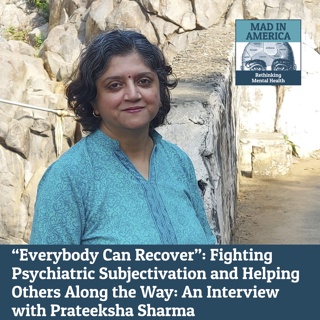
"Everybody Can Recover": Fighting Psychiatric Subjectivation and Helping Others Along the Way: An Interview with Prateeksha Sharma

"Everybody Can Recover": Fighting Psychiatric Subjectivation and Helping Others Along the Way: An Interview with Prateeksha Sharma

Psychosis and conditions like Schizophrenia have been tainted with pessimism right from the beginning. Doctors often don't know that recovery is possible and can convey this fatalism to their patients...

15 Apr 34min
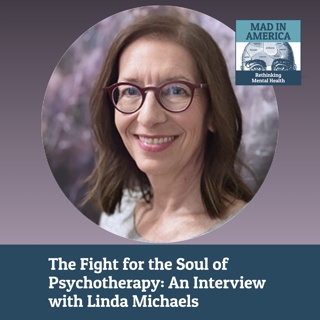
The Fight for the Soul of Psychotherapy: An Interview with Linda Michaels

The Fight for the Soul of Psychotherapy: An Interview with Linda Michaels

Linda Michaels is a psychologist in private practice in Chicago and a co-founder of the Psychotherapy Action Network (PsiAN). She trained at the Illinois School of Professional Psychology and complete...

8 Apr 1h 11min
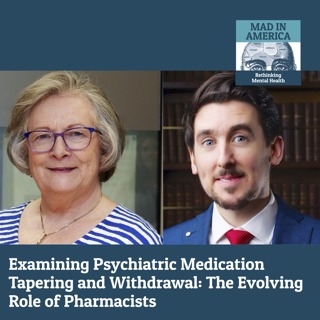
Examining Psychiatric Medication Tapering and Withdrawal: The Evolving Role of Pharmacists — A Conversation with Agnes Higgins and Cathal Cadogan

Examining Psychiatric Medication Tapering and Withdrawal: The Evolving Role of Pharmacists — A Conversation with Agnes Higgins and Cathal Cadogan

Welcome to the Mad in America podcast, my name is James. Today, we are discussing the experiences of people who have attempted to stop taking psychiatric drugs. These experiences are captured in a sur...

1 Apr 32min
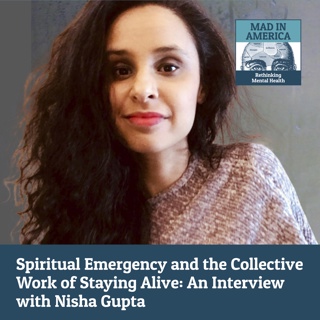
Spiritual Emergency and the Collective Work of Staying Alive: An Interview with Nisha Gupta

Spiritual Emergency and the Collective Work of Staying Alive: An Interview with Nisha Gupta

Nisha Gupta is an existential phenomenologist, a depth psychotherapist, a creativity scholar, and an artist. She's an Associate Professor of Psychology at the University of West Georgia and earned her...

25 Mars 48min
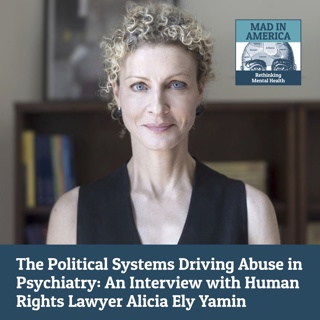
The Political Systems Driving Abuse in Psychiatry: An Interview with Human Rights Lawyer Alicia Ely Yamin

The Political Systems Driving Abuse in Psychiatry: An Interview with Human Rights Lawyer Alicia Ely Yamin

Alicia Ely Yamin is the Director of the Global Health and Rights Project and a lecturer at Harvard Law School. She's also an adjunct senior lecturer on health policy and management at the Harvard T.H....

18 Mars 45min
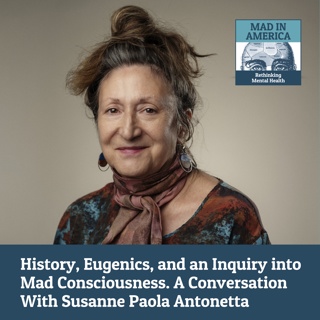
History, Eugenics, and an Inquiry into Mad Consciousness: A Conversation With Susanne Paola Antonetta

History, Eugenics, and an Inquiry into Mad Consciousness: A Conversation With Susanne Paola Antonetta

Susanne Paola Antonetta is an accomplished writer and poet, the author of numerous books, and in 2001 her book Body Toxic: An Environmental Memoir, won a prestigious American Book Award. Her latest bo...

11 Mars 49min
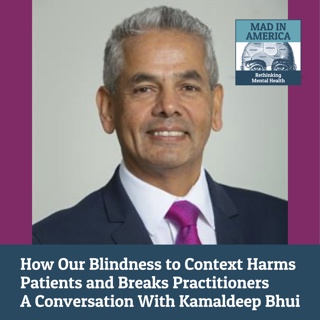
How Our Blindness to Context Harms Patients and Breaks Practitioners: A Conversation With Kamaldeep Bhui

How Our Blindness to Context Harms Patients and Breaks Practitioners: A Conversation With Kamaldeep Bhui

Kamaldeep Bhui is Professor of Psychiatry at the University of Oxford and Honorary Professor at Queen Mary University of London. He is internationally recognized for his groundbreaking work on cultura...

4 Mars 51min

Populärt inom Hälsa

somna-med-henrik
rss-bara-en-till-om-missbruk-medberoende-2
rss-jossan-nina
inga-beiga-morsor
rss-vuxna-pa-latsas
johannes-hansen-podcast
not-fanny-anymore
angestpodden
sexnoveller-deluxe
rss-viktmedicinpodden
alska-oss
brottarbroder
sova-med-dan-horning
sa-in-i-sjalen
tyngre-radio
rss-sjalsligt-avkladd
tyngre-traningssnack
rss-basta-livet
rss-livet-pagar-din-coachningpodcast
smartare-fitness-podden