LBBB Sgarbossa Criteria: 1 Excessive Disc, 2 Concordance Contact Lenses

LBBB Sgarbossa Criteria: 1 Excessive Disc, 2 Concordance Contact Lenses

When a left bundle branch block (LBBB) throws a wrench into your ECG interpretation, how do you know if it’s a STEMI… or just baseline noise?


In this unforgettable episode, we ride full throttle into the wild world of wide QRS complexes, Scarbossa criteria, and the modified rules that help unmask true occlusion amidst the electrical chaos.


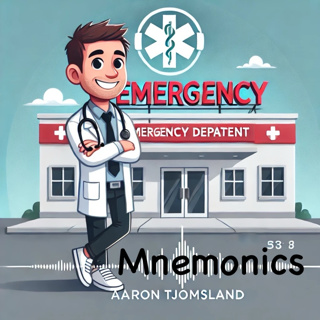
Visualize Evel Knievel launching off the QRS ramp — only to slam into the Left Bundle Branch Block cinder block. His forehead tattoo reads “Scar,” and as he collides, contact lenses fly from his eyes — one labeled “Any Lead ↑1mm” and the other, “V1–V3 ↓1mm” — representing concordant ST changes in opposite directions. Meanwhile, a giant frisbee labeled “EXCESSIVE DISC >25%” flies through the scene, reminding us of the Smith-modified criteria for proportional discordant ST elevation.


You’ll learn:

• Why LBBB and paced rhythms mask the usual signs of infarction

• What “appropriate discordance” really means

• The 3 ways Scarbossa criteria cut through the noise

• How to visually anchor each criteria with unforgettable imagery

• And why you only need one criteria to trigger concern


This episode breaks down advanced electrophysiology into a high-octane, cartoon-style teaching experience you’ll never forget. Whether you’re a medical student, resident, PA, NP, or attending, this episode locks in high-yield ECG wisdom that sticks.


✅ Smith-Modified Sgarbossa Criteria


Used in Left Bundle Branch Block (LBBB) or Ventricular Paced Rhythm to detect Occlusion MI (OMI):


You need only ONE of the following three to be positive:

1. Concordant ST Elevation ≥1 mm in any lead with a positive QRS

➤ ST segment is in the same direction as the QRS (both upright)

2. Concordant ST Depression ≥1 mm in leads V1–V3

➤ ST segment and QRS are both downward in V1–V3 (anterior leads)

3. Proportionally Excessive Discordant ST Elevation:

➤ ST Elevation is ≥25% of the depth of the preceding S wave in a lead with a negative QRS

➤ This replaces the old “5 mm” rule with a more accurate proportional one


💡 You only need one of these three criteria to suspect occlusion MI in the setting of LBBB or ventricular pacing.


Keywords: LBBB, Scarbossa Criteria, Modified Scarbossa, STEMI Equivalent, ECG Interpretation, Emergency Medicine, Paced Rhythm, Smith Criteria, Evel Knievel, Visual Mnemonics, Wide QRS, Electrocardiography, ST Elevation, ST Depression, STEMI Mimic, Cardiology, EM Boards

Avsnitt(63)

Sick-Tachy or Tachy-sick: S.T.O.P. Secondary Compensations (Must-consider Differentials)

Sick-Tachy or Tachy-sick: S.T.O.P. Secondary Compensations (Must-consider Differentials)

When the heart rate blasts past 150, our reflex is often to grab a syringe—diltiazem, metoprolol, something to slow things down. But here’s the hard truth: if the patient is in sick-tachy—tachycardia ...

11 Sep 202540min

6 S’s & 6 H’s Heart Score: Chest Pain & Diamond Classification Risk Stratification

6 S’s & 6 H’s Heart Score: Chest Pain & Diamond Classification Risk Stratification

Chest pain is one of the most common—and highest risk—complaints in the ED. Missing acute coronary syndrome can be catastrophic, but keeping every patient in the hospital isn’t realistic either. That’...

11 Sep 202539min

STEMI ischemic and reciprocal change patterns

STEMI ischemic and reciprocal change patterns

In a cardiac emergency, pattern recognition saves lives. The ability to rapidly identify ST-elevation myocardial infarctions (STEMIs) — and recognize their reciprocal changes — is one of the most high...

5 Sep 202554min

EKG Basic Basic Basic Framework for EM Docs: Ischemia, Arrhythmias, Intervals, Anomalies

EKG Basic Basic Basic Framework for EM Docs: Ischemia, Arrhythmias, Intervals, Anomalies

This is the most basic, essential framework for EKG interpretation — built for emergency medicine clinicians who need clarity, speed, and confidence in the heat of the moment.Our brains are wired for ...

26 Aug 20251h 5min

Macrocytic Anemia in the ED: My Liver Bleeds a Lot (part 3)

Macrocytic Anemia in the ED: My Liver Bleeds a Lot (part 3)

Step into the macrocytic anemia caboose and remember the non-megaloblastic causes with the mnemonic My Liver Bleeds a Lot: • My → Multiple Myeloma (CRAB: Hypercalcemia, Renal failure, Anemia, Bone les...

11 Aug 202551min

Sickle Cell Crisis: 4 R’s Mnemonic — Recognize, Reverse, Radiology, Refer

Sickle Cell Crisis: 4 R’s Mnemonic — Recognize, Reverse, Radiology, Refer

In the fast-paced, high-stakes world of emergency medicine, every second matters—especially when it comes to sickle cell crisis. This podcast takes you straight to the heart of what matters most for E...

8 Aug 202522min

Hemolytic Anemias: TAG My Suitcase mnemonic

Hemolytic Anemias: TAG My Suitcase mnemonic

Hemolytic Anemias Mnemonic for the ED: TAG MY SUITCASEIn this high‑impact episode of Emergency Medicine Mind Palace, we break down hemolytic anemias into a memorable 5‑suitcase system that will stick ...

2 Aug 202519min

Populärt inom Hälsa

somna-med-henrik
rss-bara-en-till-om-missbruk-medberoende-2
rss-jossan-nina
inga-beiga-morsor
alska-oss
not-fanny-anymore
rss-vuxna-pa-latsas
sexnoveller-deluxe
brottarbroder
johannes-hansen-podcast
angestpodden
rss-viktmedicinpodden
sova-med-dan-horning
sa-in-i-sjalen
rss-the-house-podcast-3
vinterpasset
tyngre-radio
rss-sjalsligt-avkladd
smartare-fitness-podden
sex-pa-riktigt-med-marika-smith