150. Exploring All-New ECS Managed Instances (MI) Mode
AWS Bites28 Marras 2025

150. Exploring All-New ECS Managed Instances (MI) Mode

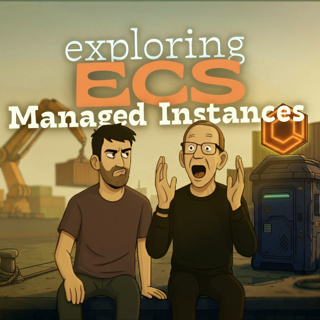
Love AWS Fargate, but occasionally hit the “I need more control” wall (GPUs, storage, network bandwidth, instance sizing)? In this episode of AWS Bites, Eoin and Luciano put the brand-new Amazon ECS Managed Instances (ECS MI) under the microscope as the “middle path” between Fargate simplicity and ECS on EC2 flexibility. We unpack what ECS MI actually is and where it fits in the ECS spectrum, especially how it changes the way you think about clusters and capacity providers. From there we get practical: we talk through the pricing model (EC2 pricing with an additional ECS MI fee that can be a bit counterintuitive if you rely heavily on Reserved Instances or Savings Plans), and we share what it feels like to finally get GPU support in an experience that’s much closer to Fargate than to “full EC2 fleet management”. To make it real, we walk through what we built: a GPU-enabled worker that transcribes podcast audio using OpenAI Whisper, including the end-to-end setup in CDK (roles, capacity provider wiring, task definitions, and service configuration). Along the way we call out the rough edges we ran into, like configuration options that look like they might enable Spot-style behavior, and the operational realities you should expect, such as tasks taking roughly 3–4 minutes to start when ECS needs to provision fresh capacity. We close by mapping out the workloads where ECS MI shines (queue-driven GPU jobs, HPC-ish compute, tighter storage/network control) and the scenarios where it’s probably the wrong choice, like when you need custom AMIs, SSH access, or stricter isolation guarantees.


In this episode, we mentioned the following resources:


Do you have any AWS questions you would like us to address?

Leave a comment here or connect with us on X/Twitter, BlueSky or LinkedIn:


- ⁠⁠⁠⁠⁠⁠⁠⁠⁠⁠⁠⁠⁠⁠⁠⁠⁠⁠⁠⁠⁠⁠⁠⁠⁠⁠⁠⁠⁠⁠⁠⁠⁠⁠⁠⁠⁠⁠https://twitter.com/eoins⁠⁠⁠⁠⁠⁠⁠⁠⁠⁠⁠⁠⁠⁠⁠⁠⁠⁠⁠⁠⁠⁠⁠⁠⁠⁠⁠⁠⁠⁠⁠⁠⁠⁠⁠⁠⁠⁠ | ⁠⁠⁠⁠⁠⁠⁠⁠⁠⁠https://bsky.app/profile/eoin.sh⁠⁠⁠⁠⁠⁠⁠⁠⁠⁠ | ⁠⁠⁠⁠⁠⁠⁠⁠⁠⁠https://www.linkedin.com/in/eoins/⁠⁠⁠

⁠⁠⁠⁠⁠⁠⁠⁠⁠⁠⁠⁠⁠- ⁠⁠⁠⁠⁠⁠⁠⁠⁠⁠⁠⁠⁠⁠⁠⁠⁠⁠⁠⁠⁠⁠⁠⁠⁠⁠⁠⁠⁠⁠⁠⁠⁠⁠⁠⁠⁠⁠https://twitter.com/loige⁠⁠⁠⁠⁠⁠⁠⁠⁠⁠⁠⁠⁠⁠ | ⁠⁠⁠⁠⁠⁠⁠⁠⁠⁠https://bsky.app/profile/loige.co⁠⁠⁠⁠⁠⁠⁠⁠⁠⁠ | ⁠⁠⁠⁠⁠⁠⁠⁠⁠⁠https://www.linkedin.com/in/lucianomammino/

Jaksot(157)

129. Lambda Provisioned Concurrency

129. Lambda Provisioned Concurrency

In this episode, we discuss AWS Lambda provisioned concurrency. We start with a recap of Lambda cold starts and the different concurrency control options. We then explain how provisioned concurrency w...

22 Elo 202422min

128. Writing a book about Rust & Lambda

128. Writing a book about Rust & Lambda

In this episode, we discuss Luciano's new book project on using Rust to write AWS Lambda functions. We start with a recap on why Rust is a good fit for Lambda, including performance, efficiency, safet...

25 Heinä 202426min

127. Which Load Balancer should you use?

127. Which Load Balancer should you use?

An overview of load balancers, explaining how they distribute traffic across multiple servers and provide high availability. We discuss layer 4 and layer 7 load balancers, detailing their pros and con...

11 Heinä 202424min

126. Bastion Containers

126. Bastion Containers

This episode discusses solutions for securely accessing private VPC resources for debugging and troubleshooting. We cover traditional approaches like bastion hosts and VPNs and newer solutions using c...

27 Kesä 202413min

125. A first look at CloudFront Hosting Toolkit

125. A first look at CloudFront Hosting Toolkit

In this episode, we discuss the newly announced CloudFront Hosting Toolkit from AWS. We provide an overview of the tool, which aims to simplify deploying modern front-end applications to AWS while ret...

13 Kesä 202433min

124. S3 Performance

124. S3 Performance

In this episode, we discuss some tips and tricks for optimizing performance when working with Amazon S3 at scale. We start by giving an overview of how S3 works, highlighting the distributed nature of...

30 Touko 202420min

123. What do you need to know about DynamoDB?

123. What do you need to know about DynamoDB?

In this episode, we provide a comprehensive overview of DynamoDB, including how it compares to relational databases, when to use it, how to get started, writing and querying data, secondary indexes, a...

16 Touko 202435min

122. Amazing Databases with Aurora

122. Amazing Databases with Aurora

In this episode, we provide an overview of Amazon Aurora, a relational database solution on AWS. We discuss its unique capabilities like distinct storage architecture for better performance and faster...

2 Touko 202428min

