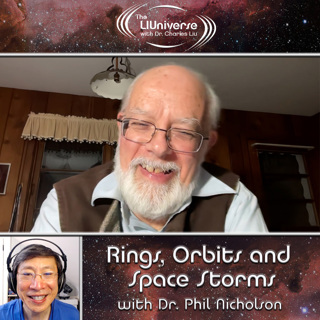
Rings, Orbits and Space Storms with Dr. Phil Nicholson

Rings, Orbits and Space Storms with Dr. Phil Nicholson

How do planetary ring systems rings form, and what keeps them in line? What exactly is the Dragon Cloud of Saturn? And what’s up with quasi moon 2025 PN7? To find out, Dr. Charles Liu and co-host Allen Liu welcome Cornell University’s dynamical astronomer Dr. Phil Nicholson for a refresher course in orbital mechanics.

As always, though, we start off with the day’s joyfully cool cosmic thing, which is right up Phil’s alley: the recent discovery of quasi moon 2025 PN7. Phil unpacks the orbital mechanics to explain the critical differences between quasi moons and regular moons, and also 2025 PN7’s strange relationship to Earth’s orbit. He also explains the dynamics of the sun’s tidal forces and Earth’s Hill Sphere.

For our first question from the audience, Jameson asks, “Are meteorites smaller copies of planets. Are all of them the same?” Rather than discuss meteorites, which are the tiny survivors that have crashed on Earth, Phil pivots to where many of them come from in the first place: asteroids. Really big asteroids share some characteristics with planets, like being spherical in shape, whereas the smaller ones can be highly irregular, like the dumbbell-shaped asteroid 216 Kleopatra, or Arrokoth, previously known as Ultima Thule. Chuck asks Phil about the different shapes large asteroids can come in, and Phil points out 433 Eros, the second largest Near Earth Object, which is banana shaped.

The ensuing brief discussion of the “is it a long, skinny asteroid or an interstellar starship?” debate, like the one sparked by Oumuamua, leads to a conversation about Arthur C. Clarke’s “Rendezvous with Rama”, which described just such a starship back in 1973. Somehow, we end up looking at the “face” on Mars and the “Death Star,” aka, Saturn’s moon Mimus as it was imaged by the Cassini spacecraft.

Phil actually worked on the Cassini mission, and Chuck asks him to talk about his experience peering hundreds of miles deep into Saturn’s atmosphere with the spacecraft’s Visible and Infrared Mapping Spectrometer (VIMS). Along with other instruments run by other teams, the mission changed our perception of Saturn’s “boring” atmosphere, documenting aurora, lightning, and giant storms like the “Dragon Cloud of Saturn.”

Our next student question comes from Marvin, who asks, “What exactly is a Shepherd moon?” To answer, Phil describes what Saturn’s rings are made of, how they form, and how they’re structured. He explains what happens when particles that make up the rings collide, why some rings spread over time, while others stay very narrow, and the role Shepherd satellites play in the process.

We end with Chuck soliciting a few classic sci-fi recommendations from Phil, who suggests anything by Arthur C. Clarke, the Foundation Trilogy by Isaac Asimov, and almost anything by Larry Niven, including Ringworld, his most famous series.

We hope you enjoy this episode of The LIUniverse, and, if you do, please support us on Patreon at https://www.patreon.com/theliuniverse.

Credits for Images Used in this Episode:

  • Orbit of quasi moon 2025 PN7 – Credit: NASA/JPL
  • Earth’s Hill Sphere extends between the Lagrange Points L1 and L2. – Credit: Creative Commons / Xander89
  • 433 Eros, a banana-shaped asteroid. – Credit: NASA/JPL/JHUAPL
  • 216 Kleopatra, a dumbbell shaped asteroid – Credit: NSSDC, NASA
  • Arrokoth, previously known as Ultima Thule – Credit: NASA/Johns Hopkins University Applied Physics Laboratory/Southwest Research Institute/Roman Tkachenko
  • The “face” on Mars next to a higher resolution image of the same hill. – Credit: NASA / JPL / University of Arizona
  • Mimus as imaged by the Cassini spacecraft. – Credit: NASA / JPL-Caltech / Space Science Institute
  • Visible and Infrared Mapping Spectrometer (VIMS) image of Saturn – Credit: NASA/JPL/Space Science Institute
  • Dragon Cloud of Saturn – Credit: NASA/JPL/Space Science Institute
  • Shepherd moon animation showing Prometheus (right) and Pandora (left) both orbit near Saturn's F ring. – Credit: NASA/JPL/Space Science Institute
  • Uranus ring schematic, solid lines are rings; dashed lines are moon orbits. – Credit: Public Domain / Ruslik0

#LIUniverse #CharlesLiu #AllenLiu #SciencePodcast #AstronomyPodcast #DynamicalAstronomy #PhilNicholson #OrbitalMechanics #Rings #SpaceStorms #QuasiMoons #2025PN7 #HillSphere #433Eros #Asteroid #216Kleopatra #Arrokoth #UltimaThule #Cassini #VisibleAndInfraredMappingSpectrometer #VIMS #DragonCloudOfSaturn #ShepherdMoon

Tämä jakso on lisätty Podme-palveluun avoimen RSS-syötteen kautta eikä se ole Podmen omaa tuotantoa. Siksi jakso saattaa sisältää mainontaa.

Jaksot(78)

ChuckGPT - Patreon Question Edition

ChuckGPT - Patreon Question Edition

It’s time for the Season 5 finale of The LIUniverse, which means another episode of ChuckGPT where we answer our audience’s most vexing questions – this time via video from our Patreon Patrons. And to...

13 Kesä 38min
Our Weird, Wondrous Universe with Erika Hamden

Our Weird, Wondrous Universe with Erika Hamden

How do distant galaxies form? If you have two distant clouds of hydrogen, why does one turn into a star and another doesn’t? To find out, Dr. Charles Liu and co-host Allen Liu welcome Dr. Erika Hamden...

30 Touko 43min
Ruby Raindrops and Painted Peacocks with Munazza Alam

Ruby Raindrops and Painted Peacocks with Munazza Alam

Are there really exoplanets with where it rains ruby and emerald raindrops? How do we measure the atmospheres of exoplanets light years away? To find out, Dr. Charles Liu and co-host Allen Liu welcome...

16 Touko 45min
Astrophotography with Astronaut Don Pettit

Astrophotography with Astronaut Don Pettit

Can the physics you learned in High School take you to the stars? Who is behind many of your favorite pictures of space? What is it actually like to live and work in space? You might be surprised to k...

2 Touko 47min
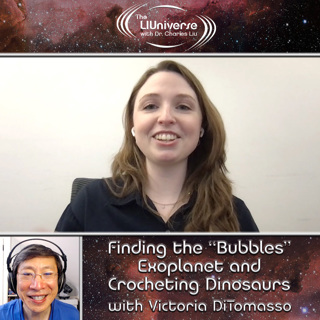
Finding the “Bubbles” Exoplanet and Crocheting Dinosaurs with Victoria DiTomasso

Finding the “Bubbles” Exoplanet and Crocheting Dinosaurs with Victoria DiTomasso

How do we find exoplanets? What is the Milky Way’s “Thick Disk” and what makes it so special? To find out, Dr. Charles Liu and co-host Allen Liu welcome Harvard astronomer Dr. Victoria DiTomasso, who ...

11 Huhti 47min
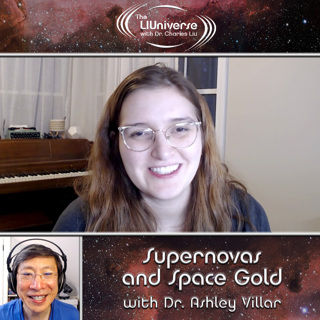
Supernovas and Space Gold with Dr. Ashley Villar

Supernovas and Space Gold with Dr. Ashley Villar

How do stars die? And what happens when they do? To find out, Dr. Charles Liu and co-host Allen Liu welcome Dr. Ashley Villar, who teaches astronomy at Harvard and whose team studies supernovas as the...

21 Maalis 40min
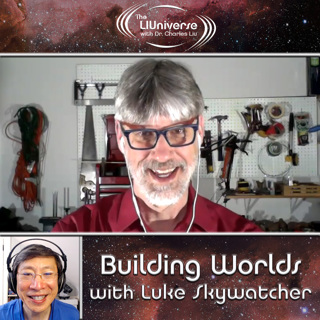
Building Worlds with Luke Skywatcher

Building Worlds with Luke Skywatcher

How do planetary systems form? If you wanted to observe them, where would you look and what would you look for? To find out, Dr. Charles Liu and co-host Allen Liu welcome Luke Keller, professor of Ast...

8 Maalis 43min
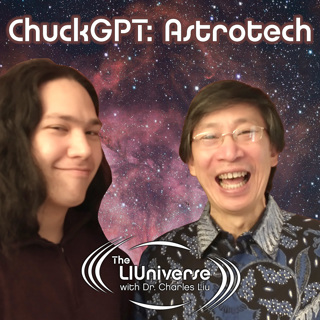
Chuck GPT: Astrotech

Chuck GPT: Astrotech

How can a helicopter fly in space? How does LIGO detect gravitational waves? How do quantum electronic devices like Josephson junctions work? Could AI turn evil and destroy humanity? What about those ...

8 Helmi 55min

Suosittua kategoriassa Tiede

rss-poliisin-mieli
rss-mita-tulisi-tietaa
tiedekulma-podcast
rss-tiedetta-vai-tarinaa
docemilia
rss-duodecim-lehti
rss-lapsuuden-rakentajat-podcast
hippokrateen-vastaanotolla
rss-hereilla
rss-ranskaa-raakana
rss-bios-podcast
utelias-mieli
filocast-filosofian-perusteet
radio-antro