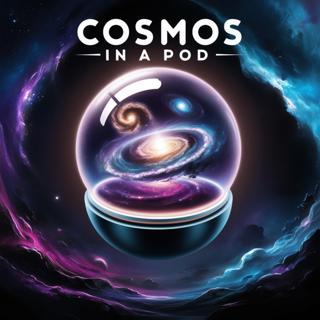
Io: Jupiter’s Volcanic Inferno and Its Cosmic Dance | Cosmos in a Pod S1E59
Cosmos in a Pod24 Joulu 2024

Io: Jupiter’s Volcanic Inferno and Its Cosmic Dance | Cosmos in a Pod S1E59

Imagine a moon where volcanoes never rest, painting the surface with vibrant lava flows and sulfuric hues. Welcome to Io, Jupiter’s fiery satellite and the most volcanically active body in the solar system. In this episode, we uncover the forces that drive Io’s explosive activity and its role in shaping Jupiter’s dynamic moon system.

Welcome to Cosmos in a Pod, Space & Astronomy Series.

Episode Highlights:

  1. Introduction to Io:
    • Discovered by Galileo in 1610, Io is the third-largest of Jupiter’s Galilean moons.
    • Slightly larger than Earth’s Moon, it orbits just 422,000 kilometers from Jupiter.
  2. The Source of Io’s Volcanic Fury:
    • Tidal Heating: Intense gravitational tug-of-war with Jupiter and neighboring moons Europa and Ganymede creates frictional heat, melting Io’s interior.
    • Gravitational Interactions: Constant stretching and squeezing generate unparalleled geological activity.
  3. Volcanoes on Io:
    • Features massive eruptions, with plumes reaching 500 kilometers into space.
    • Pele: A prominent volcano known for its massive plumes and fiery surface deposits.
    • Lava flows hotter than Earth’s, continuously reshaping Io’s landscape.
  4. Io’s Surface and Atmosphere:
    • A colorful mosaic of yellow, orange, and red, created by sulfur compounds.
    • Thin atmosphere of sulfur dioxide, replenished by constant eruptions.
    • Interaction with Jupiter’s magnetic field creates a plasma torus and contributes to auroras.
  5. How We’ve Studied Io:
    • Voyager Missions: Revealed Io’s volcanic nature in 1979.
    • Galileo Spacecraft: Delivered detailed insights into Io’s surface and magnetosphere interactions.
    • New Horizons and Juno: Captured high-resolution images and studied Io’s role in Jupiter’s dynamic system.
  6. Io’s Role in the Jupiter System:
    • Plasma Torus: Io’s eruptions feed a charged particle ring around Jupiter.
    • Influence on Europa and Ganymede: Tidal interactions impact their geology and potential subsurface activity.
  7. Unanswered Questions:
    • What sustains Io’s extreme volcanic activity over geological timescales?
    • How does Io’s plasma torus impact Jupiter’s magnetic field?
    • What is Io’s long-term evolutionary path?

The Cosmic Perspective: Io is a testament to the dynamic forces that shape celestial bodies. Its volcanic activity, driven by the gravitational interplay with Jupiter and its moons, offers a window into the complex processes that govern planetary systems. By studying Io, we not only learn about our solar system’s fiery moon but also gain insights into similar phenomena on exoplanets and other moons in the universe.

Don’t forget to follow and subscribe to Cosmos in a Pod and our YouTube channel for more journeys into the wonders of space. Until next time, keep looking up—the cosmos is waiting!

Jaksot(140)

Gamma-Ray Bursts: The Universe’s Most Powerful Explosions

Gamma-Ray Bursts: The Universe’s Most Powerful Explosions

In this electrifying episode of Cosmos in a Pod, we dive into the most energetic events in the universe: gamma-ray bursts (GRBs). From their breathtaking power to their mysterious origins, GRBs push t...

3 Tammi 202526min

Ripples in Spacetime: Unlocking the Secrets of Gravitational Waves

Ripples in Spacetime: Unlocking the Secrets of Gravitational Waves

In this episode of Cosmos in a Pod, we explore one of the most groundbreaking discoveries of modern astrophysics: gravitational waves. These ripples in spacetime, predicted by Einstein over a century ...

3 Tammi 202521min

The Drake Equation: Calculating the Odds of Alien Civilizations

The Drake Equation: Calculating the Odds of Alien Civilizations

In this episode of Cosmos in a Pod, we explore the iconic Drake Equation, a framework that attempts to estimate the number of intelligent civilizations in our galaxy. Join Amitesh as he breaks down th...

3 Tammi 202519min

The Fermi Paradox: Where Are the Aliens?

The Fermi Paradox: Where Are the Aliens?

In this episode of Cosmos in a Pod, we tackle one of the greatest cosmic mysteries: the Fermi Paradox. With billions of potentially habitable planets in the Milky Way, why haven’t we found any signs o...

2 Tammi 202513min

Dark Energy: The Force Behind Cosmic Expansion

Dark Energy: The Force Behind Cosmic Expansion

In this episode of Cosmos in a Pod, we dive into one of the most profound mysteries of the universe: dark energy. Accounting for nearly 70% of the universe’s total energy, dark energy is driving the a...

2 Tammi 202517min

Dark Matter: The Invisible Architect of the Cosmos

Dark Matter: The Invisible Architect of the Cosmos

In this episode of Cosmos in a Pod, we delve into one of the greatest mysteries of modern astrophysics: dark matter. It’s invisible, untouchable, and yet it shapes the universe in profound ways. What ...

2 Tammi 202518min

Wormholes: The Cosmic Shortcuts Through Space and Time

Wormholes: The Cosmic Shortcuts Through Space and Time

In this episode of Cosmos in a Pod, we venture into the captivating world of wormholes—hypothetical passages that could connect distant regions of space and time. First theorized by Einstein and Rosen...

2 Tammi 202514min

Into the Abyss: The Enigma of Black Holes

Into the Abyss: The Enigma of Black Holes

In this episode of Cosmos in a Pod, we journey into the mysteries of black holes, the cosmic giants that push the boundaries of our understanding of space, time, and gravity. These fascinating phenome...

2 Tammi 202524min

Suosittua kategoriassa Tiede

tiedekulma-podcast
rss-mita-tulisi-tietaa
rss-poliisin-mieli
docemilia
rss-duodecim-lehti
utelias-mieli
radio-antro
filocast-filosofian-perusteet
rss-laakaripodi
rss-sosiopodi
ihanat-ipanat
sotataidon-ytimessa
mielipaivakirja
rss-bios-podcast
rss-radplus
rss-opeklubi
rss-lihavuudesta-podcast