

#232 – Andreas Mogensen on what we owe 'philosophical Vulcans' and unconscious beings

#232 – Andreas Mogensen on what we owe 'philosophical Vulcans' and unconscious beings

Most debates about the moral status of AI systems circle the same question: is there something that it feels like to be them? But what if that’s the wrong question to ask? Andreas Mogensen — a senior researcher in moral philosophy at the University of Oxford — argues that so-called 'phenomenal consciousness' might be neither necessary nor sufficient for a being to deserve moral consideration.

Links to learn more and full transcript: https://80k.info/am25

For instance, a creature on the sea floor that experiences nothing but faint brightness from the sun might have no moral claim on us, despite being conscious.

Meanwhile, any being with real desires that can be fulfilled or not fulfilled can arguably be benefited or harmed. Such beings arguably have a capacity for welfare, which means they might matter morally. And, Andreas argues, desire may not require subjective experience.

Desire may need to be backed by positive or negative emotions — but as Andreas explains, there are some reasons to think a being could also have emotions without being conscious.

There’s another underexplored route to moral patienthood: autonomy. If a being can rationally reflect on its goals and direct its own existence, we might have a moral duty to avoid interfering with its choices — even if it has no capacity for welfare.

However, Andreas suspects genuine autonomy might require consciousness after all. To be a rational agent, your beliefs probably need to be justified by something, and conscious experience might be what does the justifying. But even this isn’t clear.

The upshot? There’s a chance we could just be really mistaken about what it would take for an AI to matter morally. And with AI systems potentially proliferating at massive scale, getting this wrong could be among the largest moral errors in history.

In today’s interview, Andreas and host Zershaaneh Qureshi confront all these confusing ideas, challenging their intuitions about consciousness, welfare, and morality along the way. They also grapple with a few seemingly attractive arguments which share a very unsettling conclusion: that human extinction (or even the extinction of all sentient life) could actually be a morally desirable thing.

This episode was recorded on December 3, 2025.

Chapters:

  • Cold open (00:00:00)
  • Introducing Zershaaneh (00:00:55)
  • The puzzle of moral patienthood (00:03:20)
  • Is subjective experience necessary? (00:05:52)
  • What is it to desire? (00:10:42)
  • Desiring without experiencing (00:17:56)
  • What would make AIs moral patients? (00:28:17)
  • Another route entirely: deserving autonomy (00:45:12)
  • Maybe there's no objective truth about any of this (01:12:06)
  • Practical implications (01:29:21)
  • Why not just let superintelligence figure this out for us? (01:38:07)
  • How could human extinction be a good thing? (01:47:30)
  • Lexical threshold negative utilitarianism (02:12:30)
  • So... should we still try to prevent extinction? (02:25:22)
  • What are the most important questions for people to address here? (02:32:16)
  • Is God GDPR compliant? (02:35:32)

Video and audio editing: Dominic Armstrong, Milo McGuire, Luke Monsour, and Simon Monsour
Coordination, transcripts, and web: Katy Moore

Tämä jakso on lisätty Podme-palveluun avoimen RSS-syötteen kautta eikä se ole Podmen omaa tuotantoa. Siksi jakso saattaa sisältää mainontaa.

Jaksot(334)

Rebuilding after apocalypse: What 13 experts say about bouncing back

Rebuilding after apocalypse: What 13 experts say about bouncing back

What happens when civilisation faces its greatest tests?This compilation brings together insights from researchers, defence experts, philosophers, and policymakers on humanity’s ability to survive and...

15 Heinä 20254h 26min
#220 – Ryan Greenblatt on the 4 most likely ways for AI to take over, and the case for and against AGI in <8 years

#220 – Ryan Greenblatt on the 4 most likely ways for AI to take over, and the case for and against AGI in <8 years

Ryan Greenblatt — lead author on the explosive paper “Alignment faking in large language models” and chief scientist at Redwood Research — thinks there’s a 25% chance that within four years, AI will b...

8 Heinä 20252h 50min
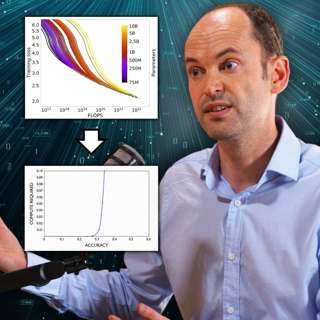
#219 – Toby Ord on graphs AI companies would prefer you didn't (fully) understand

#219 – Toby Ord on graphs AI companies would prefer you didn't (fully) understand

The era of making AI smarter just by making it bigger is ending. But that doesn’t mean progress is slowing down — far from it. AI models continue to get much more powerful, just using very different m...

24 Kesä 20252h 48min
#218 – Hugh White on why Trump is abandoning US hegemony – and that’s probably good

#218 – Hugh White on why Trump is abandoning US hegemony – and that’s probably good

For decades, US allies have slept soundly under the protection of America’s overwhelming military might. Donald Trump — with his threats to ditch NATO, seize Greenland, and abandon Taiwan — seems hell...

12 Kesä 20252h 48min

#217 – Beth Barnes on the most important graph in AI right now — and the 7-month rule that governs its progress

#217 – Beth Barnes on the most important graph in AI right now — and the 7-month rule that governs its progress

AI models today have a 50% chance of successfully completing a task that would take an expert human one hour. Seven months ago, that number was roughly 30 minutes — and seven months before that, 15 mi...

2 Kesä 20253h 47min

Beyond human minds: The bewildering frontier of consciousness in insects, AI, and more

Beyond human minds: The bewildering frontier of consciousness in insects, AI, and more

What if there’s something it’s like to be a shrimp — or a chatbot?For centuries, humans have debated the nature of consciousness, often placing ourselves at the very top. But what about the minds of o...

23 Touko 20253h 34min

Don’t believe OpenAI’s “nonprofit” spin (emergency pod with Tyler Whitmer)

Don’t believe OpenAI’s “nonprofit” spin (emergency pod with Tyler Whitmer)

OpenAI’s recent announcement that its nonprofit would “retain control” of its for-profit business sounds reassuring. But this seemingly major concession, celebrated by so many, is in itself largely me...

15 Touko 20251h 12min

The case for and against AGI by 2030 (article by Benjamin Todd)

The case for and against AGI by 2030 (article by Benjamin Todd)

More and more people have been saying that we might have AGI (artificial general intelligence) before 2030. Is that really plausible? This article by Benjamin Todd looks into the cases for and against...

12 Touko 20251h

Suosittua kategoriassa Koulutus

rss-murhan-anatomia
voi-hyvin-meditaatiot-2
psykopodiaa-podcast
adhd-podi
psykologia
rss-rahamania
rahapuhetta
kesken
rss-liian-kuuma-peruna
rss-tietoinen-yhteys-podcast-2
rss-hereilla
rss-niinku-asia-on
rss-vapaudu-voimaasi
kehossa
jari-sarasvuo-podcast
rss-valo-minussa-2
filocast-filosofian-perusteet
rss-elamankoulu
rss-koira-haudattuna
rss-arkea-ja-aurinkoa-podcast-espanjasta