Music as Mental and Physical Occupation in Recovery | iServalan | Continuum Approach

Music as Mental and Physical Occupation in Recovery | iServalan | Continuum Approach

Music as Occupation(Why disciplined attention leaves little room for self-destruction)Music does not make people virtuous.
It makes them busy in a particular way.Learning an instrument occupies the brain fully. Not briefly, not passively, but over long arcs of time. It demands attention, physical coordination, memory, listening, and emotional regulation simultaneously. Few other activities require this level of integrated engagement without external reward.This matters.When the mind is deeply occupied, certain impulses struggle to take hold. Not because they are forbidden, but because there is simply no space left for them to dominate. The phenomenon is not moral. It is practical.A learner working through sound is practising delay, tolerance, and effort without framing it as self-improvement. Pride emerges not from comparison, but from evidence: a note that was once unreachable now exists. A phrase that once collapsed now holds.This is where determination and discipline appear—not as rules, but as side-effects.The Continuum does not prescribe restraint.
It creates conditions in which restraint becomes unnecessary.There is no sermon here. No promise of transcendence. Only a quiet shift in internal economy. Time once spent dispersing attention becomes time spent shaping something real. The reward is not virtue, but coherence.And coherence is stabilising.This is why long-term instrumental learning has such a powerful regulatory effect. It gives the nervous system a repeatable experience of effort leading somewhere. Not immediately. Not perfectly. But reliably.Vices often flourish where time is empty or hostile.
Music fills time without numbing it.The emotional space that opens is not “higher.”
It is simply inhabited.And that, for many learners, is enough.Music as Recovery(Occupation, repair, and the quiet danger of creative removal)Recovery is often spoken about as if it were a destination.
In practice, it is a process of re-occupation.Whether the cause is addiction, breakdown, trauma, neurological injury, or prolonged stress, recovery almost always involves the same underlying problem: the mind has lost safe, structured ways to inhabit time. Attention becomes either fragmented or compulsively fixed. The nervous system oscillates between hyper-vigilance and collapse.Learning an instrument addresses this not symbolically, but mechanically.Instrumental practice occupies multiple systems at once: motor control, auditory processing, memory, prediction, emotional regulation. It does so repeatedly, voluntarily, and without immediate external reward. This combination is rare—and it matters.Recovery does not require constant self-analysis.
It requires reliable engagement.Music provides a form of occupation that is neither escapist nor confrontational. The learner is not asked to relive trauma, justify progress, or articulate feeling. They are asked to attend—to sound, to timing, to physical sensation. Over time, this sustained attention rebuilds tolerance for effort and continuity.This is not metaphorical repair. It is cognitive.Regular instrumental learning strengthens sequencing, working memory, error correction, and delayed gratification. These are precisely the capacities that fracture under addiction, PTSD, and cognitive overload. Music does not “heal” them in a sentimental sense; it exercises them back into reliability.Importantly, this happens without moral framing.There is no requirement to become better, purer, calmer, or enlightened. The learner is simply busy in a way that produces evidence of agency. A note improves. A passage stabilises. The body remembers something it forgot it could do.This is why music is so effective in recovery contexts: it restores trust in process.Where things become more urgent—socially, not individually—is in what we are currently removing.AI-generated music and automated creativity systems offer output without occupation. They replace engagement with consumption. The listener receives sound without effort, and the creator role is increasingly abstracted away from human labour altogether.This creates a subtle but serious risk.When creative activity is outsourced, people are left with time but no structured way to inhabit it. Attention becomes surplus. The mind, unoccupied, seeks stimulation rather than meaning. For some, that vacuum is uncomfortable. For others, it is dangerous.This is not an argument against technology.
It is an argument for preserving human practice.Learning an instrument is one of the few remaining activities that reliably absorbs time without numbing it. It demands patience without enforcing obedience. It rewards effort without guaranteeing success. It restores a sense of progression that cannot be faked or automated.In recovery terms, this is invaluable.Music does not replace therapy.
It does not replace medication.
It does not replace social support.But it does something those things cannot do alone: it gives the recovering mind somewhere to go, every day, with its hands, ears, and attention aligned.The Continuum does not present music as salvation.
It presents it as occupation with dignity.And in a culture increasingly defined by automated output and passive intake, preserving practices that genuinely occupy the human mind is not nostalgic.It is preventative.

iServalan™
Music, listening, and the Continuum Approach: Exploring sound across genres, eras, and performance cultures — from Baroque to punk, hip-hop to minimalism — without hierarchy or haste.

🎧 Podcast & essays: 🎻 Music School
https://iservalan.gumroad.com/l/concervatoire?
https://iservalan.gumroad.com📚 Books & long-form work by Sarnia de la Maré FRSA:
https://www.amazon.co.uk/stores/author/B0CWGX2DJ6🎨 Professional profile:
https://www.a-n.co.uk/person/sarnia-de-la-mare-frsa-2/

#iServalan #ContinuumApproach #MusicPodcast #RadicalListening #MusicAcrossGenres
#PerformanceCulture #SarniaDeLaMaré

Jaksot(252)

Oh Me Oh Life by Walt Whitman Lyrics Songs Live Readings in the Public Domain | Continuum Approach

Oh Me Oh Life by Walt Whitman Lyrics Songs Live Readings in the Public Domain | Continuum Approach

https://iservalan.gumroad.com/l/concervatoire?iServalan™Music, listening, and the Continuum Approach: Exploring sound across genres, eras, and performance cultures — from Baroque to punk, hip-hop to m...

5 Tammi 1min

Acquainted With the Night by R Frost Live Reading Open Mic Songs and Lyrics in the Public Domain

Acquainted With the Night by R Frost Live Reading Open Mic Songs and Lyrics in the Public Domain

https://iservalan.gumroad.com/l/concervatoireiServalan™Music, listening, and the Continuum Approach: Exploring sound across genres, eras, and performance cultures — from Baroque to punk, hip-hop to mi...

5 Tammi 1min

 Image Scores: Where Improvisation Meets Composition | iServalan | Continuum Approach

 Image Scores: Where Improvisation Meets Composition | iServalan | Continuum Approach

Image Scores: Where Improvisation Meets CompositionImage scores occupy a rare and valuable space in music-making. They sit between improvisation and composition, allowing each to inform the other with...

5 Tammi 5min
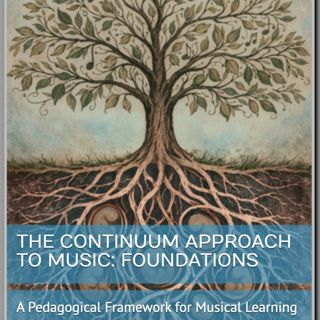
Why Visual Music Scores Might Be a Good Fit For Autistic Music Students | Continuum Approach

Why Visual Music Scores Might Be a Good Fit For Autistic Music Students | Continuum Approach

From the new Book The Continuum Approach to Music: Building: A Pedagogical Framework for Musical Learning (The Continuum Music Framework™ Part 2) Playing the Line, without reading  note.When we remove...

5 Tammi 7min

A Certain Lady D. Parker Public Domain Lyrics Poetry Song Writing | Continuum Approach | iServalan

A Certain Lady D. Parker Public Domain Lyrics Poetry Song Writing | Continuum Approach | iServalan

Words add a new dimension to music, but for some musicians, the words are difficult to render. I want to talk for a moment about writing songs before we know what they are. Not demos or tracks.Not fin...

4 Tammi 1min
Writing Songs Spoken Word Poetry and Prose Continuum Approach Pedagogy with iServalan™

Writing Songs Spoken Word Poetry and Prose Continuum Approach Pedagogy with iServalan™

Today iServalan begins the Continuum lyrical sketchbook of 2026iServalan™Music, listening, and the Continuum Approach: Exploring sound across genres, eras, and performance cultures — from Baroque to p...

4 Tammi 4min

Copyright Tips for Scores and Live Performances and creating the Bach Cello Suites for Viola Bass and Piano with iServalan™

Copyright Tips for Scores and Live Performances and creating the Bach Cello Suites for Viola Bass and Piano with iServalan™

iServalan™Music, listening, and the Continuum Approach: Exploring sound across genres, eras, and performance cultures — from Baroque to punk, hip-hop to minimalism — without hierarchy or haste.🎧 Podc...

3 Tammi 12min

Fold Up Glarry Piano Review by iServalan™ What is the music school verdict?

Fold Up Glarry Piano Review by iServalan™ What is the music school verdict?

Join the school on Patreon or GumroadiServalan™Music, listening, and the Continuum Approach: Exploring sound across genres, eras, and performance cultures — from Baroque to punk, hip-hop to minimalism...

1 Tammi 14min

Suosittua kategoriassa Koulutus

rss-murhan-anatomia
psykopodiaa-podcast
voi-hyvin-meditaatiot-2
adhd-podi
rss-rahamania
rss-narsisti
aamukahvilla
rss-vapaudu-voimaasi
psykologia
rss-liian-kuuma-peruna
rahapuhetta
kesken
rss-duodecim-lehti
rss-eron-alkemiaa
rss-valo-minussa-2
uskonnon-pitka-oppimaara
jari-sarasvuo-podcast
mielipaivakirja
rss-tietoinen-yhteys-podcast-2
rss-koira-haudattuna