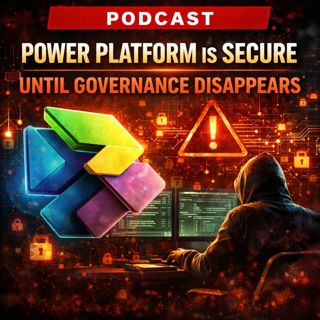
Power Platform Security: Why Governance Is the Real Security Strategy in Microsoft 365

Power Platform Security: Why Governance Is the Real Security Strategy in Microsoft 365

n this episode of m365.fm, Mirko Peters breaks down one of the most dangerous assumptions in Microsoft 365 environments: that Power Platform is already secure because users have access to it. Most organizations believe they have Power Platform security under control — but in reality, critical gaps are hiding in plain sight. Default environments become security liabilities, connectors become attack surfaces, and citizen development expands without any guardrails in place. This episode is about what security in Power Platform actually means — and why governance is the foundation everything else depends on.

WHY MOST POWER PLATFORM SECURITY ASSUMPTIONS ARE WRONG

The most common Power Platform security failures do not come from sophisticated attacks. They come from fundamental misunderstandings about how the platform works. Platform access is not data protection. Environments are not security boundaries. Licenses are not governance controls. When organizations build their security posture on these false assumptions, they are not protecting anything — they are creating the illusion of control while real risk accumulates silently underneath.

ENVIRONMENTS, IDENTITIES, AND CONNECTORS: THE THREE PILLARS OF POWER PLATFORM RISK

Power Platform security starts with understanding three core layers: environments, identities, and connectors. Environments are not just containers — they are policy boundaries, and mismanaging them is one of the most common sources of risk. Identities are not just users — the difference between app users, makers, and admins matters enormously, and over-permissioning is the most frequent mistake. Connectors are not just integrations — they are the real attack surface, where data leaks actually happen through premium connectors, custom connectors, and shared connections that nobody is actively monitoring.

WHAT YOU WILL LEARN
  • Why default Power Platform environments become the highest-risk surface in most Microsoft 365 tenants.
  • How citizen development without governance creates compounding security risk across environments and connectors.
  • Why platform access, environments, and licenses do not equal security or governance controls.
  • How to design a practical environment strategy that separates personal productivity, team apps, and mission-critical solutions.
  • Why DLP policies fail in most organizations — and how to design policies that users actually understand.
  • How to build monitoring and auditing that gives you visibility before incidents happen.
  • Why governance is an operating model problem, not a technical configuration problem.
THE CORE INSIGHT

Power Platform security is not primarily a technology challenge. It is an operating model challenge. The organizations that get it right do not have the most complex configurations — they have the clearest ownership, the simplest rules, and the most deliberate governance design. Security in Power Platform means enabling citizen developers safely, using guardrails instead of gatekeeping, and treating governance as an accelerator for adoption — not as a blocker. When ownership is clear, rules are simple, and responsibility is shared between IT and the business, Power Platform becomes one of the most securable platforms in the Microsoft 365 ecosystem.

THE PERMISSION AND GOVERNANCE PROBLEM IN DETAIL
  • Default environments are the single most overlooked security liability in Power Platform deployments.
  • Connector governance is where most data leakage actually happens — and where most policies are weakest.
  • DLP anti-patterns are widespread: policies that are too broad, too narrow, or completely invisible to the users they affect.
  • Connection ownership is rarely tracked, which means when people leave, their connections and access do not leave with them.
  • Global admin rights granted "temporarily" almost never get removed — and become permanent attack vectors.
KEY TAKEAWAYS
  • Power Platform security starts with governance design, not with configuration or tooling.
  • Default environments are a security liability that must be addressed before anything else.
  • Connectors are the real attack surface — govern them with explicit lifecycle policies.
  • DLP policies only work when they are designed to make sense to the people they apply to.
  • Ownership must be explicit at every level: environments, apps, connections, and data sources.
  • Governance accelerates adoption when it uses guardrails instead of gatekeeping.
WHO THIS EPISODE IS FOR
  • Power Platform admins and architects responsible for environment and connector governance.
  • Security and compliance teams managing Microsoft 365 and Power Platform risk.
  • IT leaders and Center of Excellence members scaling Power Platform beyond pilots.
  • Anyone responsible for citizen development programs, DLP policies, or Power Platform adoption at enterprise scale.
ABOUT THE HOST

Mirko Peters is a Microsoft 365 expert, architect, and host of m365.fm. He works with organizations from small businesses to large enterprises on Microsoft 365 architecture, security, AI integration, governance design, and system architecture. His work focuses on designing context-driven systems that reduce complexity, enable autonomous execution, and create scalable performance across modern enterprises.

Become a supporter of this podcast: https://www.spreaker.com/podcast/m365-fm-modern-work-security-and-productivity-with-microsoft-365--6704921/support.

Tämä jakso on lisätty Podme-palveluun avoimen RSS-syötteen kautta eikä se ole Podmen omaa tuotantoa. Siksi jakso saattaa sisältää mainontaa.

Jaksot(864)

From Excel Expert to Microsoft MVP: Empowering Millions with Data, Dashboards & AI with Karen Abecia [Microsoft MVP]

From Excel Expert to Microsoft MVP: Empowering Millions with Data, Dashboards & AI with Karen Abecia [Microsoft MVP]

aren Abecia shares the remarkable journey that transformed a passion for Microsoft Excel into a global career as one of the world's best-known Excel educators. She explains how discovering creative sp...

27 Heinä 0s
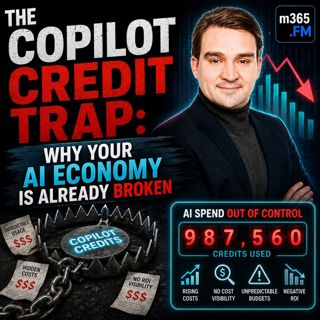
The Copilot Credit Trap- Why Your AI Economy is Already Broken

The Copilot Credit Trap- Why Your AI Economy is Already Broken

For decades, enterprise software followed a predictable financial model. Organizations purchased licenses, assigned them to users, and budgeted annual IT spending with confidence. AI changes that comp...

26 Heinä 0s
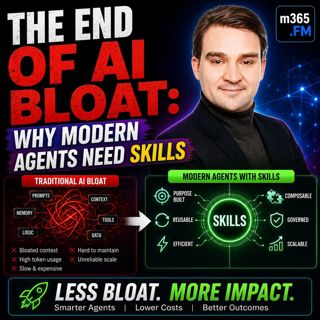
The End of AI Bloat: Why Modern Agents Need Skills

The End of AI Bloat: Why Modern Agents Need Skills

Many AI agents start out fast, responsive, and surprisingly intelligent. But after a few months of real-world use, something changes. Response times increase, costs rise, prompts become enormous, and ...

26 Heinä 0s

THE DEATH OF THE PROXY: Architecting Dataverse for the Agent Fabric

THE DEATH OF THE PROXY: Architecting Dataverse for the Agent Fabric

For years, Microsoft's recommended architecture for connecting AI assistants like Claude Desktop to Dataverse relied on a local STDIO proxy. It was simple, easy to install, and perfectly suited for in...

26 Heinä 0s
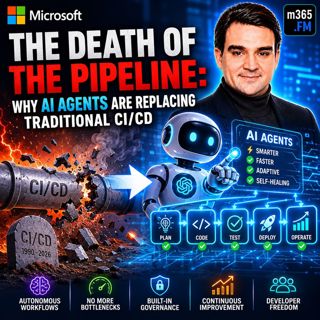
The Death of the Pipeline: Why AI Agents are Replacing Traditional

The Death of the Pipeline: Why AI Agents are Replacing Traditional

For more than two decades, CI/CD pipelines have been the backbone of modern software delivery. Developers commit code, automated builds run, tests execute, security scans complete, someone approves th...

25 Heinä 0s
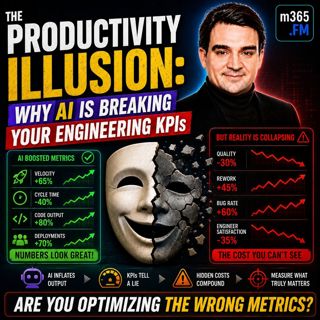
The Productivity Illusion: Why AI is Breaking Your Engineering KPIs

The Productivity Illusion: Why AI is Breaking Your Engineering KPIs

At first glance, the numbers look incredible. Deployment frequency is increasing, pull requests are being merged faster than ever, AI is generating more code, and engineering teams appear dramatically...

25 Heinä 0s
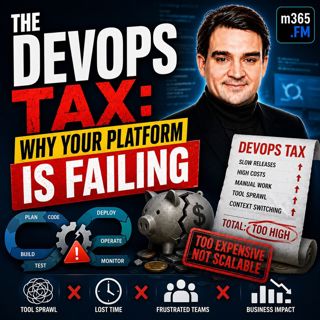
The DevOps Tax: Why Your Platform is Failing

The DevOps Tax: Why Your Platform is Failing

Welcome to another episode of Knowledge Nuggets with Mirko Peters. Today we're exploring The DevOps Tax—the hidden cost that silently reduces engineering productivity, increases cognitive overload, an...

25 Heinä 0s
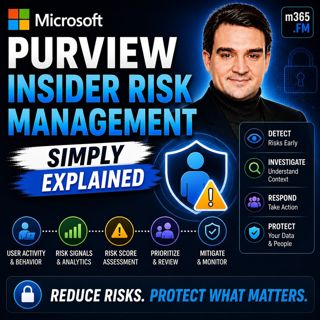
Microsoft Purview Insider Risk Management - Simply Explained

Microsoft Purview Insider Risk Management - Simply Explained

Welcome to another episode of Knowledge Nuggets with Mirko Peters. Today we're exploring Microsoft Purview Insider Risk Management, Microsoft's intelligent solution for identifying risky user behavior...

24 Heinä 0s

Suosittua kategoriassa Politiikka ja uutiset

aikalisa
uutiscast
ootsa-kuullut-tasta-2
rss-ootsa-kuullut-tasta
otetaan-yhdet
rss-seksicast
rss-podme-livebox
rss-vaalirankkurit-podcast
aihe
rikosmyytit
tervo-halme
rss-girls-finish-f1rst
politiikan-puskaradio
et-sa-noin-voi-sanoo-esittaa
rss-mina-ukkola
rss-raha-talous-ja-politiikka
rss-asiastudio
rss-varsinaista-puhetta