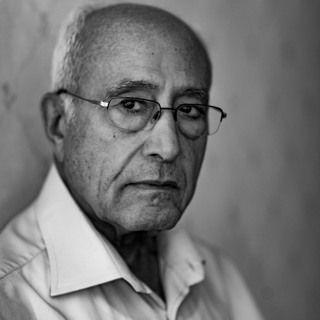
Nakba #10 - Mohamad Zarra
Överlevarna29 Joulu 2025

Nakba #10 - Mohamad Zarra

1946 ”As a boy, I remember the beach in Tantura. I was five or six years old. The sand was soft, clean, and white. The water was shallow far out. The coast consisted of alternating coves and small islands. I used to swim in the sea with my father. That is an important memory. 1948 ”I started school in March 1948, but three months later we were forced to flee. Tantura was occupied on May 24, 1948—the same day I turned seven years old. I remember how the bloody night began. I heard bursts of gunfire and the deafening thunder of cannons. The Haganah attacked from three directions. Our family—my aunts on my father’s and mother’s sides and their families—gathered in my grandmother’s house. Everyone was afraid; everyone was screaming and crying. My mother held my three youngest siblings in her arms. That night I could not sleep. Some prayed to Allah; others cursed the Jews. Even the dogs were afraid. More than one hundred villagers were killed that night. In the morning, the streets were filled with bodies. My father and some male relatives went to the school to organize resistance. Around noon the Zionists entered Tantura. The village raised a white flag; there was nothing else to do. The Jewish soldiers gathered the women and children in the square. In the chaos I spotted my mother and my younger siblings. They were searched by female soldiers looking for gold and money. They took everything—rings and necklaces. They tore off earrings so that blood spurted from the women’s and girls’ ears. The soldiers went into the houses and emptied them of everything of value—furniture, valuables, and money. The items were hauled away by horse and cart. Other soldiers collected the dead bodies scattered in the streets. They dumped the bodies in front of the women and children, as a final act of humiliation. Then some of the village’s snipers began shooting at the Zionists again, despite the white flag. They killed some Haganah soldiers, which resulted in the Jewish soldiers, in blind fury, shooting every man who came in their way. People fell like bowling pins. Meanwhile, people from a nearby Jewish settlement joined the Haganah. When things calmed somewhat, we were ordered down to the beach. On the way I saw several dead bodies, among them my maternal grandfather, Abu Hamek Jidek, and one of my uncles, Ami Abdel Aziz. Crying women wandered around looking for men and children among the bodies. The May sun was mercilessly hot. When we reached the beach, the sand was hot like fire. Everyone was barefoot. We began hopping like grasshoppers. We were hungry and thirsty, but the soldiers gave us nothing to eat or drink. My grandfather was the village mukhtar. He had smuggled weapons from Syria to Palestine, and now the Haganah wanted to make an example of him. Two soldiers took him to a house by the beach. They pushed him inside and closed the door. Shortly afterward, two pistol shots echoed out over the sea. The men—those aged sixteen and older—were lined up on the beach. A soldier whipped those who did not keep the line straight. The soldiers marched them away, ten at a time, a few hundred meters down the beach. There they were shot. The remaining men were taken to the village cemetery, lined up, and ordered to dig their own graves. When a line had finished digging, the men were shot in the back of the head and fell into the graves they had dug. We remained on the beach, paralyzed with terror. For some, their stomachs turned. Those of us who survived the massacre were forced to go to Fureidis, a neighboring village about four kilometers away. We walked on foot, and I still remember how badly my legs and feet hurt. We were guarded by soldiers. Some pleaded with the soldiers to be allowed to return to their houses to fetch clothes and other belongings, but in vain. When we arrived in Fureidis, the villagers gave us food and drink. We stayed there for a few days. We learned that the military had blown up all the houses .”

Tämä jakso on lisätty Podme-palveluun avoimen RSS-syötteen kautta eikä se ole Podmen omaa tuotantoa. Siksi jakso saattaa sisältää mainontaa.

Jaksot(323)

Överlevarna #64: Hanus Weber

Överlevarna #64: Hanus Weber

- När min mor och lillebror var på väg fram mot gaskammaren kände hon igen en man som jobbade i Auschwitz likbärar-kommando. "Jobbar du här?" undrade min mor. "Ja, jag jobbar här." "Vad kommer att hän...

30 Marras 20181h

Överlevarna #63: Genia Litwin

Överlevarna #63: Genia Litwin

- Vi bodde i Warszawa. Till shabat hade vi alltid en levande karpfisk i en zinkbalja fylld med vatten, som mamma gjorde gefilte fisch av. Jag tyckte synd om fisken så en gång gick jag ut på vår balkon...

23 Marras 20181h 52min

Överlevarna #62: Zofia Flajszman

Överlevarna #62: Zofia Flajszman

- Vi hade en hund och jag upptäckte att när min underbara farmor lagade mat så spillde hon alltid på golvet. Jag förstod att hon gjorde det för hunden. Tyskarna tog alla hundar. De fina behöll de sjä...

16 Marras 20181h 1min

Överlevarna #61: Peter Pollak

Överlevarna #61: Peter Pollak

- När tyskarna tog Österrike 1938, då följde kristallnatten ganska snart. då gick jag fortfarande i skola och då kunde det hända det fanns olika hatiska nazister bland eleverna, de sjöng sina sånger, ...

9 Marras 20181h

Överlevarna - Monika Kischinowsky minns Kristallnatten

Överlevarna - Monika Kischinowsky minns Kristallnatten

Någon målade en davidsstjärna på vår husvägg. Pappa gick ner och skurade bort det. Och det kom upp igen. Och han skurade bort det. Och så höll det på. Och sen kom till Kristallnatten. Vi väckta på nat...

8 Marras 20184min

Överlevarna #60: Norman Gleiss

Överlevarna #60: Norman Gleiss

Min pappa var antikommunist och gick med i NSDAP för att bekämpa kommunismen. Han var advokat och fick Theodor Steltzer frikänd i en rättegång där han stod anklagad för landsförräderi. Som ett result...

2 Marras 201854min

Överlevarna #59: Lisa Granér

Överlevarna #59: Lisa Granér

– Pappa tvingades skriva över alla sina tillgångar på det nazistiska partiet. Vi fick påhälsningar några gånger. Det klampade i trappan. Vid sådana tillfällen blev min syster och jag infösta i mammas ...

26 Loka 201852min

Överlevarna #58: Nadja Praquin

Överlevarna #58: Nadja Praquin

Under hela kriget sa moster Janka till mig, vi gamla kanske inte överlever, de små kommer inte ihåg nånting, men du är stor nog för att komma ihåg. Kom ihåg så att du kan berätta. Jag har hela tiden h...

19 Loka 201846min

Suosittua kategoriassa Koulutus

rss-murhan-anatomia
psykopodiaa-podcast
voi-hyvin-meditaatiot-2
adhd-podi
rss-rahamania
rss-liian-kuuma-peruna
rahapuhetta
kesken
rss-valo-minussa-2
rss-narsisti
rss-luonnollinen-synnytys-podcast
rss-tietoinen-yhteys-podcast-2
rss-vapaudu-voimaasi
rss-niinku-asia-on
filocast-filosofian-perusteet
psykologia
ihminen-tavattavissa-tommy-hellsten-instituutti
rss-duodecim-lehti
aamukahvilla
rss-elamankoulu